Food trucks are hot in Los Angeles, but local restaurateurs are understandably upset by the surprise competition. Mobile vendors have banded together and established a "gourmet food lot" downtown as a sort of solution.


Contributing Editor Nate Berg writes in GOOD: "[Matt Geller, president of the Southern California Mobile Food Vendors Association] and his cadre of industrious truck owners had actually tried in early January to set up another mobile food truck lot in nearby Santa Monica, but they were shut down by the city after only one day due to zoning violations. They were parking in the lot of an unused former car dealership, a space volunteered by its owner. But 'mobile food truck vending' is not among the 44 approved land uses listed in the city of Santa Monica's zoning code for that particular property and city officials came early on day two to enforce.
While the food vendors and their enthusiastic followers may have been miffed by the harsh realities of zoning, some city planners see it as a broader and potentially city-changing issue. For a city with notoriously sparse streetlife, the food trucks breathe new life into Los Angeles. Otherwise empty, unused, and essentially dead space, the small lot has found new life through these trucks, and helped to revive a small piece of the landscape."
Read the full story: Los Angeles's Food Truck Revolution

Policy Confusion Over Food Trucks
Food trucks are becoming an increasingly visible part of streetlife in many cities, but few have figured out how to deal with them from a policy standpoint.

Food Trucks, Already an Industry Force, Set for More Growth
A new report details the state of the mobile food vending industry and makes predictions for the short-term future.
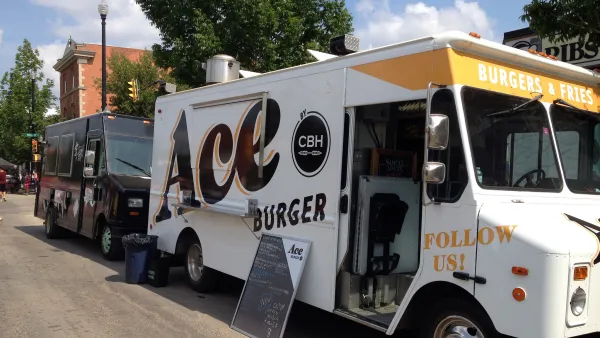
Proposed Boulder Food Park Faces Zoning Challenges
The proposed Boulder Food Park repurposes a decrepit site into usable space for food truck patrons. Since the site is adjacent to a brick-and-mortar restaurant, a zoning exemption may be required.

Planetizen Federal Action Tracker
A weekly monitor of how Trump’s orders and actions are impacting planners and planning in America.

Northwest rail fans eager for Sept. 30 debut of Amtrak’s Airo fleet
Get ready for that new train smell and more seats. But they won’t go faster or run more frequently on the Cascades route in Washington and Oregon.

Trump is considering data centers on 6 states' public land — some state officials say they had no idea
If the administration approves the proposed projects, data center and data center-related developments will cover 17,600 acres of public land.

California may destroy its beaches trying to save homes from El Niño
Boulders and seawalls can protect homes from waves, but ultimately destroy sandy beaches.

California high-speed rail accomplishes only one legislative goal in 2026
The majority of the agency's failed pitches were never developed into written proposals.

Sharp cuts to federal passenger rail, public transit funding arrive today
The American Public Transportation Associations estimates the stopgap bill will result in an over 80% cut to federal passenger rail investment and 20% cut to public transit investment.

FREE Course: Walkable City 1: Why Walkability?
After describing his path towards focusing on walkability as the essence of good planning, Jeff Speck marches through his five principal reasons for making more walkable places.
Reinventing Malls: Planning Alchemy—Turning Gray Fields Into Gold
The course focuses on the opportunities and imperatives that shape reinvention of mall sites.

City of Thousand Oaks
City of Wisconsin Rapids
Harvard University Graduate School of Design
The Architects Foundation
University of Cincinnati Online
Northern Illinois Transit Authority (NITA)
The Pocatello Development Authority
The Urban Renewal Agency of the City of Pocatello