Ten years after its opening, over a million Utahns now hop aboard the SLC-area light rail each month.


"UTA officials already have a broad vision for what the upcoming decades will hold. Train tracks, either light or commuter rail, will be the backbone of a network that will include streetcars, buses and bus-rapid transit, as well as pedestrian and bike ways across the Wasatch Front, [UTA general manager John] Inglish said. Eventually, he wants 90 percent of the urban population within one mile of public transportation.
'You won't need a car, but you'll still want to have one,' Inglish said, adding the best transit solution is a mixture of both."
Read the full story: Commuter rail: Once a gamble, TRAX ingrained in Wasatch Front's future
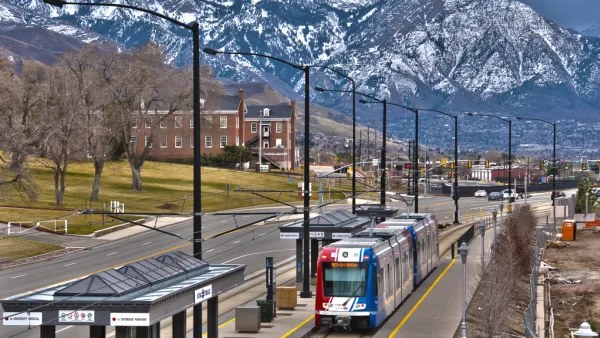
Utah Rail System Finishes Ahead of Schedule and $300 Million Under Budget
DOT Secretary Anthony Foxx and U.S. Senator Orin Hatch (R-Utah) attended the grand opening of the fifth and final rail line of Utah Transit Authority's (UTA) Frontlines 2015 Program, two years ahead of schedule and $300 million under budget.
New Transit Lines Open Early, Under Budget
New TRAX light rail lines in Salt Lake City opened a year early and 20% under budget.
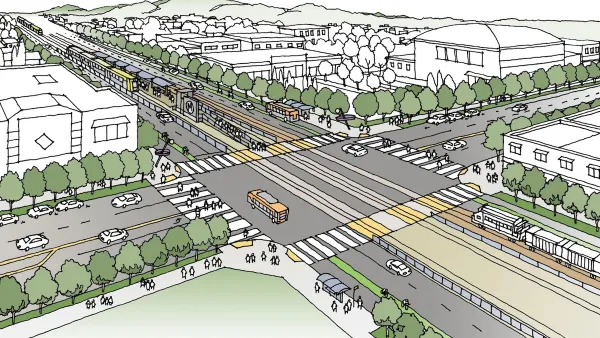
After years of opposition to light rail, this L.A. city wants a $200 million station
Cerritos officials want the Southeast Gateway Line, a planned 14.5-mile light rail route through Los Angeles County, to stop in their city.

Planetizen Federal Action Tracker
A weekly monitor of how Trump’s orders and actions are impacting planners and planning in America.

Eastern Nebraska is running out of electricity
Data centers and electrification are straining eastern Nebraska’s grid, throttling economic development.

Study reveals best places in the U.S. for cycling, walking
New research from Streetlight Data examines bicycle and pedestrian miles per capita in the 100 largest U.S. cities by population.

DSA members accuse Mamdani of 'abandoning values' over housing redevelopment
New York City's mayor plans to replace about 2,000 units of public housing with private, mixed-income housing.

All sides of BRT debate unhappy with CDOT’s most recent move
The Colorado Department of Transportation is no longer considering center-running bus lanes for Colorado Boulevard.

Massachusetts bogs generate both power, and cranberries
Putting solar panels above farmland is one way Massachusetts is advancing toward its goal of net-zero carbon emissions by 2050.

FREE Course: Walkable City 1: Why Walkability?
After describing his path towards focusing on walkability as the essence of good planning, Jeff Speck marches through his five principal reasons for making more walkable places.
Reinventing Malls: Planning Alchemy—Turning Gray Fields Into Gold
The course focuses on the opportunities and imperatives that shape reinvention of mall sites.

City of Rosemead
Rutgers University, Edward J. Bloustein School of Planning and Public Policy
One Hundred Miles
University of Michigan School for Environment and Sustainability (SEAS)
Hunter College, City University of New York (CUNY)
The Architects Foundation
City of Cambridge
The Pocatello Development Authority
The Urban Renewal Agency of the City of Pocatello