Seattle is in the midst of a mayoral election, and while typical election issues are getting their own share of lip service from the candidates, land use is being overlooked.


"The first McGinn-Mallahan debate is this Thursday, September 10, before the business community at the Cinerama. The debate agenda looks focused on specific issues, including such things as attention to "a regulatory environment that fosters capital investment and job creation." One facet of that "regulatory environment" is land-use policy and practice. Seattle deserves an integrated approach to city planning, rather than a piecemeal focus on the viaduct, streetcars, Mercer corridor, light rail celebrations, and posturing about reduced carbon footprint.
It would be exciting to move toward a truly comprehensive platform on growth, density, community form, and values. It's happening in some other cities, where land use leadership is emerging in force."
This article raises some of the city planning questions the new mayor will likely face.
Read the full story: Will a new mayor think boldly about planning?
What Yesterday’s Elections Results Mean for Cities and City Government Across the U.S.
If you can make it past rhetoric around healthcare, abortion, collective bargaining, and immigration, the November 8th election results tell a more cohesive and calming story about American’s political sentiment.
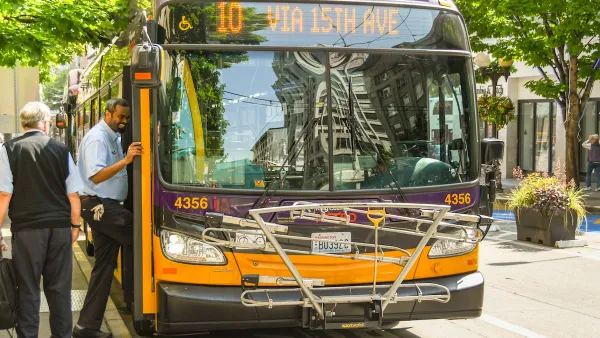
Seattle passes record-breaking transit services expansion
Proposition 1 will double the city’s transit tax to add 95,000 more bus trips and preserve 180,000 bus trips annually.
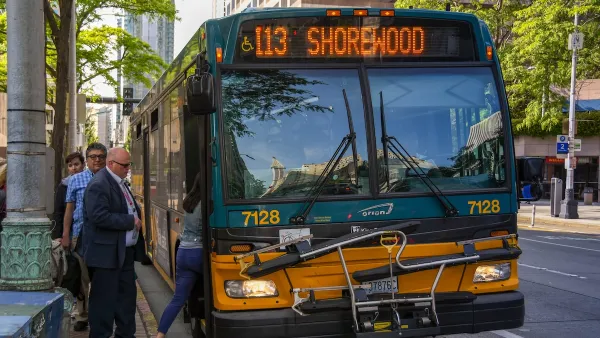
275,000 bus trips are at stake on Seattle's ballot
If passed, the Seattle Transit Measure would trigger a 0.3% sales tax and raise an average of $138 million per year to maintain and expand Seattle’s bus services.

Planetizen Federal Action Tracker
A weekly monitor of how Trump’s orders and actions are impacting planners and planning in America.

California plans to bury El Niño’s downpour
If the state plays its cards right, it may be able to store a billion acre-feet of El Niño’s water in aquifers.

Desperate measures: Advocates weigh draining Lake Powell to fill Colorado River
Draining the reservoir could reduce evaporation losses by a couple hundred thousand acre-feet.

Los Angeles just elected an urban planner as its mayor
Transportation analysts are optimistic that Raman will be more aggressive in addressing transit issues than Bass.

Mamdani’s pied-à-terre tax survives legal challenge
A panel of judges found that the plaintiffs failed to demonstrate injury as a result of New York City's implementation of the tax.

Eastern Nebraska is running out of electricity
Data centers and electrification are straining eastern Nebraska’s grid, throttling economic development.

FREE Course: Walkable City 1: Why Walkability?
After describing his path towards focusing on walkability as the essence of good planning, Jeff Speck marches through his five principal reasons for making more walkable places.
Reinventing Malls: Planning Alchemy—Turning Gray Fields Into Gold
The course focuses on the opportunities and imperatives that shape reinvention of mall sites.

City of Rosemead
Rutgers University, Edward J. Bloustein School of Planning and Public Policy
One Hundred Miles
University of Michigan School for Environment and Sustainability (SEAS)
Hunter College, City University of New York (CUNY)
The Architects Foundation
City of Cambridge
Montrose County
The Pocatello Development Authority