Dense Cairo has few sanctioned public spaces. So residents make do wherever they can.


Bridges are a major gathering place for people, who come to hang around or gaze at the Nile. This piece looks at some of the "unofficial" parks in the city, and how people make whatever open areas they find into their own parks.
"This is the largest bridge across the Nile. It is loud, and it bounces under the weight of so many vehicles. But at night its sidewalks become festive. Families pull out plastic lawn chairs, sit along the guardrail and kick back. Vendors sell tea and corn on the cob, and some sell balloons, too.
Cairo is a city with a lot of people, a lot of tightly packed houses and buildings, a lot of traffic - and very little open space. There are some parks, but they tend to be fenced off and charge admission. So Egyptians grab what public space there is and make it their own. Bridges are a favorite, but nearly any open space will do. Even a patch of grass in the middle of a traffic circle."
Read the full story: Penned-In Egyptians Find Peace in City’s Din

The Public Role of Tahrir Square
A Cairo native who had returned home before the recent unrest and revolution looks at the role of the city's Tahrir Square, and how recent events have given additional meaning to this public space.
From Dump to Park in Cairo
Cairo's first new green space in more than 100 years has opened -- on top of a 500-year old garbage dump.
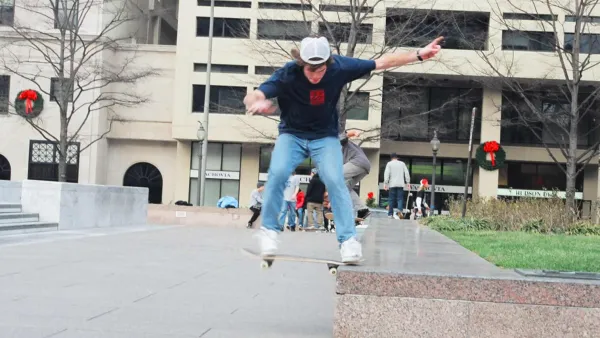
Trump's DC 'beautification' efforts threaten historic skate spots
The city is taking more aggressive measures to prevent skateboarders from using unsanctioned public spaces.

Planetizen Federal Action Tracker
A weekly monitor of how Trump’s orders and actions are impacting planners and planning in America.

Amtrak, CN end decades-long dispute with eight-year agreement
The new operating agreement establishes an updated framework for the companies to work together, including processes to resolve disputes.

Judges permit Denver to divert 77,000 acre feet from the Colorado River for reservoir expansion
Overuse and climate change have caused the Colorado River’s water levels to plummet.

NYC DOT wants faster, more permanent street upgrades
The city is examining ways to build more concrete infrastructure without getting entangled in 'decades-long' projects.

'Something we’ve never seen before:' rising utility rates could strain city finances nationwide
Data centers, climate change and other factors have caused utility rates in the United States to increase by 38% since 2020.

Trump to overrule local leaders, lease millions of acres of America’s Pacific Island territories’ seafloors to mining companies
International law says that the Indigenous people of America’s territories have a right to prior and informed consent regarding projects that impact their countries.

FREE Course: Walkable City 1: Why Walkability?
After describing his path towards focusing on walkability as the essence of good planning, Jeff Speck marches through his five principal reasons for making more walkable places.
Reinventing Malls: Planning Alchemy—Turning Gray Fields Into Gold
The course focuses on the opportunities and imperatives that shape reinvention of mall sites.

Harvard University Graduate School of Design
KFH Group Inc.
Greater Baltimore Committee
The Architects Foundation
University of Cincinnati Online
The Pocatello Development Authority
The Urban Renewal Agency of the City of Pocatello