Since Vancouver Council unanimously supported the preparation of bylaws to introduce laneway housing across the City in single family zones, the housing idea has been getting consistent media attention. Although we're in the process of using modeling and dialogue to answer the last few questions - what the parking standard should be, and the exact dimensions of the 1 1/2 story model - the most common question I get is "when can we apply for one?"


Since Vancouver Council unanimously supported the preparation of bylaws to introduce laneway housing across the City in single family zones, the housing idea has been getting consistent media attention. Although we're in the process of using modeling and dialogue to answer the last few questions - what the parking standard should be, and the exact dimensions of the 1 1/2 story model - the most common question I get is "when can we apply for one?"
For those other cities thinking about this idea, here is our fact sheet regarding our on-going work and a smattering of articles on the local interest.
City votes to allow rezoning for laneway rental homes – Vancouver Sun
Back alley homes could ease pressure off tight rental market - Megaphone
Garages turned into mini-houses have potential to transform entire neighbourhoods – The Province
Builders bring backyard living to spring show – Vancouver Sun
As one promoter noted, with the downturn affecting the viability of "business-as-usual" projects and the critical need for rental housing, it's a housing idea that seems to match the times well. For that reason, a laneway housing model is the centre-piece of this years' huge Vancouver Home Show. The built model, by local company Smallworks Studios, shares many attributes with the direction our city regulatory model is going in, although ours is a little less intrusive on the backyard, as we decided that the laneway house must stay within the footprint of the initial garage (to preserve urban gardening opportunities, livability, and natural systems/infiltration). By comparison, the Smallworks built model, I hear, would penetrate the yard space a bit - something that would have to change if Council ultimately approves the bylaws as expected.
Despite this, it'll be a great chance for the public to see something close to what may soon be allowed across the city. Council will consider the final bylaws later this year.

Desperate measures: Advocates weigh draining Lake Powell to fill Colorado River
Draining the reservoir could reduce evaporation losses by a couple hundred thousand acre-feet.

Eastern Nebraska is running out of electricity
Data centers and electrification are straining eastern Nebraska’s grid, throttling economic development.
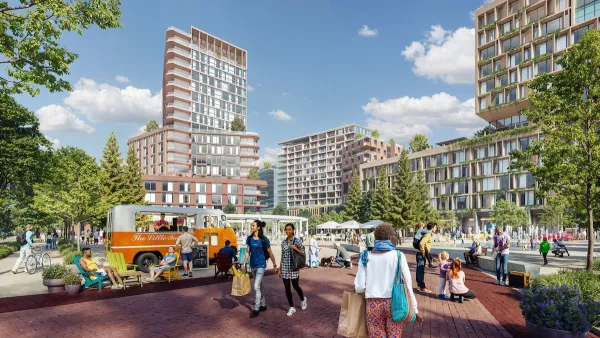
Malls are becoming the midtowns of the future
Mall and office park redevelopments are a generational opportunity to create new nodes of urbanity.

NYC breaks ground on anti-flooding infrastructure project
New York City's new system will reduce stormwater flows to local sewers by 90%.

One Kentucky town’s secret to affordable housing
The Smoketown Community Land Trust has already built seven affordable homes for community members.

Houston gains petal-shaped cooling infrastructure to make streets more ‘delightful’
The city has installed the pavilions along 15 blocks in Houston.

FREE Course: Walkable City 1: Why Walkability?
After describing his path towards focusing on walkability as the essence of good planning, Jeff Speck marches through his five principal reasons for making more walkable places.
Reinventing Malls: Planning Alchemy—Turning Gray Fields Into Gold
The course focuses on the opportunities and imperatives that shape reinvention of mall sites.

City of Rosemead
Rutgers University, Edward J. Bloustein School of Planning and Public Policy
One Hundred Miles
University of Michigan School for Environment and Sustainability (SEAS)
Hunter College, City University of New York (CUNY)
The Architects Foundation
City of Cambridge
Montrose County
The Pocatello Development Authority

