Most states are required to balance their budgets. The economic crisis combined with lowered expectation for federal stimulus relief means that the only option left is to start cutting budgets.


"[F]or fiscal year 2010, [the states] will face a $84.3-billion hole, according to the National Conference of State Legislatures. The total shortfall through fiscal 2011 is estimated at $350 billion, according to the Center on Budget and Policy Priorities, a nonpartisan think tank in Washington.
State lawmakers can expect some relief from the federal stimulus package -- but it is far from a cure-all. The version passed by the House of Representatives would cover only about 45% of the projected state deficits. A Senate version of the bill, which has yet to be approved, would, in its present form, offer even less relief.
The budget-cutting plans that have emerged from state capitols so far have a potential effect on almost everyone. Parks will close. Environmental programs will be scaled back. Bus and ferry routes will shut down, possibly sending more drivers onto clogged streets and highways. Schools may go without school nurses, and classes may become more crowded. Sick people who rely on state health programs may instead get sicker."
Read the full story: States' only option now is budget pain


Report: How States Can Improve Housing Policy
While many policies that affect housing are decided on at the local level, there are several steps state officials can take to pave the way for healthier housing markets.

How State Governments Can Support Urban Revitalization
States have tremendous power to constrict or enable policy at the local level. A new report offer guidance in getting states and localities on the same page for the sake of urban revitalization.
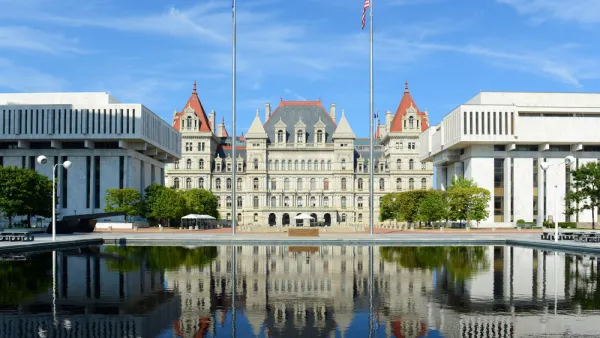
Are States Too Active or Not Active Enough? Yes.
State governments like to limit local taxing authority but not local zoning—maybe they should do the exact opposite.

Planetizen Federal Action Tracker
A weekly monitor of how Trump’s orders and actions are impacting planners and planning in America.

Amtrak, CN end decades-long dispute with eight-year agreement
The new operating agreement establishes an updated framework for the companies to work together, including processes to resolve disputes.

Judges permit Denver to divert 77,000 acre feet from the Colorado River for reservoir expansion
Overuse and climate change have caused the Colorado River’s water levels to plummet.

NYC DOT wants faster, more permanent street upgrades
The city is examining ways to build more concrete infrastructure without getting entangled in 'decades-long' projects.

'Something we’ve never seen before:' rising utility rates could strain city finances nationwide
Data centers, climate change and other factors have caused utility rates in the United States to increase by 38% since 2020.

Trump to overrule local leaders, lease millions of acres of America’s Pacific Island territories’ seafloors to mining companies
International law says that the Indigenous people of America’s territories have a right to prior and informed consent regarding projects that impact their countries.

FREE Course: Walkable City 1: Why Walkability?
After describing his path towards focusing on walkability as the essence of good planning, Jeff Speck marches through his five principal reasons for making more walkable places.
Reinventing Malls: Planning Alchemy—Turning Gray Fields Into Gold
The course focuses on the opportunities and imperatives that shape reinvention of mall sites.

Harvard University Graduate School of Design
KFH Group Inc.
Greater Baltimore Committee
The Architects Foundation
University of Cincinnati Online
The Pocatello Development Authority
The Urban Renewal Agency of the City of Pocatello