When Sony was preparing to build a virtual meeting space for Playstation 3 users, they took the unusual step of hiring a real-world architect, Kenji Ikemoto.


"Ikemoto had nothing to compare the experience to. Typically, architects have to think about cost, availability of materials, and local building codes, and can spend up to two-thirds of a project in on-site meetings with the builders and other contractors. With Home, none of those things mattered. It was as if a developer had written Ikemoto a blank check and freed him from the usual limitations. Ikemoto was stumped. 'Without those considerations, it's harder than you might think,' he said.
Sony's team in Tokyo was also in unfamiliar territory. Many of the team's members had experience creating games and were accustomed to giving orders to programmers and designers. 'We had to do the opposite this time,' said Home producer Yoshikatsu Kanemaru.
Using standard architectural CAD software called VectorWorks, Ikemoto condensed several months' work into a few weeks. He pulled all-nighters to finish a blueprint and kept up the frenetic pace during his Friday meetings at Sony's offices, where programmers and producers transformed his ideas into computer-generated 3D images."
Read the full story: Architect Designs Sony's Virtual World
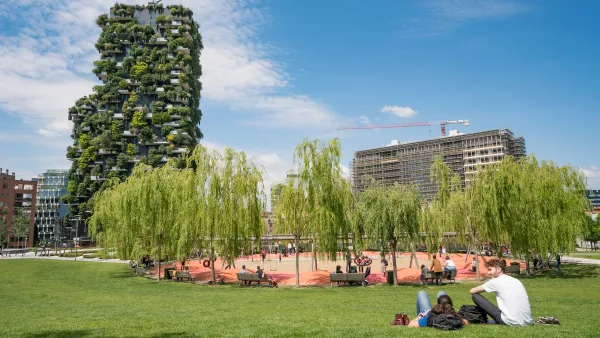
Planning for Love, Part 1: The link between urban form and dating
A brief exploration of dating through history highlights how the spaces in which we live and move shape our social lives and relationships.

Survey: US Public Spaces Not Meeting Community Needs
A lack of funding prevents many U.S. parks and public spaces from playing a more significant role in helping residents meet daily needs.

North Texas Town Launches Downtown Revitalization Plan
The Design Downtown Denton plan takes aim at improving walkability and highlighting the city’s historic assets.

Planetizen Federal Action Tracker
A weekly monitor of how Trump’s orders and actions are impacting planners and planning in America.

California plans to bury El Niño’s downpour
If the state plays its cards right, it may be able to store a billion acre-feet of El Niño’s water in aquifers.

Desperate measures: Advocates weigh draining Lake Powell to fill Colorado River
Draining the reservoir could reduce evaporation losses by a couple hundred thousand acre-feet.

Los Angeles just elected an urban planner as its mayor
Transportation analysts are optimistic that Raman will be more aggressive in addressing transit issues than Bass.

Mamdani’s pied-à-terre tax survives legal challenge
A panel of judges found that the plaintiffs failed to demonstrate injury as a result of New York City's implementation of the tax.

Eastern Nebraska is running out of electricity
Data centers and electrification are straining eastern Nebraska’s grid, throttling economic development.

FREE Course: Walkable City 1: Why Walkability?
After describing his path towards focusing on walkability as the essence of good planning, Jeff Speck marches through his five principal reasons for making more walkable places.
Reinventing Malls: Planning Alchemy—Turning Gray Fields Into Gold
The course focuses on the opportunities and imperatives that shape reinvention of mall sites.

City of Rosemead
Rutgers University, Edward J. Bloustein School of Planning and Public Policy
One Hundred Miles
University of Michigan School for Environment and Sustainability (SEAS)
Hunter College, City University of New York (CUNY)
The Architects Foundation
City of Cambridge
Montrose County
The Pocatello Development Authority