Through festivals, lighting master plans, and creative integrations of artistic interpretations, cities across the world are harnessing the power of light to reinvigorate neglected areas and renew public interest.


"This holistic approach to illuminating cities has come to be known as a lighting master plan. While few cities outside Europe have a plan currently in place, the steps involved in creating one help officials evaluate how the layers of lighting – street-level, marquees and directional signage, and monuments or cultural landmarks – should work together and be energy efficient."
"An example of a master plan on a smaller scale can be seen in the Quartier des Spectacles in Montreal, Quebec, where the city has harnessed the power of light to create a distinct identity for an arts and cultural district."
"Artists see their role as reengaging people with their cities. "The surprising factor is that the US is still discovering this tool," says Lucette de Rugy, a French lighting designer in New York whose company, Art Lumière, has applied a painterly touch to facades from Geneva to Dallas. While a number of American cities host light festivals, the idea of reinvigorating downtowns or shopping districts with light has not really caught on yet."
FULL STORY: Cities shed artful light on the canvas of night

Light and the City
A new film explores the impact of urban light pollution on humans and the natural environment, and calls on designers and planners to revise the way our cities are lit.
15 US cities and their global namesakes
Hundreds of cities around the United States are named after other places. We tour a few of them.
New study visualizes how city shapes impact mobility
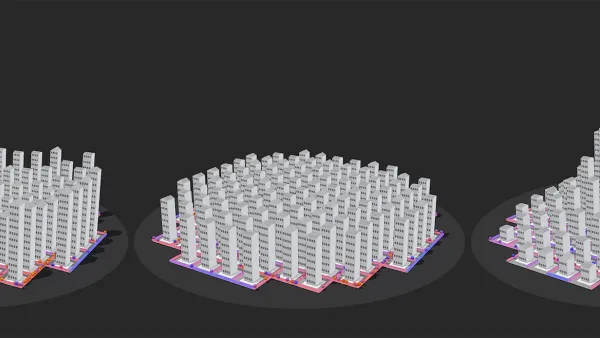
Whether circular or linear, the shape and layout of cities affects how their residents get around.

Planetizen Federal Action Tracker
A weekly monitor of how Trump’s orders and actions are impacting planners and planning in America.

The state-sanctioned urbicide of Austin
People don’t kill cities. Freeways do.

US to reduce Colorado River water deliveries to Mexico
A new Colorado Treaty amendment reduces Mexico’s Colorado River water allocation by 250,000 acre feet.

5 New England states march closer to 800 megawatt wind energy project
Securing federal approval for the project may be complicated under the Trump administration, which has historically been hostile towards domestic wind power.

Baltimore to break ground on $50 million Transit Priority Project
The project will bring faster bus trips, safer streets and better bike connections to Baltimore.

Airbnb launches $250 million 'last-dollar financing' housing accelerator, makes first investment in Austin
The company will put $6.4 million towards affordable housing development in Texas’ capital.

FREE Course: Walkable City 1: Why Walkability?
After describing his path towards focusing on walkability as the essence of good planning, Jeff Speck marches through his five principal reasons for making more walkable places.
Reinventing Malls: Planning Alchemy—Turning Gray Fields Into Gold
The course focuses on the opportunities and imperatives that shape reinvention of mall sites.

Eagle County Government
Harvard University Graduate School of Design
Nashville Planning Department
The Architects Foundation
University of Cincinnati Online
The Pocatello Development Authority
The Urban Renewal Agency of the City of Pocatello
Journal of the American Planning Association