This article from the Miami Herald looks at the annual art fair Art Basel and how it transforms the city -- temporarily and permanently.


"Seven years ago, a Swiss art fair came to Miami Beach, and with it came the international art world. Connoisseurs, collectors, spectators and glitterati filled the Convention Center to gaze at and (in the case of some, at least) buy the art that Art Basel Miami Beach brought with it. The excitement spilled over into the streets of the Design District, to the shipping containers-turned-exhibition spaces over by the beach, to the hotels that opened their rooms to become instant mini-galleries."
"The week that we call Art Basel is upon us again, with all its frenetic glamour and reflected glory. It's a week when much of Miami Beach, the entire Design District and most of Wynwood are transformed, almost magically, into a world center of art and design, into an admittedly imperfect (would we want it another way?) fantasyland."
"Seven years is not a lifetime, not even a generation, but it's enough to allow for a look back, to try to figure out, at least in part, what it all means. Most likely, it's possible to quantify the impact of Art Basel week in dollars and cents -- the number of artworks bought, the number of hotel rooms occupied -- but, in the end, those are numbers without resonating meaning."
"And so I ask myself the question: What would this place be like had there been no Art Basel, no Design Miami, no Wynwood fairs?"
Read the full story: Art Basel: The power of art
Art Leads a Miami Neighborhood's Comeback
After a decade of establishing itself on the global art calendar, the "once-forlorn slab of Miami called Wynwood" is now a year-round must-see destination.
Miami's Burgeoning Downtown Art Scene
Mera Rubell, one of America's premier art collectors, explains to Richard Florida why she loves collecting her art in Miami, and which is the best American City for artists.
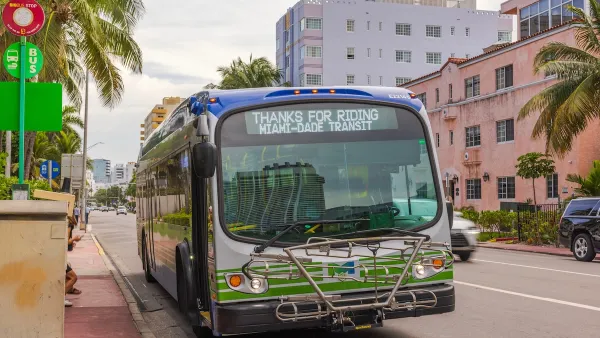
More money, less service: Miami-Dade slashes bus routes after hiking fare
The department is facing a multi-million dollar funding gap.

Planetizen Federal Action Tracker
A weekly monitor of how Trump’s orders and actions are impacting planners and planning in America.

Eastern Nebraska is running out of electricity
Data centers and electrification are straining eastern Nebraska’s grid, throttling economic development.

Study reveals best places in the U.S. for cycling, walking
New research from Streetlight Data examines bicycle and pedestrian miles per capita in the 100 largest U.S. cities by population.

DSA members accuse Mamdani of 'abandoning values' over housing redevelopment
New York City's mayor plans to replace about 2,000 units of public housing with private, mixed-income housing.

All sides of BRT debate unhappy with CDOT’s most recent move
The Colorado Department of Transportation is no longer considering center-running bus lanes for Colorado Boulevard.

Massachusetts bogs generate both power, and cranberries
Putting solar panels above farmland is one way Massachusetts is advancing toward its goal of net-zero carbon emissions by 2050.

FREE Course: Walkable City 1: Why Walkability?
After describing his path towards focusing on walkability as the essence of good planning, Jeff Speck marches through his five principal reasons for making more walkable places.
Reinventing Malls: Planning Alchemy—Turning Gray Fields Into Gold
The course focuses on the opportunities and imperatives that shape reinvention of mall sites.

City of Rosemead
Rutgers University, Edward J. Bloustein School of Planning and Public Policy
One Hundred Miles
University of Michigan School for Environment and Sustainability (SEAS)
Hunter College, City University of New York (CUNY)
The Architects Foundation
City of Cambridge
The Pocatello Development Authority
The Urban Renewal Agency of the City of Pocatello