Thousands of Americans who have lost their homes in the foreclosure crisis may find themselves ineligible to vote in November.


"More than a million people have lost their homes through foreclosure in the last two years, and many of them are still registered to vote at the address of the home they lost. Now election officials and voting rights groups are struggling to prevent thousands of them from losing their vote when they go to the polls in November.
Many of these voters will be disqualified at the polls because, in the tumult of their foreclosure, they neglected to tell their election board of their new address. Some could be forced to vote with a provisional ballot or challenged by partisan poll watchers, a particular concern among Democrats who fear that poor voters will be singled out. That could add confusion and stretch out lines that are already expected to be long because of unprecedented turnout.
Many of the nation's highest foreclosure rates are also in crucial swing states like Colorado, Florida, Michigan and Ohio. Because many homeowners in foreclosure are black or poor, and are considered probable Democratic voters in many areas, the issue has begun to have political ramifications. Political parties have long challenged voters with expired registrations, but the possible use of foreclosure lists to remove people from the rolls - though entirely legal - has become a new partisan flashpoint."
FULL STORY: As Homes Are Lost, Fears That Votes Will Be, Too


Quantifying the Impact of Pandemic Housing Assistance
The massive federal injection of funding into housing programs has had major impacts on many Americans’ ability to stay housed and out of debt, but fears loom as the end of some funding sources nears.
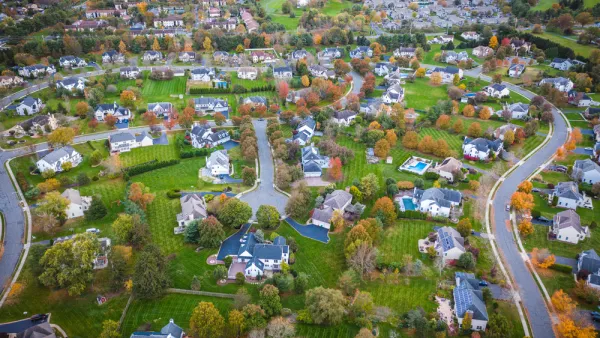
New Jersey Bill Would Ease the Path to Homeownership for Low-Income Families
A bill passed by the New Jersey state legislature would discourage investors from buying and flipping homes while giving households that have experienced foreclosure first bidding rights on auction properties.
Map of Pandemic Real Estate Risk Focuses on New Jersey, Illinois, California
A new study evaluates county-level foreclosure risk, underwater home values, and more real estate market data after two years of the Covid-19 pandemic in the United States.

Planetizen Federal Action Tracker
A weekly monitor of how Trump’s orders and actions are impacting planners and planning in America.

The state-sanctioned urbicide of Austin
People don’t kill cities. Freeways do.

US to reduce Colorado River water deliveries to Mexico
A new Colorado Treaty amendment reduces Mexico’s Colorado River water allocation by 250,000 acre feet.

5 New England states march closer to 800 megawatt wind energy project
Securing federal approval for the project may be complicated under the Trump administration, which has historically been hostile towards domestic wind power.

Baltimore to break ground on $50 million Transit Priority Project
The project will bring faster bus trips, safer streets and better bike connections to Baltimore.

Airbnb launches $250 million 'last-dollar financing' housing accelerator, makes first investment in Austin
The company will put $6.4 million towards affordable housing development in Texas’ capital.

FREE Course: Walkable City 1: Why Walkability?
After describing his path towards focusing on walkability as the essence of good planning, Jeff Speck marches through his five principal reasons for making more walkable places.
Reinventing Malls: Planning Alchemy—Turning Gray Fields Into Gold
The course focuses on the opportunities and imperatives that shape reinvention of mall sites.

Eagle County Government
Harvard University Graduate School of Design
Nashville Planning Department
The Architects Foundation
University of Cincinnati Online
The Pocatello Development Authority
The Urban Renewal Agency of the City of Pocatello
Journal of the American Planning Association