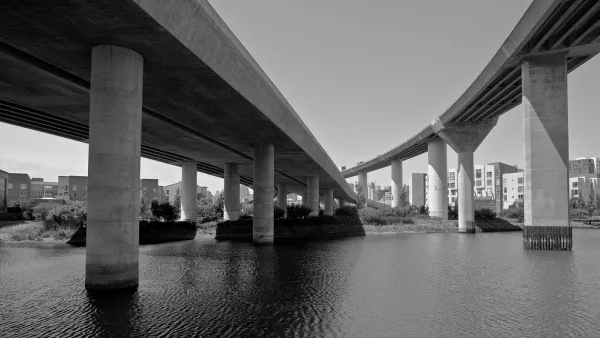
The Congress for the New Urbanism has released a list of the top ten urban freeways that need to be torn down.


"The list was generated from an open call for nominations and prioritized based on factors including the age of the structure, redevelopment potential, potential cost savings, ability to improve both overall mobility and local access, existence of pending infrastructure decisions, and local support.
Cities around the world are replacing urban highways with surface streets, saving billions of dollars on transportation infrastructure and revitalizing adjacent land with walkable, compact development. Transportation models that support connected street grids, improved transit, and revitalized urbanism will make reducing gasoline dependency and greenhouse gas emissions that much more convenient. It pays to consider them as cities evaluate their renewal strategies - and as the U.S. evaluates its federal transportation and climate policy."
Here are the top five:
1. Alaskan Way Viaduct, Seattle, WA
2. Sheridan Expressway, Bronx, NY
3. The Skyway and Route 5, Buffalo, NY
4. Route 34, New Haven, CT
5. Claiborne Expressway, New Orleans, LA
Read the full story: A National List of Top Teardown Prospects
10 Freeways That Have Got to Go
The Congress for New Urbanism has released the latest Freeways Without Futures list, updating a list we last saw in 2014.
How An Inner-City Freeway Disappeared
A "crazy idea" to remove an inner city freeway in Seoul, South Korea turned to reality. This piece tells the story about how this unlikely event came to be.
Freeway Teardowns: The Prudent Choice?
Efforts to tear down the Interstate-10 Claiborne Expressway, a 2.2 mile section of elevated roadway in New Orleans that many locals and activists have blamed for separating neighborhoods. Neal Pierce says teardowns might begin to grow in popularity.

Desperate measures: Advocates weigh draining Lake Powell to fill Colorado River
Draining the reservoir could reduce evaporation losses by a couple hundred thousand acre-feet.

Eastern Nebraska is running out of electricity
Data centers and electrification are straining eastern Nebraska’s grid, throttling economic development.

Move over, LA: St. Louis gears up for Olympics, invests millions in downtown redevelopment
The Missouri city will host the 2028 Olympic soccer group stage and knockout matches.

California, Hawaii, Rhode Island approve housing propositions
Hawaii and Rhode Island each approved their sole proposition, while California approved two of its three.

Officials claim feds 'rushed' Amtrak environmental review
Amtrak plans to move their Chicago maintenance facility from an industrial area to a residential one.

NYC breaks ground on anti-flooding infrastructure project
New York City's new system will reduce stormwater flows to local sewers by 90%.

FREE Course: Walkable City 1: Why Walkability?
After describing his path towards focusing on walkability as the essence of good planning, Jeff Speck marches through his five principal reasons for making more walkable places.
Reinventing Malls: Planning Alchemy—Turning Gray Fields Into Gold
The course focuses on the opportunities and imperatives that shape reinvention of mall sites.

City of Rosemead
Rutgers University, Edward J. Bloustein School of Planning and Public Policy
One Hundred Miles
University of Michigan School for Environment and Sustainability (SEAS)
Hunter College, City University of New York (CUNY)
The Architects Foundation
City of Cambridge
Montrose County
The Pocatello Development Authority