Despite improved air quality, China says it has no plans to continue the car control measures it has enacted during the Olympics to clean the city's air.


"Olympic host city Beijing has no plans to extend traffic control measures that have seen half the cars taken off the roads past the Games, despite their success at curbing pollution and congestion, an official said on Wednesday. But Zhou Zhengyu, deputy head of the Beijing Municipal Committee of Communications, added he hoped citizens would continue talking public transport of their own will and leave their cars at home voluntarily once the Olympics finish."
"Under the rules, in force from July 20 to Sept. 20, cars are banned on alternate days depending on whether their licence plates end in odd or even numbers, part of emergency steps taken by Beijing to ease smog levels that could affect athletes."
Read the full story: Olympics-Beijing says no extension of car controls post Games

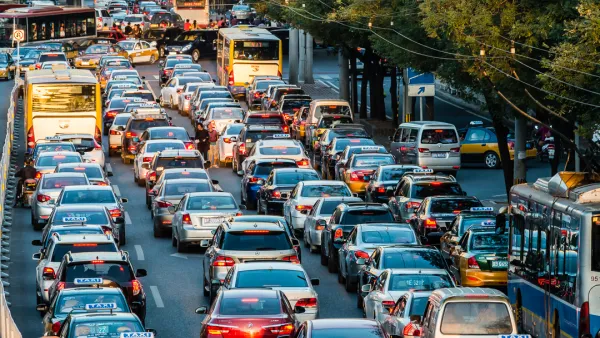
Cities Have Tried to Rein in Cars, and the Results Have Been Mixed
Vehicle pollution is making cities around the world unlivable. Some cities have taken steps to curb auto use and emissions, with varying levels of success.
Beijing's Temporary Clean Air Policies May Stick
With some of the its cleanest air in decades, Beijing is warming up to some of the pollution-cutting regulations officials have enacted during the Olympics. Some may become permanent.
EPA Guts Emissions Regulations
The agency is eliminating the endangerment finding that underpins the agency’s authority to regulate greenhouse gas emissions.

Planetizen Federal Action Tracker
A weekly monitor of how Trump’s orders and actions are impacting planners and planning in America.

The state-sanctioned urbicide of Austin
People don’t kill cities. Freeways do.

US to reduce Colorado River water deliveries to Mexico
A new Colorado Treaty amendment reduces Mexico’s Colorado River water allocation by 250,000 acre feet.

Brightline West’s future may rely on $6 billion federal loan
The company has until Nov. 2 to make a $400 million equity investment into its proposed high-speed rail line.

LA Metro’s ultimatum: no extra buses for LA28 if federal funding isn’t imminently secured
If Metro does not provide additional buses, LA28 organizers will have to find a new way to manage Olympic traffic. LA28’s budget does not include a line item for transit.

Colorado’s Largest Data Center Could Rise Next to Homes — Without a Public Hearing
The proposed campus would consume 11 times the power of Denver International Airport; as it has across the country, opposition mounts.

FREE Course: Walkable City 1: Why Walkability?
After describing his path towards focusing on walkability as the essence of good planning, Jeff Speck marches through his five principal reasons for making more walkable places.
Reinventing Malls: Planning Alchemy—Turning Gray Fields Into Gold
The course focuses on the opportunities and imperatives that shape reinvention of mall sites.

Eagle County Government
Harvard University Graduate School of Design
Nashville Planning Department
The Architects Foundation
University of Cincinnati Online
The Pocatello Development Authority
The Urban Renewal Agency of the City of Pocatello
Journal of the American Planning Association