This commentary from Reason looks at the prospect of a national infrastructure bank and argues that much more needs to be done.


"The leading vehicle is S. 1926, introduced last summer by Sen. Chris Dodd (D, CT) and Chuck Hagel (R, NE). It would "target large capacity-building projects not adequately served by current financing mechanisms" including "mass transit systems, housing properties, roads, bridges, drinking water systems, and wastewater systems." The NIB would be set up as an independent government entity, modeled after the Federal Deposit Insurance Corporation, with a five-member board of directors appointed by the President and confirmed by the Senate. Minimum federal investment per project would be $75 million. The legislation calls for the bank to issue $60 billion in long-term (up to 50-year) bonds."
"My initial reaction to this proposal is 'Huh?' There's no question that this country has not been investing enough in either rebuilding and modernizing existing infrastructure or adding much-needed new capacity. But is a new federal entity of this sort a sensible response?"
"One clue that this is mostly smoke and mirrors is the paltry $60 billion amount. With estimates of infrastructure funding shortfalls at or above a trillion dollars, this seems like the proverbial drop in the bucket."
Read the full story: A National Infrastructure Bank?
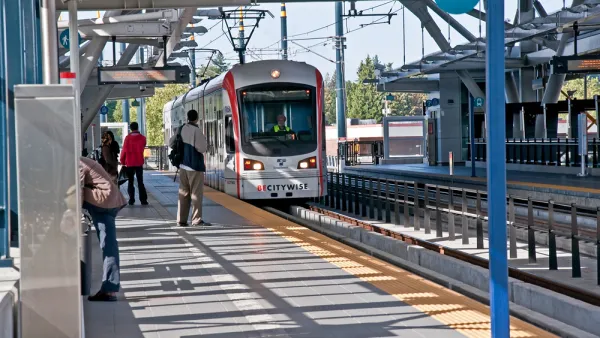
Sound Transit, Feds Agree to Low Interest Rates on $2 Billion in Transportation Funding
If getting low interest rates from the federal government on money borrowed to finance transportation projects sounds like a national infrastructure bank, you're on the right track.
Dissecting the National Infrastructure Bank Idea
Hillary Clinton recently proposed the creation of a national infrastructure bank—an idea also put forward several times by the Obama Administration. Posts by Vox and City Observatory put the idea under a microscope.
How to Turn $10 billion into $300 Billion: Create an Infrastructure Bank
It's certainly not a new idea - what's new is the current bipartisan Senate bill, cutely abbreviated as the BRIDGE Act, seeded with $10 billion of federal funds that would attract funds from the private sector to be loaned to worthy projects.

Planetizen Federal Action Tracker
A weekly monitor of how Trump’s orders and actions are impacting planners and planning in America.

California plans to bury El Niño’s downpour
If the state plays its cards right, it may be able to store a billion acre-feet of El Niño’s water in aquifers.

Desperate measures: Advocates weigh draining Lake Powell to fill Colorado River
Draining the reservoir could reduce evaporation losses by a couple hundred thousand acre-feet.

Housing is the top priority of Seattle’s sole new councilmember
Jenks campaigned on building 1,000 new units of affordable housing.

New tax cuts may slash $1.5 billion in funding for Miami transit, public parks
Amendment 3 will save Miami-Dade homeowners $2,700 in 2028.

Arizona, Wisconsin, Pennsylvania hope to finally advance climate goals post-midterms
The three states have spent years under Republican or divided control.

FREE Course: Walkable City 1: Why Walkability?
After describing his path towards focusing on walkability as the essence of good planning, Jeff Speck marches through his five principal reasons for making more walkable places.
Reinventing Malls: Planning Alchemy—Turning Gray Fields Into Gold
The course focuses on the opportunities and imperatives that shape reinvention of mall sites.

City of Rosemead
Rutgers University, Edward J. Bloustein School of Planning and Public Policy
One Hundred Miles
University of Michigan School for Environment and Sustainability (SEAS)
Hunter College, City University of New York (CUNY)
The Architects Foundation
City of Cambridge
Montrose County
The Pocatello Development Authority