In many cities across the U.S., commuters are taking to their bikes as gas prices climb. But as the Wall St. Journal reports, it takes guts to bike in Los Angeles, where bike lanes and racks are a rarity.


"Paula Rodriguez, who lives in the San Fernando Valley, got so disgusted with soaring fuel prices last spring that she stopped driving, sold her SUV and bought a bike.
But pedaling the 15 miles home from her job, the 30-year-old Ms. Rodriquez has encountered something more frightening than $4.50-a-gallon gasoline: the mean streets of L.A., home of the nation's most entrenched car culture.
"Drivers scream at me to get off the road," says the medical-billing clerk. The main commuting route near her home is so terrifying, she says, that she usually takes an alternative route that adds four miles to her trip.
Even then, it's not an easy ride. On one stretch, splintered glass in the street could puncture her tires, she says. On Wednesdays, she has to dodge garbage cans blocking the bike lane. On Friday evenings, as the sun sets, she feels menaced by drunk drivers. Such threats compel her to sometimes swing onto the sidewalk, even though that could get her a ticket. "I go slow, ring my little bell and stop sometimes to say 'hi' to pedestrians," she says."
FULL STORY: Risking Life and Limb, Riding a Bike to Work in L.A.

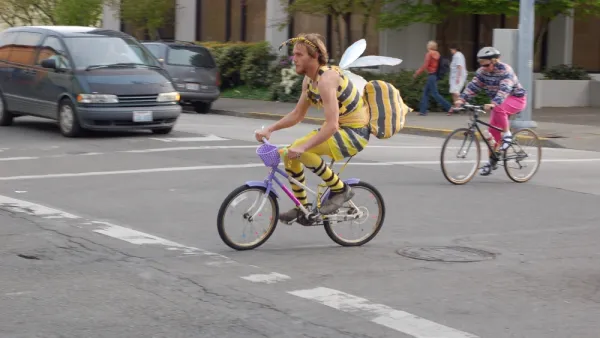
The New Wonder Drug? Cycling, Some Advocates Say
Cycling has positive impacts both for cyclists and non-cyclists alike, helping to reduce pollution and congestion and improving health and economic factors with just two wheels.
Simple Cycling Solutions
Now that the weather in Los Angeles has gone from pleasant to perfect with the subtle advent of spring, I've been spending more time risking my life atop my bicycle as I wend my way to meetings and errands. As a faithful urbanist I have little trouble convincing myself of cycling's merits, which, as former California State Health Officer Dr. Richard Jackson likes to say, can "improve your life span, lower your blood pressure, make you better looking, improve your sex life, and save you money." Sounds good to me.
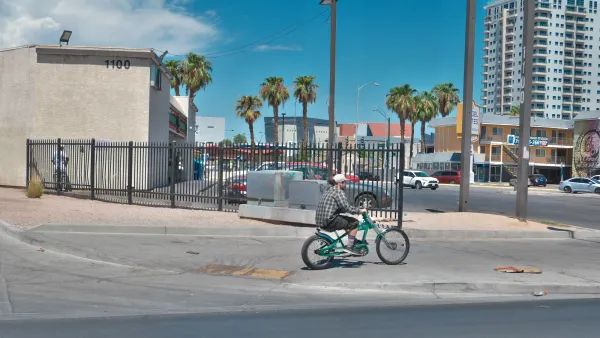
Las Vegas is building its first protected bike lane
The new lane connects Henderson and the Las Vegas Raiders headquarters via Starr Avenue.

Planetizen Federal Action Tracker
A weekly monitor of how Trump’s orders and actions are impacting planners and planning in America.

The state-sanctioned urbicide of Austin
People don’t kill cities. Freeways do.

US to reduce Colorado River water deliveries to Mexico
A new Colorado Treaty amendment reduces Mexico’s Colorado River water allocation by 250,000 acre feet.

5 New England states march closer to 800 megawatt wind energy project
Securing federal approval for the project may be complicated under the Trump administration, which has historically been hostile towards domestic wind power.

Baltimore to break ground on $50 million Transit Priority Project
The project will bring faster bus trips, safer streets and better bike connections to Baltimore.

Airbnb launches $250 million 'last-dollar financing' housing accelerator, makes first investment in Austin
The company will put $6.4 million towards affordable housing development in Texas’ capital.

FREE Course: Walkable City 1: Why Walkability?
After describing his path towards focusing on walkability as the essence of good planning, Jeff Speck marches through his five principal reasons for making more walkable places.
Reinventing Malls: Planning Alchemy—Turning Gray Fields Into Gold
The course focuses on the opportunities and imperatives that shape reinvention of mall sites.

Eagle County Government
Harvard University Graduate School of Design
Nashville Planning Department
The Architects Foundation
University of Cincinnati Online
The Pocatello Development Authority
The Urban Renewal Agency of the City of Pocatello
Journal of the American Planning Association