Next American City reflects on the changing face of suburbia.


"(T)he American suburbs have grown so immense and diverse, now housing more than half the U.S. population, that no out-of-date stereotypes can capture their complexity, meaning or future direction.
For example, according to Census data, the number of single people living in the suburbs continues to grow. In fact, some suburbs now have more single households than families with children. Another example: The suburbs in all big metropolitan areas except New York and Chicago contain more office space than the regions' central business districts.
American suburbs now have essentially the same elements that make a place urban - just arranged in a way that differs enough from traditional central cities.
"Cosmoburbs" is the term used in the forthcoming book "Boomburbs: The Rise of America's Accidental Cities" to describe wealthy suburbs that are also diverse and that increasingly contain non-traditional households. Leading examples around the nation include Naperville, Ill., Plano, Texas, Bellevue, Wash., and Lakewood and Aurora in Colorado."
Read the full story: Op-ed: Diversity and the changing face of suburbia
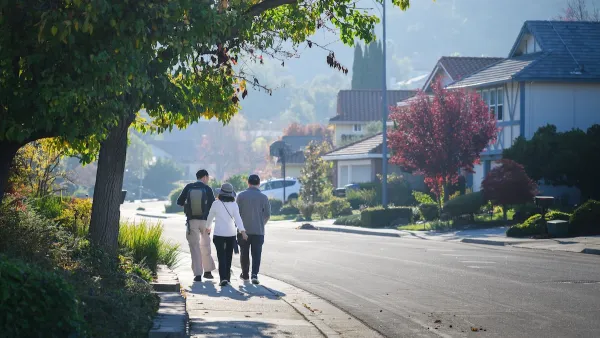
Will sprawl save California?
California residents will vote on Proposition 45 in November, which would make it easier to build large housing developments on the outskirts of the state’s cities.
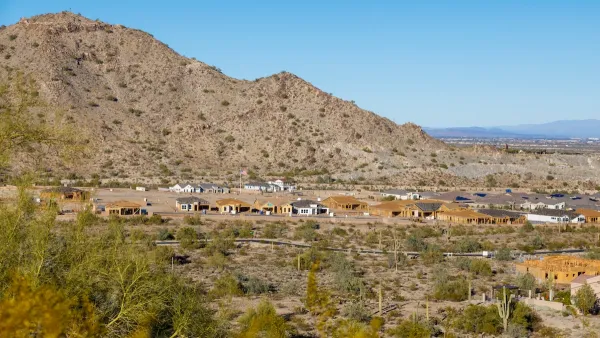
Arizona Overrides Moratorium Imposed due to Water Crisis, Approves up to 60K New Homes
A newly created legal process allows development to proceed if builders agree to bring in renewable water sources and reduce their groundwater use by 25%.
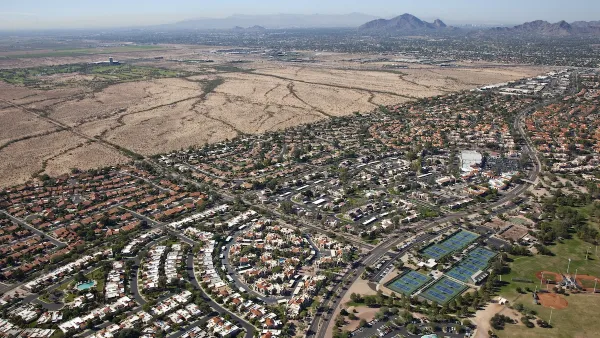
Nearly Half a Million New Arizona Homes Halted Due to Water Crisis
The Arizona Department of Water Resources has put a moratorium on new water supply permits, making the future of planned residential developments uncertain.

Planetizen Federal Action Tracker
A weekly monitor of how Trump’s orders and actions are impacting planners and planning in America.

California plans to bury El Niño’s downpour
If the state plays its cards right, it may be able to store a billion acre-feet of El Niño’s water in aquifers.

Desperate measures: Advocates weigh draining Lake Powell to fill Colorado River
Draining the reservoir could reduce evaporation losses by a couple hundred thousand acre-feet.

In Texas, data centers are swallowing promised parkland
Residents who moved to Taylor, Texas for a rural community now have to contend with three data centers in their backyard.

How a Chicago-sized wind farm beat the odds and powered on
The project spanned five presidential administrations and a standoff with a U.S. military base.

MTA gives itself 30 days to transform pit into basketball court
The site has been under construction since 2022; the city originally estimated it would finish the court in 2024.

FREE Course: Walkable City 1: Why Walkability?
After describing his path towards focusing on walkability as the essence of good planning, Jeff Speck marches through his five principal reasons for making more walkable places.
Reinventing Malls: Planning Alchemy—Turning Gray Fields Into Gold
The course focuses on the opportunities and imperatives that shape reinvention of mall sites.

City of Rosemead
Rutgers University, Edward J. Bloustein School of Planning and Public Policy
One Hundred Miles
Hunter College, City University of New York (CUNY)
The Architects Foundation
University of Cincinnati Online
City of Cambridge
Montrose County
The Pocatello Development Authority