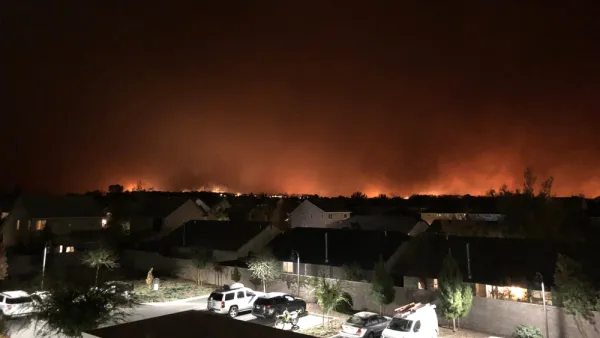
When you live near raging wildfires, you begin to understand why the State of California spends nearly $1 billion a year on firefighting. You also start to see why some state lawmakers say it's time for more local responsibility.


"Those of us who live in a state responsibility area (SRA) are thankful that state taxpayers subsidize our fire protection. But the free ride may be over for us soon. And we might not get many more neighbors."
"It appears possible that the state budget deal could include some sort of new funding for the California Department of Forestry and Fire Protection, either in the form of a surcharge on insurance premiums or a direct assessment on property owners. A homeowner like me might pay something in the neighborhood of $50 a year."
In addition, several pieces of legislation seek to limit development in state responsibility areas, or to force local agencies to take more responsibility for fire protection.
Read the full story: As The Countryside Burns, Planning Changes Gain Urgency
LA Times: Poor Planning Sealed Paradise's Fate
The planning history of Paradise, California is blamed for the destruction of the city in the Camp Fire. Can planners find new models for both limiting carbon emissions and preparing for the effects of climate change?

The next era of climate resilience will be measured in co-benefits
Why the strongest resilience investments solve more than one problem at once.

Nearly a third of US housing is in the wildland-urban interface — and at growing risk of wildfire
As suburbs increasingly mingle with undeveloped land, homes face a higher risk from destructive fires.

Planetizen Federal Action Tracker
A weekly monitor of how Trump’s orders and actions are impacting planners and planning in America.

Eastern Nebraska is running out of electricity
Data centers and electrification are straining eastern Nebraska’s grid, throttling economic development.

Study reveals best places in the U.S. for cycling, walking
New research from Streetlight Data examines bicycle and pedestrian miles per capita in the 100 largest U.S. cities by population.

Federal government nominates new FTA administrator
Mark Aesch is currently the founder and CEO of a transportation management consulting firm.

Developers reveal $10 billion stadium plan as ‘Hail Mary’ to keep Bears in Chicago
The plan would also boast a public park, high- and mid-rise buildings and a youth sports complex.

As Texas embraces carbon storage, a Black community questions the risks
Texas now issues permits for companies to store carbon dioxide underground. East Texas residents fear safety risks, and skeptics doubt the climate benefits.

FREE Course: Walkable City 1: Why Walkability?
After describing his path towards focusing on walkability as the essence of good planning, Jeff Speck marches through his five principal reasons for making more walkable places.
Reinventing Malls: Planning Alchemy—Turning Gray Fields Into Gold
The course focuses on the opportunities and imperatives that shape reinvention of mall sites.

City of Charlotte
City of Rosemead
Rutgers University, Edward J. Bloustein School of Planning and Public Policy
University of Michigan School for Environment and Sustainability (SEAS)
Hunter College, City University of New York (CUNY)
The Architects Foundation
City of Cambridge
The Pocatello Development Authority
The Urban Renewal Agency of the City of Pocatello