Downtown Cairo has undergone a steady decline in recent years, with more slums developing and more beggars filling the streets. This article from Bloomberg says there are many reasons for the decline.


"These days, unemployed youths shout vulgar catcalls at women shoppers walking past crumbling facades. Vendors on pot- holed sidewalks peddle Chinese-made T-shirts. Legless beggars grab the ankles of passers-by for alms."
"There are graver ills in Egypt's megalopolis of 18 million people: Outlying neighborhoods thirst for drinking water, ramshackle houses collapse on shallow foundations and trash clutters miles of dirt alleyways. Still, the district Cairenes know simply as downtown provokes a kind of longing for possibilities lost in a once cutting-edge and even glamorous city."
"It's hard to pinpoint any one reason for the decline. Rent controls have made it unprofitable to renovate the buildings' flowery stone fronts and Art Deco design. Cairo's penchant for informal housing hurts: Squatters have taken root on rent-free rooftops. Lack of zoning rules has also contributed: Kiosks, whose owners pay as little as $50 a month to do business, fill once-spacious arcades."
Read the full story: Legless Beggars Replace Princes, Movie Stars in Cairo Downtown

Egypt's New Capital City Development Gets Chinese Backing
Plans for the development of a new, unnamed capital city just east of Cairo has received the financial backing of Chinese investors.
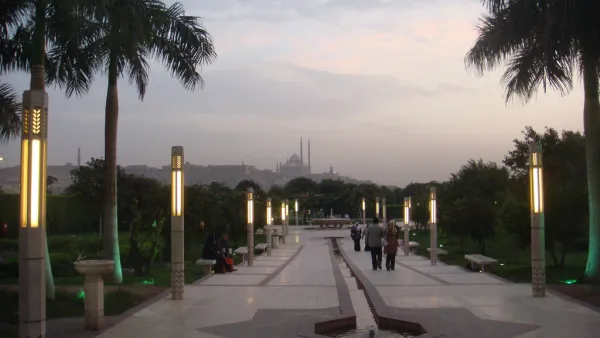
Open Spaces Are Contested Spaces in the Middle East
Parks and other public open spaces continue to be squeezed out by private development and attempts to limit political dissent throughout cities in Arab countries.
Should Egypt Build a New Capital to Replace Cairo?
Reviewing the plausibility of replacing the thousand-year-old capital of Cairo with a new, master planner, $45 billion capital city.

Planetizen Federal Action Tracker
A weekly monitor of how Trump’s orders and actions are impacting planners and planning in America.

Eastern Nebraska is running out of electricity
Data centers and electrification are straining eastern Nebraska’s grid, throttling economic development.

Study reveals best places in the U.S. for cycling, walking
New research from Streetlight Data examines bicycle and pedestrian miles per capita in the 100 largest U.S. cities by population.

DSA members accuse Mamdani of 'abandoning values' over housing redevelopment
New York City's mayor plans to replace about 2,000 units of public housing with private, mixed-income housing.

All sides of BRT debate unhappy with CDOT’s most recent move
The Colorado Department of Transportation is no longer considering center-running bus lanes for Colorado Boulevard.

Massachusetts bogs generate both power, and cranberries
Putting solar panels above farmland is one way Massachusetts is advancing toward its goal of net-zero carbon emissions by 2050.

FREE Course: Walkable City 1: Why Walkability?
After describing his path towards focusing on walkability as the essence of good planning, Jeff Speck marches through his five principal reasons for making more walkable places.
Reinventing Malls: Planning Alchemy—Turning Gray Fields Into Gold
The course focuses on the opportunities and imperatives that shape reinvention of mall sites.

City of Rosemead
Rutgers University, Edward J. Bloustein School of Planning and Public Policy
One Hundred Miles
University of Michigan School for Environment and Sustainability (SEAS)
Hunter College, City University of New York (CUNY)
The Architects Foundation
City of Cambridge
The Pocatello Development Authority
The Urban Renewal Agency of the City of Pocatello