Residents of small and mid-sized cities in the US and Canada are getting an introduction to bike-sharing thanks to large local companies.


"As metropolises like New York and Philadelphia consider the benefits of bike sharing, and with Washington DC already off and riding, smaller cities are getting in on the action as well, often through the initiative of major local employers."
"Last year, health care giant Humana started a bike-share for employees at its Louisville, Kentucky headquarters. As of this May, some 2,500 of Humana's 8,500 Louisville-based workers had enrolled in the "Freewheelin" program, which, as the name implies, is offered at no charge. Humana is bringing 1,000 Freewheelin bikes to Minneapolis-St. Paul for the Republican National Convention in September, and will leave behind 70 of them, along with checkout kiosks, for use in the Twin Cities' own fledgling bike-share program."
Thanks to Streetsblog
Read the full story: Big Companies Bringing Bike-Share to Small Cities

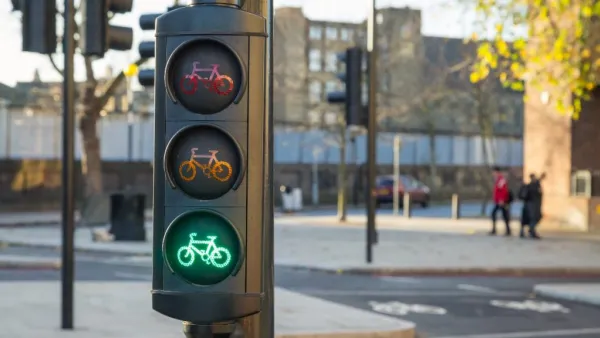
This is How the British Started Cycling More
Cycling has never felt more relevant or encouraged in the UK. Since May, the London Councils have upgraded 60 km of bike lanes in the capital city, added 20,000 square metres of extra pavement space, and installed 1,500+ additional cycle parking.
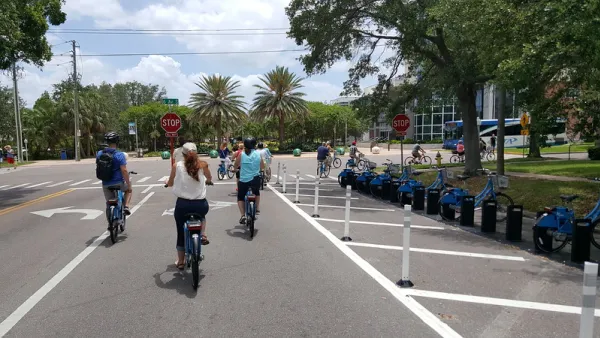
The Present And Future State Of Bike Share Systems In Florida
A quick run down of Florida's existing bike share programs and a look at what's coming in 2017.
Bay Area Bike Share Renamed for New Sponsor: An Auto Company
The new, Detroit-based sponsor will help pay for a ten-fold expansion of the Bay Area's regional bike share program coming this spring and a new Palo Alto program. Low income residents will be offered discounted rates to join Bay Area Bike Share.

Planetizen Federal Action Tracker
A weekly monitor of how Trump’s orders and actions are impacting planners and planning in America.

Amtrak, CN end decades-long dispute with eight-year agreement
The new operating agreement establishes an updated framework for the companies to work together, including processes to resolve disputes.

Judges permit Denver to divert 77,000 acre feet from the Colorado River for reservoir expansion
Overuse and climate change have caused the Colorado River’s water levels to plummet.

NYC DOT wants faster, more permanent street upgrades
The city is examining ways to build more concrete infrastructure without getting entangled in 'decades-long' projects.

'Something we’ve never seen before:' rising utility rates could strain city finances nationwide
Data centers, climate change and other factors have caused utility rates in the United States to increase by 38% since 2020.

Trump to overrule local leaders, lease millions of acres of America’s Pacific Island territories’ seafloors to mining companies
International law says that the Indigenous people of America’s territories have a right to prior and informed consent regarding projects that impact their countries.

FREE Course: Walkable City 1: Why Walkability?
After describing his path towards focusing on walkability as the essence of good planning, Jeff Speck marches through his five principal reasons for making more walkable places.
Reinventing Malls: Planning Alchemy—Turning Gray Fields Into Gold
The course focuses on the opportunities and imperatives that shape reinvention of mall sites.

Harvard University Graduate School of Design
KFH Group Inc.
Greater Baltimore Committee
The Architects Foundation
University of Cincinnati Online
The Pocatello Development Authority
The Urban Renewal Agency of the City of Pocatello