The federal government needs to recognize the economic power of the country's metropolises and work with them to create successful regions, according to a recent study from the Brookings Institution.


"Crafting a new federal role for metropolitan America – one that recognizes the importance not just of cities but entire metropolitan areas, together with the idiosyncrasies and differing strengths of each region – is at the heart of a major report the Brookings Institution released Thursday at a summit of mayors, county officials, and business and civic leaders in Washington."
"Ultimately, its goal is to revolutionize the way the US views its metropolises."
"'If you're going to get serious about the economy, then you've got to get specific about how you're going to leverage metropolitan economies,' says Bruce Katz, director of the metropolitan policy program at Brookings."
"Even though America's 100 largest cities generate two-thirds of US jobs and three-quarters of domestic economic output, much of the policy coming from Washington – and from the presidential candidates – is still rooted in a Jeffersonian ideal of hamlets and small towns, Mr. Katz says."
Read the full story: U.S. cities for the 21st century

Trump administration says DC height limits don't apply to federal projects
A federal commission cleared the way for the president's proposed 250-foot arch.
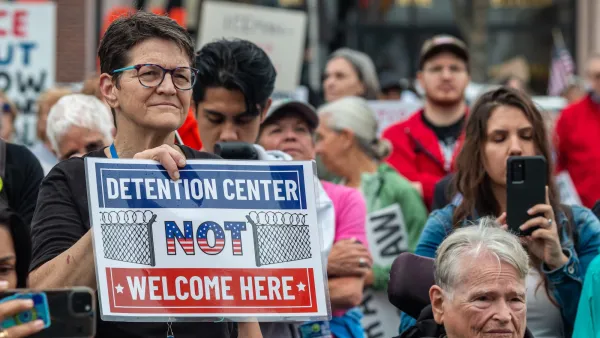
Land use as protest: How American cities are fighting federal immigration detention centers
Across the country, city officials are using zoning codes and land use law to limit where ICE detention facilities can be built.
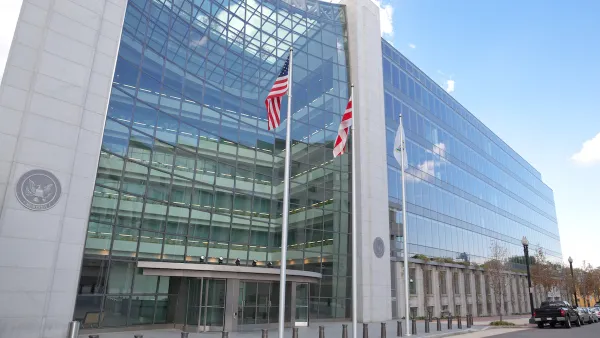
Office Vacancies at Federal Agencies as High as 75 Percent
Many federal agencies are sitting on underutilized buildings, causing a congressional committee to call into question the need for so much real estate.

Planetizen Federal Action Tracker
A weekly monitor of how Trump’s orders and actions are impacting planners and planning in America.

California plans to bury El Niño’s downpour
If the state plays its cards right, it may be able to store a billion acre-feet of El Niño’s water in aquifers.

Desperate measures: Advocates weigh draining Lake Powell to fill Colorado River
Draining the reservoir could reduce evaporation losses by a couple hundred thousand acre-feet.

In Texas, data centers are swallowing promised parkland
Residents who moved to Taylor, Texas for a rural community now have to contend with three data centers in their backyard.

How a Chicago-sized wind farm beat the odds and powered on
The project spanned five presidential administrations and a standoff with a U.S. military base.

MTA gives itself 30 days to transform pit into basketball court
The site has been under construction since 2022; the city originally estimated it would finish the court in 2024.

FREE Course: Walkable City 1: Why Walkability?
After describing his path towards focusing on walkability as the essence of good planning, Jeff Speck marches through his five principal reasons for making more walkable places.
Reinventing Malls: Planning Alchemy—Turning Gray Fields Into Gold
The course focuses on the opportunities and imperatives that shape reinvention of mall sites.

City of Rosemead
Rutgers University, Edward J. Bloustein School of Planning and Public Policy
One Hundred Miles
Hunter College, City University of New York (CUNY)
The Architects Foundation
University of Cincinnati Online
City of Cambridge
Montrose County
The Pocatello Development Authority