Upwardly-mobile city dwellers in India are heavily reliant on the neighboring slums that house their servants. But many public services are lacking beyond the walls of the affluent developments.


"Gurgaon, a largely privately developed city and a metonym for Indian ambition, has seen a building frenzy to satisfy people like the Chands. The city's population has nearly doubled in the last six years, to 1.5 million. The skyline is dotted with scaffolds. Glass towers house companies like American Express and Accenture. Not far from Hamilton Court, Burberry and BMW have set up shop."
"State services, meanwhile, have barely kept pace. The city has neither enough water nor electricity for the population. There is no sewage treatment plant yet; construction is scheduled to begin this year."
"India has long lived with such inequities, and though a Maoist rebellion is building in the countryside, the nation has for the most part skirted social upheaval through a critical safety valve: giving the poor their chance to vent at the ballot box. Indeed, four years ago, voters threw out the incumbent government, with its "India Shining" slogan, because it was perceived to have neglected the poor."
Read the full story: Inside Gate, India’s Good Life; Outside, the Servants’ Slums
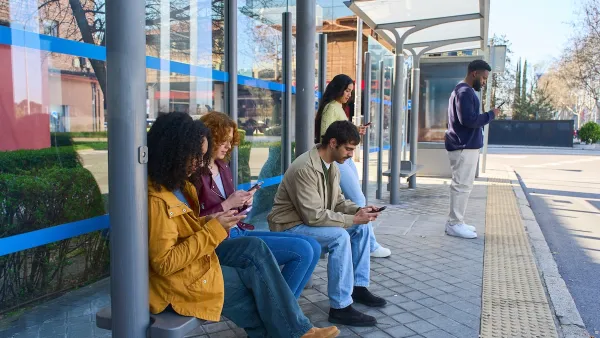
Opinion: Smartphone Dependency Mirrors Car-Centric Development
Decades ago, we started building a society based around car ownership, making it difficult to navigate U.S. cities without one. Are we making the same mistakes with smartphones?

Delivering for America Plan Will Downgrade Mail Service in at Least 49.5 Percent of Zip Codes
Republican and Democrat lawmakers criticize the plan for its disproportionate negative impact on rural communities.
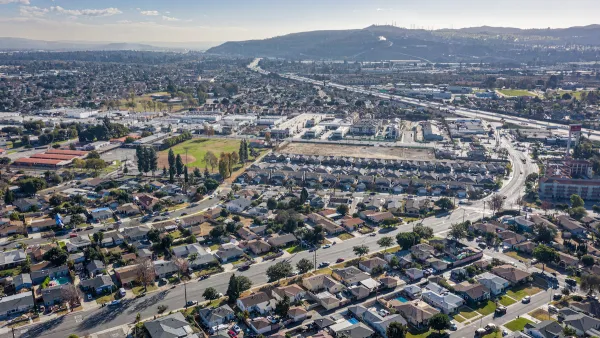
Enhancing Public Services to LA's Unincorporated Areas
The County of Los Angeles recently launched a website to better connect residents of unincorporated areas to information and municipal services offered by the county.

Planetizen Federal Action Tracker
A weekly monitor of how Trump’s orders and actions are impacting planners and planning in America.

Eastern Nebraska is running out of electricity
Data centers and electrification are straining eastern Nebraska’s grid, throttling economic development.

Study reveals best places in the U.S. for cycling, walking
New research from Streetlight Data examines bicycle and pedestrian miles per capita in the 100 largest U.S. cities by population.

Federal government nominates new FTA administrator
Mark Aesch is currently the founder and CEO of a transportation management consulting firm.

Developers reveal $10 billion stadium plan as ‘Hail Mary’ to keep Bears in Chicago
The plan would also boast a public park, high- and mid-rise buildings and a youth sports complex.

As Texas embraces carbon storage, a Black community questions the risks
Texas now issues permits for companies to store carbon dioxide underground. East Texas residents fear safety risks, and skeptics doubt the climate benefits.

FREE Course: Walkable City 1: Why Walkability?
After describing his path towards focusing on walkability as the essence of good planning, Jeff Speck marches through his five principal reasons for making more walkable places.
Reinventing Malls: Planning Alchemy—Turning Gray Fields Into Gold
The course focuses on the opportunities and imperatives that shape reinvention of mall sites.

City of Rosemead
Rutgers University, Edward J. Bloustein School of Planning and Public Policy
One Hundred Miles
University of Michigan School for Environment and Sustainability (SEAS)
Hunter College, City University of New York (CUNY)
The Architects Foundation
City of Cambridge
The Pocatello Development Authority
The Urban Renewal Agency of the City of Pocatello