The Bush Administration is reportedly considering the creation of some of the world's large marine reserves by using the presidential powers granted by the Antiquities Act of 1906.


"If implemented, President George W. Bush could, with the stroke of a pen, protect vast stretches of U.S. territorial waters from fishing, oil exploration and other forms of commercial development. The initiative could also create some of the largest marine reserves in the world - far larger than national parks like Yellowstone or the Grand Canyon."
"The idea is drawing strong support from conservationists who typically have been harshly critical of the Bush administration's overall environmental record. But some of the possible reserves are already attracting opposition from local leaders and industry groups and from some members of Congress."
"Conservationists say that CEQ officials last year invited a small number of ocean advocates to an unusual, closed-door meeting to discuss the idea. The White House asked them to help identify potential reserves in waters within the United States' 'exclusive economic zone,' which extends 200 nautical miles out from the mainland and U.S.-owned islands around the world."
"The idea, says Sobel, was to highlight areas where President Bush could create "marine monuments" under the Antiquities Act of 1906. This law gives the president broad powers to protect areas of "historic or scientific interest" without congressional approval."
Read the full story: Bush Eyes Unprecedented Conservation Program


Social Distancing Is Not a Novel Concept
Initial research on social isolation as a method to combat contagious disease included a high-school science fair project modeling social networks. Doctors learned that the spread of disease could be decelerated by disrupting these networks.
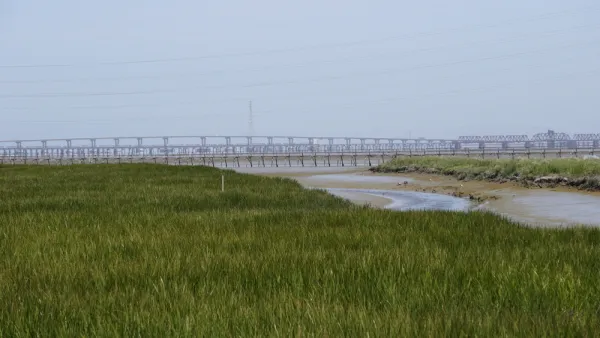
EPA and Army Corps of Engineers Propose Revision of Wetlands Definition
Fulfilling a promise he made as a candidate, the Trump administration proposed a redefinition of what is classified as a wetland, with the result being the loss of federal protection of millions of acres of waterways and wetlands.
Trump Selects Elaine J. Chao, former Labor Secretary, as Transportation Secretary
Elaine Chao served all eight years as President George W. Bush's former Secretary of Labor and also under his father's administration as Deputy Secretary of Transportation. She is married to Senate majority leader Mitch McConnell (R-Ky.).

Planetizen Federal Action Tracker
A weekly monitor of how Trump’s orders and actions are impacting planners and planning in America.

The state-sanctioned urbicide of Austin
People don’t kill cities. Freeways do.

US to reduce Colorado River water deliveries to Mexico
A new Colorado Treaty amendment reduces Mexico’s Colorado River water allocation by 250,000 acre feet.

Nation's most wind-powered state turns to coal as data centers increase energy demand
For the first time in decades, Iowa has increased its generation of coal power.

NYC cools commuters with city's first rain garden above a bus stop
New York City officials say the plants in the rain garden can absorb 16 gallons of rainwater during heavy storms.

Brightline West’s future may rely on $6 billion federal loan
The company has until Nov. 2 to make a $400 million equity investment into its proposed high-speed rail line.

FREE Course: Walkable City 1: Why Walkability?
After describing his path towards focusing on walkability as the essence of good planning, Jeff Speck marches through his five principal reasons for making more walkable places.
Reinventing Malls: Planning Alchemy—Turning Gray Fields Into Gold
The course focuses on the opportunities and imperatives that shape reinvention of mall sites.

Eagle County Government
Harvard University Graduate School of Design
Nashville Planning Department
The Architects Foundation
University of Cincinnati Online
The Pocatello Development Authority
The Urban Renewal Agency of the City of Pocatello
Journal of the American Planning Association