Two ballot measures -- one sponsored by property owners, the other by local government groups and businesses -- seek to tighten the rules around eminent domain, and potentially end rent control in the state.


"Proposition 98, which will appear on the June 3 ballot, establishes limits on what local government officials can do. It bars them from seizing private land for private use, a policy sometimes deployed for economic development, and prohibits public officials from putting rent controls on private property, which some say is the most drastic provision of the proposition.
Proponents of the measure -- property rights activists, taxpayer groups and farmers -- call it a necessary intervention to prevent heavy-handed government.
Opponents -- many government leaders, tenants groups and handful of social and environmental interests -- say the measure hinders government's basic responsibility of advancing public interest. The biggest casualty, they say, would be low-income tenants protected by rent control, of which there are thousands in Santa Cruz County.
A competing measure, Proposition 99, was put on the ballot by groups representing local government. Responding to concerns that eminent domain can be excessive, Proposition 99 provides an alternative that would ban government from taking homes for private use, but it does not rule out commercial property or farmland.
If both measures pass, language in Proposition 99 gives it precedence.
County Supervisor Jan Beautz, who sponsored a county resolution against Proposition 98, says nobody wants their property taken, but that's not what the initiatives are really about.
They're a referendum on rent control, says Beautz, whose Live Oak district includes a number of mobile home parks -- the only areas in Santa Cruz County where rent-control laws exist."
Read the full story: Competing state propositions target eminent domain, rent control
Ballot Measure to Weigh Eminent Domain in California
Two ballot measures on the June ballot in California will challenge the state's eminent domain and rent control rules.
Libertarians v. Planners - Round II
Last year California was one of the states targeted by libertarians in the post-Kelo environment for an initiative that, if successful, would essentially outlaw takings. The country is still at near-fever pitch about eminent domain, but the really scary aspect of the legislation (modeled on Oregon's Prop 37) was that it would have virtually tied local governments' hands with regard to regulatory takings as well. In California Proposition 90 failed to pass after the New York developer who was financing the campaign stopped funding it. However, the Yes campaign had created some strange bedfellows, with poor African-Americans in particular advocating Yes votes as a way to end the destruction of their neighborhoods through badly managed redevelopment initiatives.
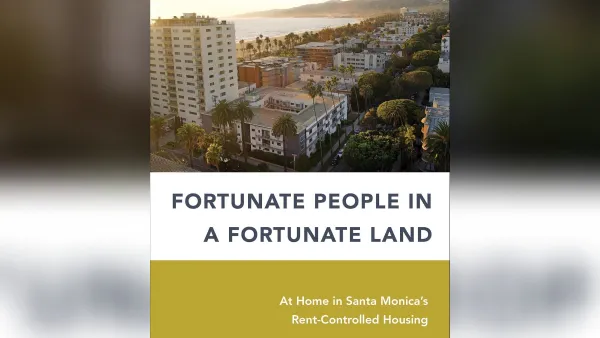
A masterful, human-centered defense of rent control
Book Review: "Fortunate People in a Fortunate Land" offers a human look at how rent control is more than just numbers and data in a spreadsheet.

Planetizen Federal Action Tracker
A weekly monitor of how Trump’s orders and actions are impacting planners and planning in America.

California plans to bury El Niño’s downpour
If the state plays its cards right, it may be able to store a billion acre-feet of El Niño’s water in aquifers.

Desperate measures: Advocates weigh draining Lake Powell to fill Colorado River
Draining the reservoir could reduce evaporation losses by a couple hundred thousand acre-feet.

Post election, Texas is no longer Musk’s 'AI oasis'
Elon Musk dolled out $446 million on the 2026 midterms, the most ever spent by a non-canidate.

Chicago voters approve permanent festival grounds, penalty for vacant property owners
Currently, major summer and fall festivals take over public parks for weeks at a time, drawing criticism from nearby residents

NYC votes to cut outdoor dining red tape, speed up permitting
New York City also voted to allow the Department of Transportation to begin work on urgent projects before notifying elected officials.

FREE Course: Walkable City 1: Why Walkability?
After describing his path towards focusing on walkability as the essence of good planning, Jeff Speck marches through his five principal reasons for making more walkable places.
Reinventing Malls: Planning Alchemy—Turning Gray Fields Into Gold
The course focuses on the opportunities and imperatives that shape reinvention of mall sites.

City of Rosemead
Rutgers University, Edward J. Bloustein School of Planning and Public Policy
One Hundred Miles
Hunter College, City University of New York (CUNY)
The Architects Foundation
University of Cincinnati Online
City of Cambridge
Montrose County
The Pocatello Development Authority