The current housing crisis in America is a product of greed -- not just the greed of homebuilders and mortgage lenders, but also the greed of consumers. Could planners have done more to prevent this greed from crashing the market?


 "Well, ladies and gentlemen, we're not here to indulge in fantasy, but in political and economic reality. America, America has become a second-rate power. Its trade deficit and its fiscal deficit are at nightmare proportions." Thus began Gordon Gekko's memorable oratory in the 1987 Hollywood movie "Wall Street". Continuing on, Gekko defended his business practices by uttering one of the film's most famous lines: "The point is, ladies and gentleman, that greed-for lack of a better word-is good. Greed is right. Greed works."
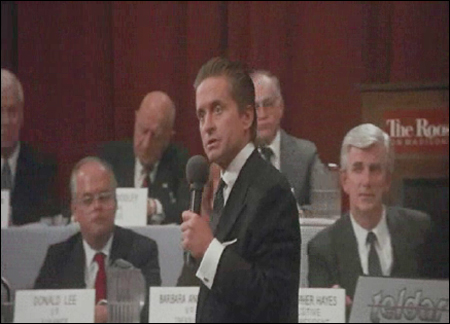
Gordon Gekko personifies the American housing market.
Twenty years after Gordon Gekko's speech, it is déjà vu all over again. America's trade and fiscal deficits show no signs of shrinking, and the international standing of the U.S. is far from its all-time best. We Americans are living on money borrowed from the Chinese, the Japanese, and practically anybody who is willing to spare us a dime. And, on top of all this, we are on the verge of a recession.
Politicians, perhaps conditioned by Gordon Gekko-like stereotypes, seem to take pleasure in railing against corporate greed. This is especially true now that we've entered the loony election season. However, in the process, the politicians conveniently ignore the fact that consumer greed, too, is just as dangerous as corporate greed. Of course, it is easy to understand why they don't dare mention that maybe the consumer is also at fault: it is the same consumer who also votes in elections!
Foxes and Lambs
While banks and real estate agents are being accused (correctly, of course) of being the proverbial greedy and conniving foxes, consumers are being portrayed as innocent lambs. It is, after all, the role of business to tempt us with products that might not always be healthy. This is why a fundamental theme in our economic system is caveat emptor-let the buyer beware. I cannot help wonder why consumers became so greedy to increase their real estate consumption-the greed that led to the traps in the form of teaser mortgage rates without any money down.
It is simply amazing how much of an appetite American consumers have. In an earlier op-ed, I wrote about the paradoxical and simultaneous growth in the size of homes and the public storage industry. I referred to a report from the National Association of Home Builders, which showed that new homes in 1970 had a median finished area of 1,385 square feet. The report shows that by 2005 this had increased to 2,227 square feet. Think about all the additional stuff-from area rugs to sofas to gadgets-that will be needed to fill all this space.
It is not as if Americans are having many more children than before and, therefore, need all that additional space. Au contraire! At the same time, the consumption of extra living space is increasing, the average family size has been decreasing.
The Economic Downturn and the Consumption Slowdown
In that September 2007 piece I wondered how long such consumption can go on. Well, apparently not for long; we have a serious economic correction underway, to put the best possible spin on it. Or, to employ the euphemism that Federal Reserve Chairman Ben Bernanke preferred in his report to Congress, the "economic situation has become distinctly less favorable."
The consumption frenzy is ending because it now turns out that we actually did not have enough money to pay for the greed. As a stereotypical card carrying member of the ACLU, and a slightly left-of-center university professor, I am not exactly a cheerleader for unrestrained capitalism. But, it does seem odd that there is very little disapproval of the irrational consumer greed that, too, has contributed to this crisis, and that all the blame is being placed squarely on businesses. My logic tells me that no housing crisis could have developed without consumers motivated by greed, who then responded to both false and true advertisements from the business world. To paraphrase one of Zen Buddhism's most famous < ahref="http://en.wikipedia.org/wiki/Koan" alt="Koan - Wikipedia">koans, one hand, after all, cannot make the clapping sound.
It was, therefore, not that much of a surprise to read in the March 2008 issue of the Atlantic that McMansions could very well turn out to be the next slums. With examples from as far away as Charlotte, North Carolina, and Elk Grove, California, author Christopher Leinberger comments that "some of the worst problems are likely to be seen in some of the country's more recently developed areas-and not only those inhabited by subprime-mortgage borrowers. Many of these areas will become magnets for poverty, crime, and social dysfunction."
A page-one story in the Wall Street Journal had one of the best possible opening sentences: "The McMansion may be shrinking." In the same story, a real estate research professional remarked that "throughout the U.S., people can't afford what they previously did. Floor plans are going to get smaller."
A Preventable Crisis?
Could better urban planning have prevented such a crisis from happening? Would it not have been in the "public interest" if planning commissions had consciously cracked down on McMansions and tranquilized the frenzied rate of home-building? I certainly believe so. However, the political reality since the Ronald Reagan/Margaret Thatcher years has promoted the individual pursuit of happiness while systematically clamping down on planning-even if it means that one's single-minded pursuit of happiness might contribute to unhappiness for themselves and others around. After all, reflecting libertarian thinking, Thatcher famously remarked in a different context that "there's no such thing as society", which essentially then prescribed an extremely limited role for governmental activities such as urban planning. No wonder then that planning commissions did very little to rein new home construction.
Oh well! I suppose that unlike the famous movie line, "love means never having to say you're sorry", greed, which is a necessary evil in the economic system, means that we often do say sorry-a lot.
Sriram Khé is an Associate Professor of Geography at Western Oregon University. Prior to this, he taught at California State University-Bakersfield, and was an Associate Planner with the Kern Council of Governments.


Planetizen Federal Action Tracker
A weekly monitor of how Trump’s orders and actions are impacting planners and planning in America.

‘Going backwards:’ Baltimore mayor, students rally against state's transit funding plan
Maryland's proposed six-year plan provides no funding for Baltimore’s BMORE bus program and reduces its road maintenance funding.

Detroit to transform waterfront with $2.2 billion investment
Developers will convert about 18 acres of unused parking lot space into civic spaces.

SF residents can no longer use potential shadows to block housing developments
The SHADE act also halves the allotted time for certain appeals before projects can progress.

HUD, USDA agree on framework to simplify housing environmental review standards
Their agreement is a requirement of the 21st Century ROAD to Housing Act.

Cost of water rising at a faster pace than inflation, median household income
California and Maryland residents have seen their water bills grow especially high.

FREE Course: Walkable City 1: Why Walkability?
After describing his path towards focusing on walkability as the essence of good planning, Jeff Speck marches through his five principal reasons for making more walkable places.
Reinventing Malls: Planning Alchemy—Turning Gray Fields Into Gold
The course focuses on the opportunities and imperatives that shape reinvention of mall sites.

planning NEXT
City of Thousand Oaks
City of Wisconsin Rapids
The Architects Foundation
University of Cincinnati Online
Northern Illinois Transit Authority (NITA)
The Pocatello Development Authority
The Urban Renewal Agency of the City of Pocatello

