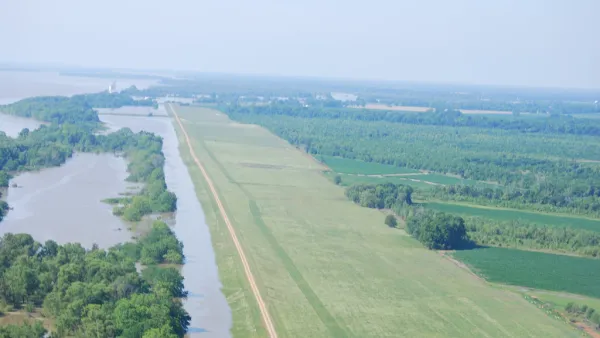
Grist offers this interactive look at various Army Corps of Engineers projects along the Mississippi River, part of its series on the Corp and the River.


"This spring, we take a look at what the nation's legendarily industrious, controversial, and misunderstood agency is up to along the Mississippi River -- and what its presence there has meant for both residents and natural resources over the last 200 years."
"How well is the Army Corps spending your tax dollars? Do the locks and levees the corps builds help or harm the river? Do the agency's plans for flood- and hurricane-prone areas leave low-income residents with nowhere to go? And why was the Corps created in the first place?"
"The Mississippi Valley Division of the U.S. Army Corps of Engineers is responsible for maintaining the Mississippi as a useful and navigable waterway. But some of the Corps' projects have critics crying 'pork.'"
Read the full story: Remaking the Mississippi

Corps Grilled on Gulf Restoration Plan
A year-late plan by the Army Corps of Engineers to restore the Louisiana Gulf Coastline is being slammed by critics.
Louisiana's $50 Billion Coastal Restoration Plan Moves Forward
A $50 billion plan to replenish lost coastal land could have significant impacts on local marine life and fishing industries.
One Geologist Predicted Floods in St. Louis Months Before They Struck
Hindsight is 20-20, but so too sometimes is the foresight of geologists. That was the case prior to the flooding that struck St. Louis this December.

Planetizen Federal Action Tracker
A weekly monitor of how Trump’s orders and actions are impacting planners and planning in America.

Amtrak, CN end decades-long dispute with eight-year agreement
The new operating agreement establishes an updated framework for the companies to work together, including processes to resolve disputes.

Northwest rail fans eager for Sept. 30 debut of Amtrak’s Airo fleet
Get ready for that new train smell and more seats. But they won’t go faster or run more frequently on the Cascades route in Washington and Oregon.

St. Louis Metro to test if single-car trains can reduce operating costs, maintain rider satisfaction
The pilot program will run from October to spring 2027, and begin with one single-car train operating on Metrolink’s Red and Blue lines.

Pennsylvania is building data centers in abandoned mines
Housing data centers in mines provides an alternative to destroying local forests and may spare residents from data centers’ noise and air pollution.

If Corpus Christi can’t revive desalination plant project, it may owe Texas $235 million
Earlier this month, city officials declined to pursue developing the plant for the second time in a year.

FREE Course: Walkable City 1: Why Walkability?
After describing his path towards focusing on walkability as the essence of good planning, Jeff Speck marches through his five principal reasons for making more walkable places.
Reinventing Malls: Planning Alchemy—Turning Gray Fields Into Gold
The course focuses on the opportunities and imperatives that shape reinvention of mall sites.

City of Thousand Oaks
City of Wisconsin Rapids
Harvard University Graduate School of Design
The Architects Foundation
University of Cincinnati Online
The Pocatello Development Authority
The Urban Renewal Agency of the City of Pocatello