Plans to convert major arteries to one-way streets in L.A. are meeting tough criticism. Many say the city needs to rethink what mobility should mean, but others say L.A. isn't ready for such a paradigm shift.


"As is the case with most traffic plans, this one has caused a huge stink. Businesses and residents have complained that it would affect the livability of their neighborhood. Some have threatened to file suit to stop it."
"Even if you don't participate in the steel-cage match that is Westside traffic, the dispute revisits a provocative question: What is the role of our streets? Do they exist to move a lot of traffic? Or should they be the spine of refurbished, pedestrian-friendly neighborhoods? Can they do both?"
"In some ways, it's commendable for public officials to act now. Few do. Villaraigosa appeared on Charlie Rose last week and the first question lobbed at him involved traffic, and it's clear the mayor gets that there's a problem."
"In this case, however, what the city is doing also happens to rub against the grain of modern urban planning."
"'One way you can move toward less congestion is if you provide people better accessibility and walkability and more pleasant streets,' said Gail Goldberg, the city's chief planner, who is not wild about the Olympic-Pico plan. 'But as a city we're not ready for that conversation yet.'"
Read the full story: L.A. officials do a 180 in traffic planning
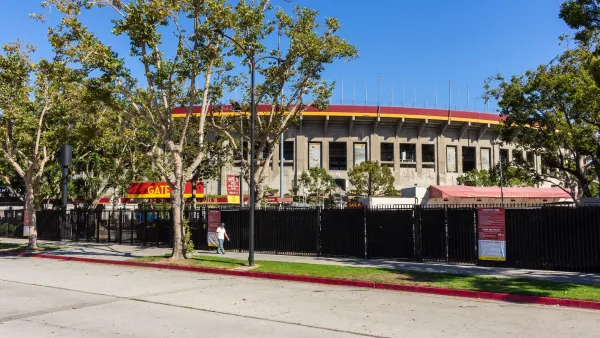
LA authorizes $9.5M for sidewalk repairs around Olympic venues
The city is hosting the Olympic and Paralympic Games in 2028.
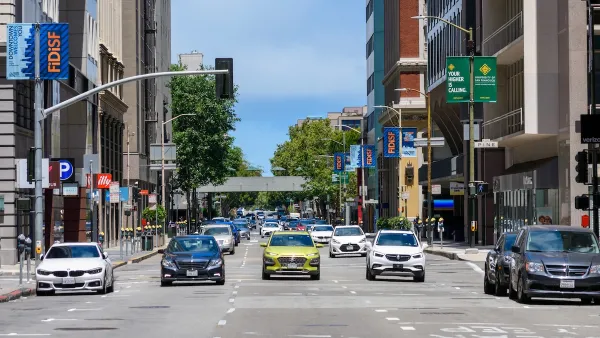
One-Way Streets Have Worse Crashes, Higher Crime and Lower Property Values — Why do we Still Use Them?
How reverting one-way streets to two-way can boost both safety and economic development.

LA’s ‘Mobility Wallet’ Helps Bridge Transportation Gaps
The city gave 1,000 residents a $150 monthly transportation stipend that covered transit, bike share, ride hailing, and car rentals.

Planetizen Federal Action Tracker
A weekly monitor of how Trump’s orders and actions are impacting planners and planning in America.

California plans to bury El Niño’s downpour
If the state plays its cards right, it may be able to store a billion acre-feet of El Niño’s water in aquifers.

Desperate measures: Advocates weigh draining Lake Powell to fill Colorado River
Draining the reservoir could reduce evaporation losses by a couple hundred thousand acre-feet.

Los Angeles just elected an urban planner as its mayor
Transportation analysts are optimistic that Raman will be more aggressive in addressing transit issues than Bass.

Mamdani’s pied-à-terre tax survives legal challenge
A panel of judges found that the plaintiffs failed to demonstrate injury as a result of New York City's implementation of the tax.

Eastern Nebraska is running out of electricity
Data centers and electrification are straining eastern Nebraska’s grid, throttling economic development.

FREE Course: Walkable City 1: Why Walkability?
After describing his path towards focusing on walkability as the essence of good planning, Jeff Speck marches through his five principal reasons for making more walkable places.
Reinventing Malls: Planning Alchemy—Turning Gray Fields Into Gold
The course focuses on the opportunities and imperatives that shape reinvention of mall sites.

City of Rosemead
Rutgers University, Edward J. Bloustein School of Planning and Public Policy
One Hundred Miles
University of Michigan School for Environment and Sustainability (SEAS)
Hunter College, City University of New York (CUNY)
The Architects Foundation
City of Cambridge
Montrose County
The Pocatello Development Authority