Writer–on-the-Range Alan Kesselheim describes the most hazardous activity in Montana -- driving, with a particular focus on Hwy 191 through Gallatin Canyon. Every western state has a similar, hazardous route.


"The Gallatin Canyon between Bozeman and Big Sky, Mont. is the second-busiest commuting corridor in the state, and the most dangerous. Between 5,500 and 7,500 drivers navigate the perilous gantlet of Highway 191 daily, on their way to work at booming construction sites, the popular Yellowstone National Park, and crowd-pleasing ski resorts."
"For these thousands of drivers and their passengers, it may be the most dangerous thing they ever do, and yet they take it on routinely enough that it becomes mundane. For all of us, unless we live in an active war zone, driving is statistically chancier than anything else in our lives. We may fixate on terrorists and nasty encounters with bears or mountain lions, but for true fear and loathing, nothing trumps time behind the wheel."
"Since 1996 there have been 21 deaths and 374 injuries along this one stretch of road. White crosses bloom on every curve. In a recent, and typical, three-year period there were 367 reported collisions between vehicles and wildlife. Who knows how many more went unreported?"
I'd like to think that my neighborhood highway nightmare is an anomaly, a Montana-based vortex of tragedy. Not so. Every state in the West has its version of the same syndrome. {Kesselheim describes particularly hazardous routes in WY, CA, CO, OR, and AK}.
Read the full story: Killer commutes in wild West: Critters, careless drivers, treacherous weather among hazards

Planetizen Federal Action Tracker
A weekly monitor of how Trump’s orders and actions are impacting planners and planning in America.

Eastern Nebraska is running out of electricity
Data centers and electrification are straining eastern Nebraska’s grid, throttling economic development.
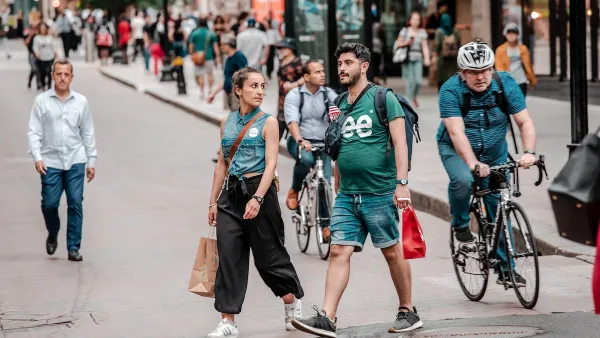
Study reveals best places in the U.S. for cycling, walking
New research from Streetlight Data examines bicycle and pedestrian miles per capita in the 100 largest U.S. cities by population.

DSA members accuse Mamdani of 'abandoning values' over housing redevelopment
New York City's mayor plans to replace about 2,000 units of public housing with private, mixed-income housing.

All sides of BRT debate unhappy with CDOT’s most recent move
The Colorado Department of Transportation is no longer considering center-running bus lanes for Colorado Boulevard.

Massachusetts bogs generate both power, and cranberries
Putting solar panels above farmland is one way Massachusetts is advancing toward its goal of net-zero carbon emissions by 2050.

FREE Course: Walkable City 1: Why Walkability?
After describing his path towards focusing on walkability as the essence of good planning, Jeff Speck marches through his five principal reasons for making more walkable places.
Reinventing Malls: Planning Alchemy—Turning Gray Fields Into Gold
The course focuses on the opportunities and imperatives that shape reinvention of mall sites.

City of Rosemead
Rutgers University, Edward J. Bloustein School of Planning and Public Policy
One Hundred Miles
University of Michigan School for Environment and Sustainability (SEAS)
Hunter College, City University of New York (CUNY)
The Architects Foundation
City of Cambridge
The Pocatello Development Authority
The Urban Renewal Agency of the City of Pocatello