I'm just back from China. Waht a week. Among other amazing experiences, we got to go for a ride in one of only 19 GM Sequel hydrogen minivans. The car is remarkably similar to a regular vehicle, except for a small computer screen on the dash that provides a detailed diagnostic readout on the hydrogen fuel cell stack. That's my colleague Mike Liebhold of the Institute for the Future behind the wheel.



I'm just back from China. Waht a week. Among other amazing experiences, we got to go for a ride in one of only 19 GM Sequel hydrogen minivans.
The car is remarkably similar to a regular vehicle, except for a small computer screen on the dash that provides a detailed diagnostic readout on the hydrogen fuel cell stack.
That's my colleague Mike Liebhold of the Institute for the Future behind the wheel.
There's a lot more information about the Sequel on GM's website, and this 2002 Wired article offers a pretty good and still relevant overview of GM's over $1 billion project to develop hydrogen fuel cell vehicles.
GM has clearly created a prototype that would be at home in a Wal-Mart parking lot (in Seattle or Shanghai for that matter). But at over $1 million each, it looks like we're at least 10-15 years away from large-scale production of these vehicles.

Five Observations from Three Years in China
I’ve spent much of the last three years working on transportation finance and planning issues in China, and Reason Foundation now has transportation policy projects up and running in the cities of Chongqing, Xi’an, and Beijing.
Beijing's traffic nightmare and public transit
BEIJING--When I first learned that I wouldn't be able to rent a car in Beijing, I was disappointed. That's how I usually break away from the business "bubble" to learn something about a city. But, it didn't take more than an hour to realize that I was better off with a local driver than tackling it myself. Driving habits, combined with roads choking with pedestrians, cars, buses, and taxis, convinced me I needed to leave the driving to a "pro".
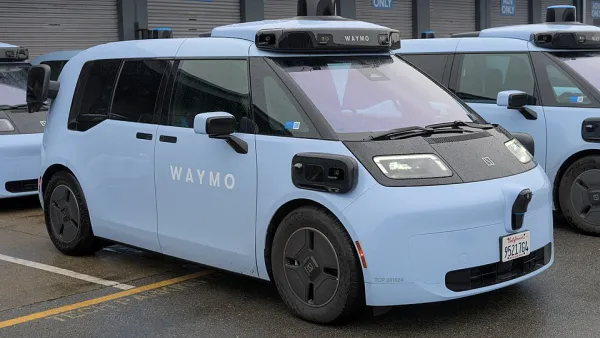
Waymo’s Ojai robotaxis from China now able to pick up all riders
Steep tariffs and tight federal laws haven’t stopped Waymo from purchasing over 3,200 vehicles from Zeekr, a Chinese manufacturer.

Desperate measures: Advocates weigh draining Lake Powell to fill Colorado River
Draining the reservoir could reduce evaporation losses by a couple hundred thousand acre-feet.

Eastern Nebraska is running out of electricity
Data centers and electrification are straining eastern Nebraska’s grid, throttling economic development.

Malls are becoming the midtowns of the future
Mall and office park redevelopments are a generational opportunity to create new nodes of urbanity.

One Kentucky town’s secret to affordable housing
The Smoketown Community Land Trust has already built seven affordable homes for community members.

Houston gains petal-shaped cooling infrastructure to make streets more ‘delightful’
The city has installed the pavilions along 15 blocks in Houston.

After years of opposition to light rail, this L.A. city wants a $200 million station
Cerritos officials want the Southeast Gateway Line, a planned 14.5-mile light rail route through Los Angeles County, to stop in their city.

FREE Course: Walkable City 1: Why Walkability?
After describing his path towards focusing on walkability as the essence of good planning, Jeff Speck marches through his five principal reasons for making more walkable places.
Reinventing Malls: Planning Alchemy—Turning Gray Fields Into Gold
The course focuses on the opportunities and imperatives that shape reinvention of mall sites.

City of Rosemead
Rutgers University, Edward J. Bloustein School of Planning and Public Policy
One Hundred Miles
University of Michigan School for Environment and Sustainability (SEAS)
Hunter College, City University of New York (CUNY)
The Architects Foundation
City of Cambridge
Montrose County
The Pocatello Development Authority

