Are industrialization and sustainabiity are incompatible? Charles Shaw searches for the answer with a comparison of the ideas of William McDonough, green architect and designer, and Derrick Jensen, environmentalist and philosopher.


"To be, or not to be -- that is the age-old question, and civilization today faces its own dire version of it. As the negative social and ecological effects of 150 years of industrialization are becoming impossible to ignore, people are asking whether we can maintain our standards of living. But very few are asking if we should.
There are, however, two contemporary thinkers for whom this question is primal: William McDonough, green architect and designer, and Derrick Jensen, neo-tribal environmentalist and philosopher. They epitomize the vanguard of the new green zeitgeist. They are the elemental planners of a future sustainable society...
Though these two men share a common belief -- that industrial civilization, with its outrageous fortune, is killing the planet, plunging all life into a veritable sea of troubles -- they represent two sides of the most important question of our age: Is civilization worth saving?..
McDonough sees civilization as a good thing, something worth saving, and chalks up our current environmental crisis to a kind of growing-pain mentality...
Derrick Jensen believes the current "civilization" -- a system of sprawl, consumerism, monoculture, industry, war, empire, and a near-total disregard for non-human life that relies on finite resources and is predicated on unlimited growth -- is, in a word, insane."
Read the full story: The Priest and the Prophet


Planetizen Federal Action Tracker
A weekly monitor of how Trump’s orders and actions are impacting planners and planning in America.

Northwest rail fans eager for Sept. 30 debut of Amtrak’s Airo fleet
Get ready for that new train smell and more seats. But they won’t go faster or run more frequently on the Cascades route in Washington and Oregon.
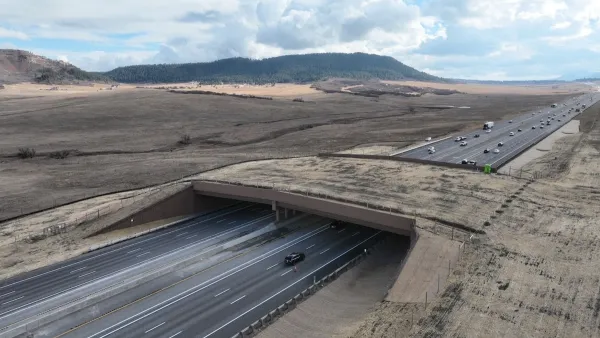
Record-breaking wildlife overpass in Colorado brings 91% reduction in animal collisions
Prior to the overpass, vehicles were hitting one deer per day on Colorado’s Interstate 25.

Detroit to transform waterfront with $2.2 billion investment
Developers will convert about 18 acres of unused parking lot space into civic spaces.

‘Going backwards:’ Baltimore mayor, students rally against state's transit funding plan
Maryland's proposed six-year plan provides no funding for Baltimore’s BMORE bus program and reduces its road maintenance funding.

Trump wants to cancel nearly 98% of funding for HUD housing support program
Multiple housing groups are suing the administration in an effort to preserve the funding.

FREE Course: Walkable City 1: Why Walkability?
After describing his path towards focusing on walkability as the essence of good planning, Jeff Speck marches through his five principal reasons for making more walkable places.
Reinventing Malls: Planning Alchemy—Turning Gray Fields Into Gold
The course focuses on the opportunities and imperatives that shape reinvention of mall sites.

City of Thousand Oaks
City of Wisconsin Rapids
Harvard University Graduate School of Design
The Architects Foundation
University of Cincinnati Online
Northern Illinois Transit Authority (NITA)
The Pocatello Development Authority
The Urban Renewal Agency of the City of Pocatello