Putting solar panels above farmland is one way Massachusetts is advancing toward its goal of net-zero carbon emissions by 2050.


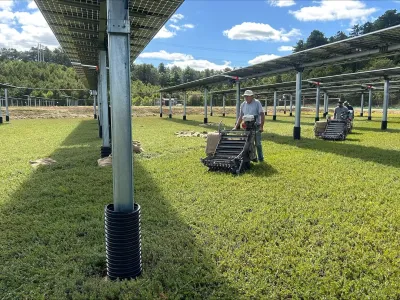
For the first time in the United States’ history, farmers are growing cranberries underneath solar panels. Dual-use solar allows Massachusetts farmers to build solar panels above farmland, resulting in land that can generate energy and food simultaneously. The strategy is one way Massachusetts is advancing toward its goal of net-zero carbon emissions by 2050.
“Solar can be particularly advantageous for cranberry farmers in Massachusetts, which grows more of the fruit than any state other than Wisconsin. While sheep farms and cornfields can often be sold to housing or commercial developers, cranberry bogs are protected wetlands: Even if they go out of production, they cannot be built on. Not all bogs are well placed to connect to the grid, but for those that are, solar panels can be a financial lifeline,” Sarah Shemkus writes for Grist.
It took some trial-and-error to determine how deep to set the foundations of the solar arrays, as developers had to dig deeper than usual to find solid ground in the cranberry bogs. Developers also had to place the foundations further apart than normal to ensure farm equipment could still navigate the bogs.
Read the full story: These cranberry bogs come with a side of solar
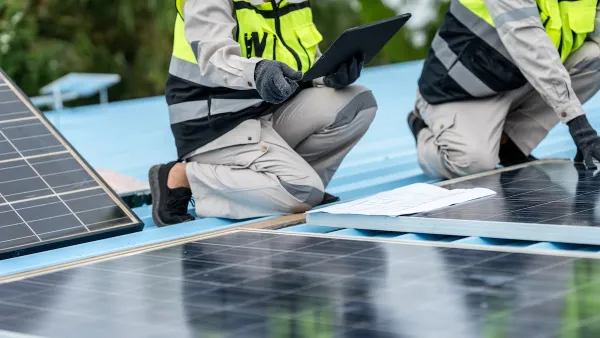
Trump administration unlawfully slashed $7 billion in clean energy grants, judge rules
The Environmental Protection Agency ended the Solar For All program, which provided the grants, after President Donald Trump’s inauguration.
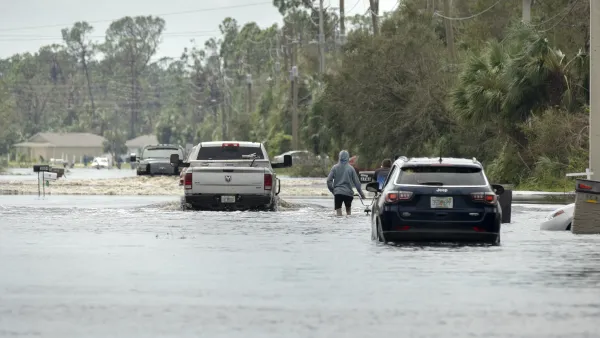
Courts order EPA to release billions in climate grants
The grants primarily funded projects aimed at Black, low-income and disadvantaged communities.
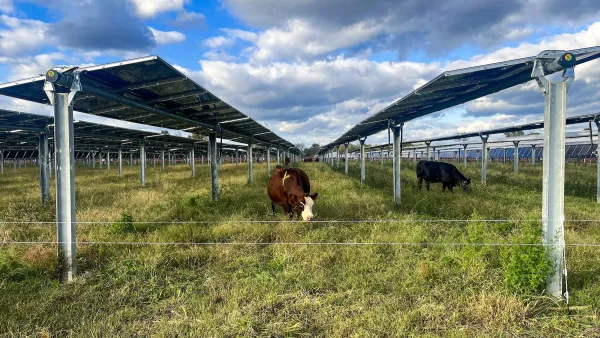
Cows at Tennessee's 'Silicon Ranch' graze under solar panels
The project aims to prove that agriculture and solar energy production can work in tandem.

Planetizen Federal Action Tracker
A weekly monitor of how Trump’s orders and actions are impacting planners and planning in America.

Eastern Nebraska is running out of electricity
Data centers and electrification are straining eastern Nebraska’s grid, throttling economic development.
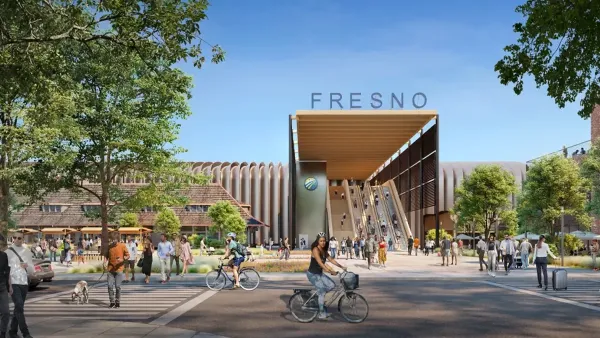
California High-Speed Rail Authority picks trainset manufacturer
The California High-Speed Rail Authority aims to start servicing passengers by 2033.

Massachusetts bogs generate both power, and cranberries
Putting solar panels above farmland is one way Massachusetts is advancing toward its goal of net-zero carbon emissions by 2050.

What could the future of LA transit look like under Raman?
The mayor-elect views broken sidewalks and potholes as crises that can be fixed with better governance.

States are counting on battery farms. Some towns don’t want them.
While fire safety has improved, some communities are still wary.

FREE Course: Walkable City 1: Why Walkability?
After describing his path towards focusing on walkability as the essence of good planning, Jeff Speck marches through his five principal reasons for making more walkable places.
Reinventing Malls: Planning Alchemy—Turning Gray Fields Into Gold
The course focuses on the opportunities and imperatives that shape reinvention of mall sites.

City of Rosemead
Rutgers University, Edward J. Bloustein School of Planning and Public Policy
One Hundred Miles
University of Michigan School for Environment and Sustainability (SEAS)
Hunter College, City University of New York (CUNY)
The Architects Foundation
City of Cambridge
The Pocatello Development Authority
The Urban Renewal Agency of the City of Pocatello