Developers will convert about 18 acres of unused parking lot space into civic spaces.


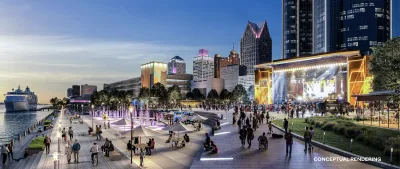
The Detroit River Conservancy is planning a $2.2 billion redesign of the city’s riverfront. The plan calls for developers to transform roughly 18 acres of unused parking lot space into civic spaces, and to build 935 units of mixed-income housing, Whitney Burney writes for ABC Detroit.
“The project aims to transform the East Riverfront and reimagine portions of the Renaissance Center campus, bringing new public spaces, housing, entertainment and retail opportunities to one of Detroit’s most visited destinations,” ABC Detroit reports.
The redevelopment plan also calls for the demolition of several towers at Detroit’s Renaissance Center Campus to open up opportunities for riverfront development. Detroit residents have expressed interest in bringing more water-related activities to the riverfront, such as fishing and swimming.
Read the full story: Detroit Riverfront community meeting seeks public input on $2.2-billion transformation
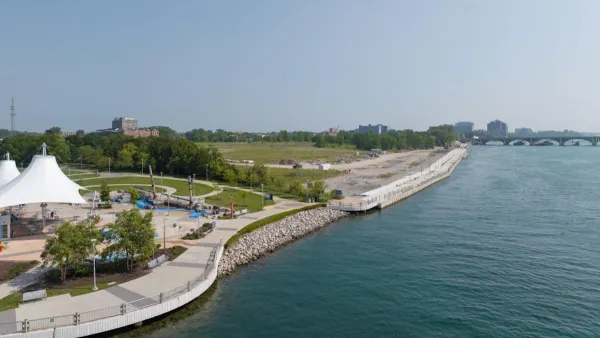
New Riverfront Promenade Opens in Detroit
The East Riverfront now provides 3.5 miles of contiguous parks and trails on the formerly industrial waterfront.
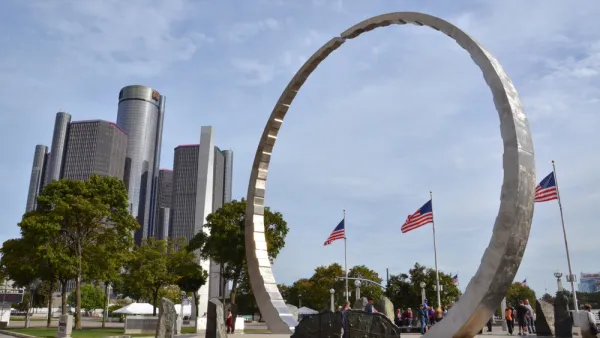
Detroit's Hart Plaza, Due for a Redesign?
Detroit's Hart Plaza is full of concertgoers during Jazz Fest, but some think the downtown space could serve the city better the rest of the year.

Learning loss and urban schools, part 2
Did test scores in progressive cities drop more post-COVID than test scores in moderate ones?

Planetizen Federal Action Tracker
A weekly monitor of how Trump’s orders and actions are impacting planners and planning in America.

Eastern Nebraska is running out of electricity
Data centers and electrification are straining eastern Nebraska’s grid, throttling economic development.

Study reveals best places in the U.S. for cycling, walking
New research from Streetlight Data examines bicycle and pedestrian miles per capita in the 100 largest U.S. cities by population.

Next-generation nuclear reactors are coming to Texas
The reactors will not require towering containment structures thanks to new safety features.

California distributes $1.3 billion to prevent transit service cuts, bolster projects
Twenty-eight projects across California received a portion of the funding.

Pennsylvania Democrats have 15 affordability, clean energy bills for flipped state Senate
Bills in consideration include a bill supporting geothermal energy and a bill supporting solar on warehouses.

FREE Course: Walkable City 1: Why Walkability?
After describing his path towards focusing on walkability as the essence of good planning, Jeff Speck marches through his five principal reasons for making more walkable places.
Reinventing Malls: Planning Alchemy—Turning Gray Fields Into Gold
The course focuses on the opportunities and imperatives that shape reinvention of mall sites.

City of Charlotte
City of Rosemead
Rutgers University, Edward J. Bloustein School of Planning and Public Policy
University of Michigan School for Environment and Sustainability (SEAS)
Hunter College, City University of New York (CUNY)
The Architects Foundation
City of Cambridge
The Pocatello Development Authority
The Urban Renewal Agency of the City of Pocatello