Chicago aims to eventually turn empty office space into 1,765 mixed-income housing units.



Downtown Chicago's first completed office-to-housing conversion project opened earlier this month in the central business district. The Rector building, now called the Bellwether, is the first of six office conversion projects that the Chicago Department of Planning Development is considering.
“Using $28 million in tax increment financing from the city and a historic landmark designation that opened up $7.8 million in federal tax credits, the developers of the 14-story Rector building turned 11 floors of unused office space into 117 residential units, 41 of them earmarked for households earning an average of 60% of the area median income,” Smart Cities Dive reports.
Chicago’s LaSalle Street Reimagined initiative aims to turn unused office spaces into 1,765 mixed-income housing units. Chicago also expects to see nearly two-dozen private conversions of office buildings into housing, which are expected to create around 4,000 new residential units, Ryan Kushner writes for Smart Cities Dive.
Read the full story: With its first office-to-housing project done, Chicago advances ‘next chapter’ for its downtown

Chicago cuts ribbon on $300,000, self-cleaning public toilet
The public toilet is the city’s first, and may pave the way for a rollout of similar facilities.

Developers reveal $10 billion stadium plan as ‘Hail Mary’ to keep Bears in Chicago
The plan would also boast a public park, high- and mid-rise buildings and a youth sports complex.
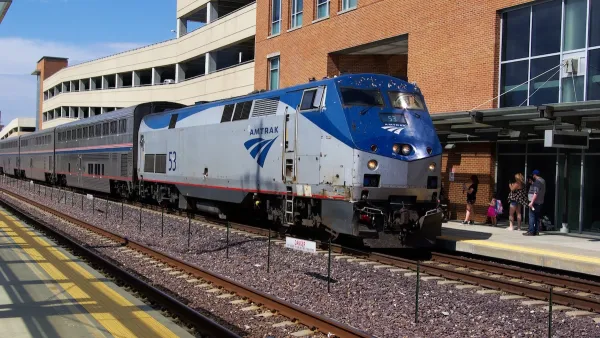
Officials claim feds 'rushed' Amtrak environmental review
Amtrak plans to move their Chicago maintenance facility from an industrial area to a residential one.

Planetizen Federal Action Tracker
A weekly monitor of how Trump’s orders and actions are impacting planners and planning in America.

Eastern Nebraska is running out of electricity
Data centers and electrification are straining eastern Nebraska’s grid, throttling economic development.

Study reveals best places in the U.S. for cycling, walking
New research from Streetlight Data examines bicycle and pedestrian miles per capita in the 100 largest U.S. cities by population.

Next-generation nuclear reactors are coming to Texas
The reactors will not require towering containment structures thanks to new safety features.

California distributes $1.3 billion to prevent transit service cuts, bolster projects
Twenty-eight projects across California received a portion of the funding.

Pennsylvania Democrats have 15 affordability, clean energy bills for flipped state Senate
Bills in consideration include a bill supporting geothermal energy and a bill supporting solar on warehouses.

FREE Course: Walkable City 1: Why Walkability?
After describing his path towards focusing on walkability as the essence of good planning, Jeff Speck marches through his five principal reasons for making more walkable places.
Reinventing Malls: Planning Alchemy—Turning Gray Fields Into Gold
The course focuses on the opportunities and imperatives that shape reinvention of mall sites.

City of Charlotte
City of Rosemead
Rutgers University, Edward J. Bloustein School of Planning and Public Policy
University of Michigan School for Environment and Sustainability (SEAS)
Hunter College, City University of New York (CUNY)
The Architects Foundation
City of Cambridge
The Pocatello Development Authority
The Urban Renewal Agency of the City of Pocatello