The bill would also require major cities in California to permit high-rise residential buildings.


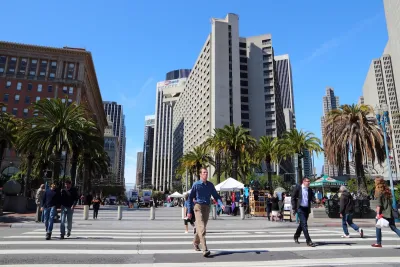
A downtown density bill that would require 7 California cities to permit high-rise residential buildings is headed to Gov. Gavin Newsom’s desk. The bill is part of a “larger effort to increase housing density in the state to meet a goal of 2.5 million new homes by 2030,” Ryan Kushner writes for Smart Cities Dive.
“AB 2074 requires major cities with transit to establish regional transit hub districts, areas with at least one transit-oriented development stop where the city must allow residential building height limits to be set at a maximum of at least 150 feet. Residential buildings with a maximum height of at least 450 feet would have to be allowed in at least 25% all regional transit hub districts in a city,” Kushner writes.
If signed, the bill will impact cities with at least two transit stops and a population of at least 400,000 people, which includes Los Angeles, San Diego and San Francisco. The bill would also “trigger a housing construction loan and financing study by the California Housing Finance Agency,” Smart Cities Dive reports.
Read the full story: More high-rises could be coming to 7 California cities under housing density bill

On Housing, Cities' Traditional Political Labels No Longer Apply
Historically liberal cities belie their supposed concern for human welfare by rejecting new development. Meanwhile, more conservative cities have seized the moment to become more progressive, innovative, and inclusive.

California Getting Way More New Jobs Than New Housing
Even with tons of building permits already issued this year, the outlook for the state’s affordability crisis is pretty grim.

California Population Grows to 39,810,000 in 2017
California added 309,000 residents last year, an 8 percent drop compared to annual increases since 2010. The state added a net 85,000 housing units, accounting for losses to wildfires.

Planetizen Federal Action Tracker
A weekly monitor of how Trump’s orders and actions are impacting planners and planning in America.

California plans to bury El Niño’s downpour
If the state plays its cards right, it may be able to store a billion acre-feet of El Niño’s water in aquifers.

Desperate measures: Advocates weigh draining Lake Powell to fill Colorado River
Draining the reservoir could reduce evaporation losses by a couple hundred thousand acre-feet.

Los Angeles just elected an urban planner as its mayor
Transportation analysts are optimistic that Raman will be more aggressive in addressing transit issues than Bass.

Mamdani’s pied-à-terre tax survives legal challenge
A panel of judges found that the plaintiffs failed to demonstrate injury as a result of New York City's implementation of the tax.

Eastern Nebraska is running out of electricity
Data centers and electrification are straining eastern Nebraska’s grid, throttling economic development.

FREE Course: Walkable City 1: Why Walkability?
After describing his path towards focusing on walkability as the essence of good planning, Jeff Speck marches through his five principal reasons for making more walkable places.
Reinventing Malls: Planning Alchemy—Turning Gray Fields Into Gold
The course focuses on the opportunities and imperatives that shape reinvention of mall sites.

City of Rosemead
Rutgers University, Edward J. Bloustein School of Planning and Public Policy
One Hundred Miles
University of Michigan School for Environment and Sustainability (SEAS)
Hunter College, City University of New York (CUNY)
The Architects Foundation
City of Cambridge
Montrose County
The Pocatello Development Authority