The Department of Motor Vehicles has issued the first ever permit for heavy-duty autonomous vehicles to be tested on California's roads.


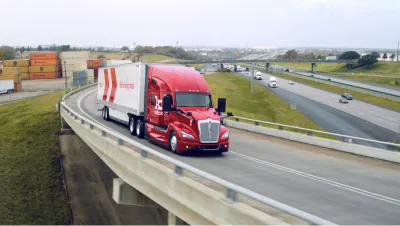
On Thursday, the California Department of Motor Vehicles issued a permit to Kodiak AI, Inc. to begin testing heavy-duty autonomous vehicles on California's roads for the first time. Until now, classification did not exist for — and therefore did not allow — vehicles heavier than 10,001 pounds.
Yahoo! News compares Kodiak's first testing phase to a leaner's permit: "What the DMV actually issued is a drivered permit. Every Kodiak tractor operating under it carries a human being in the left seat, belted in, hands near the wheel, doing exactly the job California spent a decade insisting somebody had to do," writes John Lloyd. "Kodiak's permit is the first rung of a three-rung ladder: drivered testing, then driverless testing, then driverless commercial deployment."
But Lloyd also emphasized how quickly the phase might pass.
"Before a heavy-duty developer can run driverless freight commercially in California, it needs roughly 500,000 miles logged in the safety-driver phase and another 500,000 in the driverless phase, with about 200,000 of the total accumulated inside California... [but] a single long-haul tractor covers 500,000 miles in maybe five years of hard duty. A test fleet of 20 trucks running 500 miles a day clears the same distance in about seven weeks."
Lloyd's article gives a very thorough overview and analysis of Kodiak's history, the evolving regulations of heavy-duty autonomous vehicles, and what it all means. Have a read, below.
Read the full story: California Just Handed Kodiak a Learner's Permit for Driverless Semis

Planetizen Federal Action Tracker
A weekly monitor of how Trump’s orders and actions are impacting planners and planning in America.

Eastern Nebraska is running out of electricity
Data centers and electrification are straining eastern Nebraska’s grid, throttling economic development.

Study reveals best places in the U.S. for cycling, walking
New research from Streetlight Data examines bicycle and pedestrian miles per capita in the 100 largest U.S. cities by population.

Officials look to alter BART extension as price goes through the roof
Tariffs and the war with Iran are behind the rising cost.

To power data centers, Utah company may build hundreds of nuclear reactors on state land
In its permit application, Valar asked for the county to confirm that changes within its outlined plan would still be covered by the permit.

San Antonio is using environmental review to stall ICE detention center
San Antonio sued last month to pause work on the new detention center until the federal government studied its effect on the surrounding area.

FREE Course: Walkable City 1: Why Walkability?
After describing his path towards focusing on walkability as the essence of good planning, Jeff Speck marches through his five principal reasons for making more walkable places.
Reinventing Malls: Planning Alchemy—Turning Gray Fields Into Gold
The course focuses on the opportunities and imperatives that shape reinvention of mall sites.

City of Charlotte
City of Rosemead
Rutgers University, Edward J. Bloustein School of Planning and Public Policy
University of Michigan School for Environment and Sustainability (SEAS)
Hunter College, City University of New York (CUNY)
The Architects Foundation
City of Cambridge
The Pocatello Development Authority
The Urban Renewal Agency of the City of Pocatello