Is there anything sexy about urban planning?



The work of a planner is often meticulous, slow-going and diagram-heavy. At the very least, we can admit that it may not exactly be the flashiest occupation out there.
For whatever reason, though, architects are sexy. Architects are so cool that it has long been a romantic comedy trope for one of the central love-smitten characters to be an architect, or at least an aspiring one. Joseph Gordon-Levitt in "(500) Days of Summer," Tom Hanks in "Sleepless in Seattle," Michelle Pfeiffer in "One Fine Day," Steve Martin in "It’s Complicated" and "HouseSitter…" you get it. It goes far beyond the rom-com, though, from Donald Sutherland in the horror film "Don’t Look Now" to Sean Penn in "The Tree of Life."
While what these (usually male) characters actually do at or for work is not usually significant to the movie’s plot, there is clearly something decidedly cinematic about architects — but what? Is it because they tend to be relatively well-off, creative, educated and cultured? Sure, but they’re also safe, signalling a certain reasonableness and professionalism.
Planners, on the other hand, are more of an enigma, at least for screenwriters. For starters, the general public has even less of an idea of what a planner actually does, which means it is less useful for a script seeking to build character traits quickly and effectively. "Architect" suits that shorthand in a way that "planner" does not. As Tom Campbell, author of the novel "The Planner," once wrote:
While the cult of the star architect has soared over the decades and property developers have displaced bankers as the new super-rich, the figure of the local town planner has become comic shorthand for a certain kind of faceless, under-whelming dullard. Representations of planners in literature and film are few, but when they do appear it is invariably unflattering.
Because planning and planners may not be onscreen as often, it is even more notable when it does happen, and it likewise demands a certain attention to detail to assess how successful they are, either at depicting what it’s like to be on the job, or at making it look cool — or at least as cool as architecture. Civil engineering, urban design and city planning are jobs and vocations deserving of nuanced representation; the following examples ought to just be the beginning.
Utopia (2014 - 2023)
"Utopia’s" first episode opens with an error about a brochure which inadvertently mentions community gardens in a new urban renewal initiative that didn't plan to include any such gardens. Chaos, of a decidedly administrative variety, ensues. This is a perfect set-up for what may be the planner’s ultimate piece of media, an Australian sitcom that follows a fictional government department called the Nation Building Authority (NBA).
Populated with planners, consultants, liaisons, project managers and other bureaucrats, the series explores their handling of major infrastructure projects, and the many obstacles that arise, from political grandstanding to shifts in policy. Put differently, under the guise of a workplace comedy, the series highlights how often big dreams become altered, winnowed down, corrupted or otherwise interfered with, particularly as we watch how a project develops from inception to public unveiling.
The series even touches on real-life ideas like a proposed high-speed rail line connecting Melbourne, Sydney and Brisbane, which has long been considered unviable…but maybe the NBA can do it! (They can’t. Indeed, in real life, many years later, the Australian government created the High Speed Rail Authority to develop just such a rail network). Other episodes focus on a (failed) wildlife preservation project, the proposed building of a second Sydney airport, farmland rezoning, freeway upgrades, community consultations, "Smart Cities" conferences and organizational audits — not exactly heart-racing stuff on paper, but catnip for planners hoping to see their work onscreen in a recognizable way, even when (sympathetically) played up for laughs.

Parks and Recreation (2009 - 2015)
The American sitcom "Parks and Recreation" likely needs no introduction, but we can think about it more specifically in terms of its dedication to presenting public works and city planning as noble, if frustrating and absurd, professions. Indeed, Leslie Knope (Amy Poehler), the department’s eager deputy director, treats her job as a devotion. The show’s writers consulted with urban planners and other officials to help add authenticity to their heightened farce, in addition to attending city council meetings and town halls, and that balance helped make the show into a cult hit-turned-streaming sensation.
On one hand, Knope et al.’s bright-eyed belief in the power of government to do good can seem like romanticized idealism, but at the same time, due to the writers’ commitment to reflecting real-life city planning snafus, plotlines like the early plan to turn a construction pit into a park or, later, to plan a harvest festival for the community of Pawnee did not ignore the difficulties of bringing such projects to fruition.
The city planner character, Mark Brendanawicz (Paul Schneider), is based on actual planner Scott Albright, who consulted for the series. Mark, though, is deeply jaded and disillusioned about his job, having seemingly lost faith in the red-tape-addled governmental process. This reflects what city planner M. Nolan Gray, author of "Arbitrary Lines: How Zoning Broke the American City and How To Fix It," once called the profession’s "existential cynicism."
After that character leaves the series for good at the end of the second season, planners as such show up less often on the show, yet a sense that ambitious public projects are both doable and worth doing remains throughout the series.
Ikiru (1952) and Living (2022)
"Ikiru," Akira Kurosawa’s masterpiece, may not lift the spirits, but it is one of the best tales of bureaucratic inefficiency. An early scene, for instance, depicts the Kafkaesque plight of a group of parents trying to install a playground, but they are sent back and forth between offices in the same building, stifling progress. Meanwhile, Kanji Watanabe (Takashi Shimura) works in the Tokyo public works department and is nearing retirement when he finds out he has stomach cancer. Tired of his dreadfully monotonous office-based life, he sets out to find happiness, or at least discover something new about life. Eventually, after meeting a joyful toy maker, he gets inspired and, back at work, passionately tries to push through the playground project for the community’s benefit. I won’t spoil the ending, but it’s sure to bring on the waterworks.
"Living" is a British remake of Kurosawa’s film, adapted by the novelist Kazuo Ishiguro, with the story moved to London, with character Bill Nighy working in that city’s public works department. In this case, there is a petition to turn a World War II bomb site into a playground, and though it is overall a pared-down version of the original, it demonstrates a shared postwar dedication to rebuilding and doing good for one’s community, particularly at a time when new builds and urban expansion/renewal were anxiety-ridden prospects (See also: "Hands Over the City," a 1963 Italian film about a corrupt large-scale city expansion proposal in postwar Naples).

Motherless Brooklyn (2019)
This strange film is a typical example of a Hollywood passion project, with power and the shifting city at its center (not unlike another large-scale passion project about a visionary architect, Francis Ford Coppola’s recent "Megalopolis"). "Motherless Brooklyn," based on Jonathan Lethem’s novel, was stuck in development hell for two decades before actor (and, in this case, writer and director) Edward Norton was able to find financing and get into production. Norton’s script, which moves the action from the contemporary setting of the book to the noirish 1950s, may have been part of the problem, as it seeks to combine Lethem’s story with a conspiracy around the fictional Borough Authority that resembles parts of Robert A. Caro’s "The Power Broker," a biography of the most infamous planner of all, Robert Moses. Indeed, the character of Moses Randolph (Alec Baldwin), who is referred to as more powerful than the mayor in the film and is treated like a monstrous villain, is a clear stand-in for Moses, and another character played by Cherry Jones is inspired by Jane Jacobs.
It’s interesting to note that part of the inspiration for the film arose from the fact that Norton is grandson to urban planner James Rouse, who embraced comprehensive planning and founded the planned community of Columbia, Maryland — where Norton grew up — in 1967 to eliminate segregation and avoid urban sprawl.
The Tunnel (1935)
Based on a popular 1913 book by Bernhard Kellermann, this sci-fi movie may not feature many actual planners, but the feat of engineering at its center is surely one of the largest infrastructural projects ever imagined in cinema or elsewhere: a transatlantic tube for travel between New York City and London. The innovative engineer who leads the project, played by Richard Dix, convinces several wealthy financiers to back the seemingly-impossible project, which turns him into a global celebrity. But he finds that the citizens of both countries come to lose faith in the tunnel unless he routinely inspires them in the media, all while keeping his backers happy with the progress being made.
It’s a lesson for planners, engineers and civil servants alike: the work you do, even (or especially) the long-term moonshots, will bore the public unless you keep them engaged, and there are always monied pockets to answer to. Almost as fantastical, then, is the American president in the film, played by the great Walter Huston, who claims that with the tunnel’s completion, the government will divert funds away from the military and toward "useful and peaceful channels."

Show Me a Hero (2015)
Written and conceived by "The Wire’s" David Simon alongside journalist William F. Zorzi, this HBO miniseries, starring Oscar Isaac as real-life politician Nick Wasicsko, tells the story of a public housing development in Yonkers, New York that was met with severe resistance from the community’s white middle-class citizens. This federally-mandated desegregation plan was taken up reluctantly by Wasicsko, Yonkers’ new mayor, who had initially run for office opposing the court order. This complicated figure guides us into the clash, which ultimately led to crippling fines for the city, and the series dutifully exposes the dysfunction of the political process alongside the capitalist and racist incentives behind housing discrimination in America.
As in real life, planner Oscar Newman (played by Peter Riegert) was brought in to develop the plan. Newman is best-known for originating the defensible space theory, which essentially argued that urban design can play a significant role in curbing crime by giving residents a sense of ownership and responsibility over their community and their property. What played out in Yonkers was a proof-of-concept for the theory, which continues to shape public housing and other aspects of city design today.
—
Jake Pitre is Assistant Professor in Film Studies at Carleton University in Ottawa.


5 ways to hallucination-proof your AI output
With public trust on the line, the stakes are high for urban planners to ensure accuracy in our AI work. Here’s how to do it.
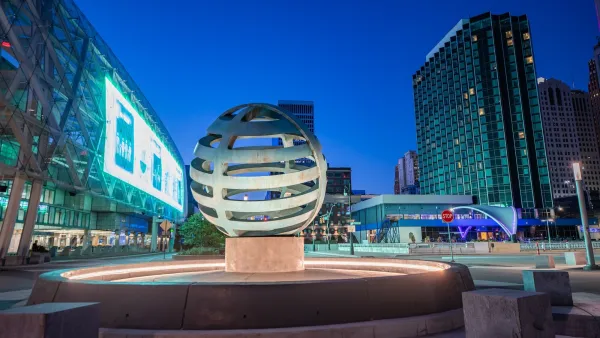
APA conference draws 4,000 urban planners to Detroit this weekend
The annual conference brings together planners for a weekend of panels, discussions and tours.

Everything you Need to Know from the APA’s 2026 Trend Report for Planners
Plus, a conversation with the APA’s Chief Foresight and Knowledge Officer, Petra Hurtado.

Planetizen Federal Action Tracker
A weekly monitor of how Trump’s orders and actions are impacting planners and planning in America.

Data reveals that NYC’s bet on congestion pricing has paid off
After almost two years of the program, reports show positive impacts on traffic and air quality and no disruptions to parking.

HUD modernizes 50-year-old manufactured housing framework
The Next Generation Manufactured Housing Action Plan establishes new energy-efficiency standards for manufactured homes, and new guidelines for anchoring them.

Florida could lose billions in funding for infrastructure, parks
If Amendment 3 passes, Miami-Dade would lose about $445 million annually by fiscal year 2028-29.

New Mexico spent millions drafting climate goals. Data centers are unraveling them
Three data centers in New Mexico and El Paso will release more emissions yearly than 2 million cars in the same timeframe.

This Ohio town is using AI to speed up transit analysis
The Greater Dayton Regional Transit Authority’s new AI tool correctly determined riders’ preferred ways to reach key commuter routes.

FREE Course: Walkable City 1: Why Walkability?
After describing his path towards focusing on walkability as the essence of good planning, Jeff Speck marches through his five principal reasons for making more walkable places.
Reinventing Malls: Planning Alchemy—Turning Gray Fields Into Gold
The course focuses on the opportunities and imperatives that shape reinvention of mall sites.

Rutgers University, Edward J. Bloustein School of Planning and Public Policy
One Hundred Miles
County of Mendocino
The Architects Foundation
University of Cincinnati Online
Montrose County
Northern Illinois Transit Authority (NITA)
The Pocatello Development Authority


