Plus, a conversation with the APA’s Chief Foresight and Knowledge Officer, Petra Hurtado.



This review is part of a special collaboration between Planetizen and Booked on Planning, a biweekly podcast where AICP planners Stephanie Rouse and Jennifer Hiatt chat with authors of the latest books shaping urban planning today. Listen to the episode with today’s author in the player below.
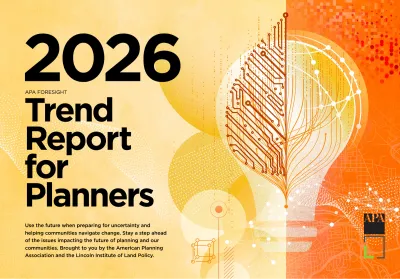
Five years ago, the American Planning Association (APA), in partnership with the Lincoln Institute of Land Policy, began publishing the “Trend Report for Planners.” They utilize a foresight community of multidisciplinary experts who meet regularly and participate in facilitated workshops to identify trends most likely to impact the planning profession over the next year. The community members provide forward thinking perspectives and are most often thought leaders in their respective fields.
The report focuses on multiple timeframes, including Act Now, Prepare, and Learn & Watch. These timeframes indicate the urgency of the trend they are reporting on. Each report covers over 100 existing, emerging, and potential future trends the APA Foresight Team and their Trend Scouting Foresight Community believe are relevant to planning and other related fields.
Across the five “Trend Reports for Planners” (2022–2026), a consistent core focus emerges around the interconnectedness of climate change, digital transformation, and shifting demographics, requiring planners to move from reactive to proactive foresight strategies. Common trends throughout all five years include the critical urgency of climate adaptation, the "digitalization of everything" including the use of AI, and a persistent housing affordability crisis.
This year’s “2026 Trend Report for Planners” serves as an optimistic and essential roadmap for the planning profession and related fields. Rather than focusing on fear of the unknown, the report is meant to be used as a proactive toolkit designed to empower planners to “embrace uncertainty” and lead their communities toward more resilient and equitable futures.
In this episode of Booked on Planning, we spoke with Petra Hurtado, APA’s Chief Foresight and Knowledge Officer about this year’s future trends. Petra points out that the APA Foresight Team and their Trend Scouting Foresight Community are not in the game of predicting the future. Instead, they “use today’s facts to help planners really prepare for what the future might look like.” As Petra says in the interview, “looking away won’t make it go away” so we might as well take a good look at some scenarios about where the planning field could be headed.
This year’s report is particularly impressive for its structured, actionable approach to uncertainty. It moves beyond mere observation and provides a strategic roadmap for professional intervention. The report does this through scenarios projecting four paths forward 5, 10, and 15 years into the future in areas including mobility, artificial intelligence, and privacy concerns.
Here are three key examples from the report that highlight this forward thinking approach:
- Human-Centric AI Insights: The report offers a nuanced "Deep Dive" into the intensifying bonds between humans and AI. It goes beyond technical jargon to address how generative AI (GenAI) and large language models (LLMs) are reshaping public engagement, warning planners to balance efficiency with essential human interaction.
- Commitment to Equity: The inclusion of "An Inclusive Approach to Futures" is a key feature. It challenges dominant perspectives and advocates for "decolonizing the future," ensuring that marginalized voices and cultural identities are central to the visioning process.
- Pragmatic Environmentalism: The report identifies "Greenhushing,” a shift where companies and municipalities are continuing to meet ambitious climate goals but doing so without the “public flag-waiving,” as a critical emerging trend, providing a clever tactical shift for planners to continue making climate progress even when public political winds are shifting.
In an era of "polycrisis” where climate change, political volatility, and technological upheaval collide, this report doesn't just list problems; it builds future literacy. It empowers planners to move from being reactive to being proactive, transforming potential disruptions into opportunities for community resilience and growth.
Whether you are a seasoned urban planner or a local community leader, this report is a masterclass in strategic foresight that will keep you a step ahead of the issues impacting our collective future.


Planning Trends for 2026: States and Cities Take Initiative, Passenger Rail Gains Steam, and the Costs of AI Revealed
With federal funding for everything from transportation projects to housing assistance under threat, city and state governments are poised to take a stronger role in building strong, resilient local economies and public services.
Will Urban Planners Lose Their Jobs to AI?
Let’s see what the data says.

Opinion: The Arrogance of Social Media Urbanists
Criticism of ‘bad’ urban design and development policies leveled at ‘planners’ often obscures the complex nature of urban politics and land use regulations.

The state-sanctioned urbicide of Austin
People don’t kill cities. Freeways do.

US to reduce Colorado River water deliveries to Mexico
A new Colorado Treaty amendment reduces Mexico’s Colorado River water allocation by 250,000 acre feet.

New Jersey’s second-largest city bans standalone data centers
Jersey City will continue to allow co-location facilities, such as those meant for research institutions that store their own data.

Amtrak not solely to blame for New Jersey commuter rail's unreliability, report finds
A new study from the Garden State Initiative found that NJ Transit’s budget grew 20% across a 4 year period, but reliability declined significantly over the same period.

EPA erases limits on planet-warming pollution from power plants
Under Monday’s plan, power plants would still have some limits on how much mercury, arsenic and other contaminants they can emit.

Phoenix announces new on-demand transit service, more frequent RAPID buses
Both new services will launch in October, and are part of Phoenix's Project Effective Access Solutions for Easing Congestion.

FREE Course: Walkable City 1: Why Walkability?
After describing his path towards focusing on walkability as the essence of good planning, Jeff Speck marches through his five principal reasons for making more walkable places.
Reinventing Malls: Planning Alchemy—Turning Gray Fields Into Gold
The course focuses on the opportunities and imperatives that shape reinvention of mall sites.

Eagle County Government
Harvard University Graduate School of Design
Nashville Planning Department
The Architects Foundation
University of Cincinnati Online
The Pocatello Development Authority
The Urban Renewal Agency of the City of Pocatello
Journal of the American Planning Association

