A deep dive into zoning and housing affordability in this edition of I Hope This Helps 👍🏽!



Editor's note: our beloved transit columnist, Joshua Woods, is very good at explaining things. Usually, he explains transit. But successful transit needs supportive land use that puts a lot of people doing a lot of things near transit. And supportive land use requires walkability, bikeability and high quality transit so everybody's not sitting in traffic. So today he's explaining zoning in a little series he likes to call I Hope This Helps 👍🏽. We highly recommend enjoying his series explaining transit planning and transit scheduling, the 101 crash course editions, too.
The sky is blue, taxes are high, and zoning is boring. I’m not pretending zoning is a sexy topic. However, this goofy book of rules is an active force in constraining shaping how our cities can grow. YIMBYism has established itself as a formal movement against the most constraining parts of modern American zoning (ADU restrictions, minimum lot sizes, parking minimums and single family zoning).¹ If you’re working in planning, or you just generally think it’s shenanigans that in over 200 US cities, you need $1 million to afford a starter home, I think you should develop an understanding of zoning.
As always, whether you're a planner, advocate, or just curious about the world around you, I hope you’ll find something here that resonates.
1️⃣ Crash Course on Zoning
Zoning uses the fact that it’s boring to hide the fact that it is simple. You subdivide the city into zones and dictate how things can develop in each zone. That’s the framework.
Most United States zoning codes dictate based on two things; What can be built, and how dense the development can be.
Top it off with a bunch of loosely thought out parking requirements, and a slurry of rules² about how structures are physically allowed to occupy the space, and you’ve got a modern American zoning code.
Here’s a link to the Chicago Zoning Ordinance, where I live. If you’re ever bored, click through it with that understanding. You can probably figure it out. (You and ChatGPT can definitely figure it out).
If you prefer multimedia content, here’s a 5 minute explainer video!
2️⃣ Zoning is an Act of Authority
I mean this in a value neutral way. Zoning is an institution, often the local government, exerting authority over private property owners, by dictating what they can do with their property, ostensibly for the public good. Euclid v. Ambler (the 1926 Supreme Court case that defended the constitutionality of zoning) established this explicitly.
The social contract we’re engaged in with the government necessitates reasonable acts of authority. However, anytime the government acts as an authority, there should be a sincere assessment of whether the authority exerted achieved the intended outcome, was commensurate with the outcome achieved, and if that outcome was aligned with the needs and will of the population.
This advocates for governing with a light touch. Modern zoning is anything but.
3️⃣ Housing is Just a Big Game of Musical Chairs
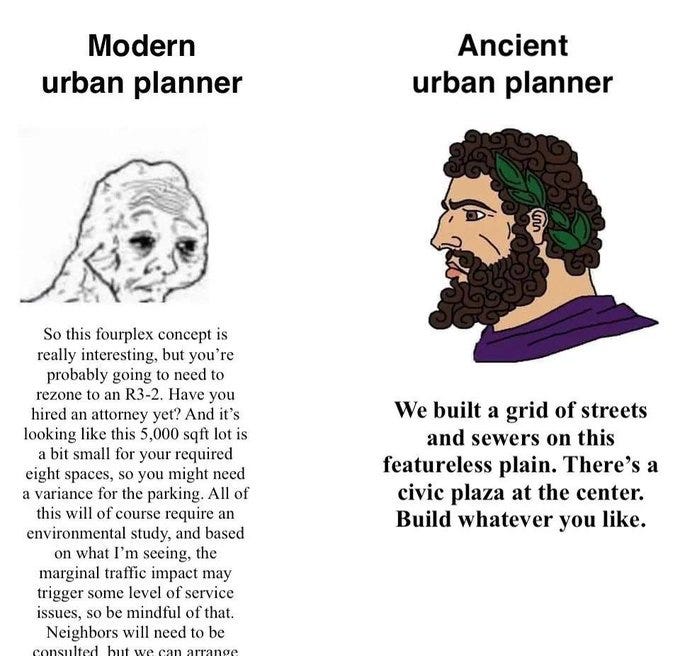
One common critique of YIMBYism is that it can’t provide housing cheap enough to be affordable to the lowest income groups. This is a valid critique, but the supply constraints imposed by zoning that YIMBYs are advocating against distort the need for solutions involving public subsidy. Recall, in over 200 US cities, you need $1 million to afford a starter home‼️
Housing is a big game of musical chairs. If we add players without adding more chairs, more people are going to be sitting on the sidelines.
In a supply constrained market, everybody is competing with everybody for the same housing. Under these circumstances, those with the most resources are always going to win. YIMBYism works to ensure that we have 10 people fighting for 12 houses (+2), not for 8 houses (-2).
This article discusses three of the major ways housing supply lowers prices.
4️⃣ Let’s See How Zoning Is Playing out in my town
Let’s see what type of housing is permitted by the Chicago Zoning Ordinance, and where. In the maps below, areas in green are where the housing type is allowed “by-right”, meaning no discretionary review is required.³ Areas in yellow are where the housing type requires special permission to be constructed. Areas in red are where the housing type is not allowed.
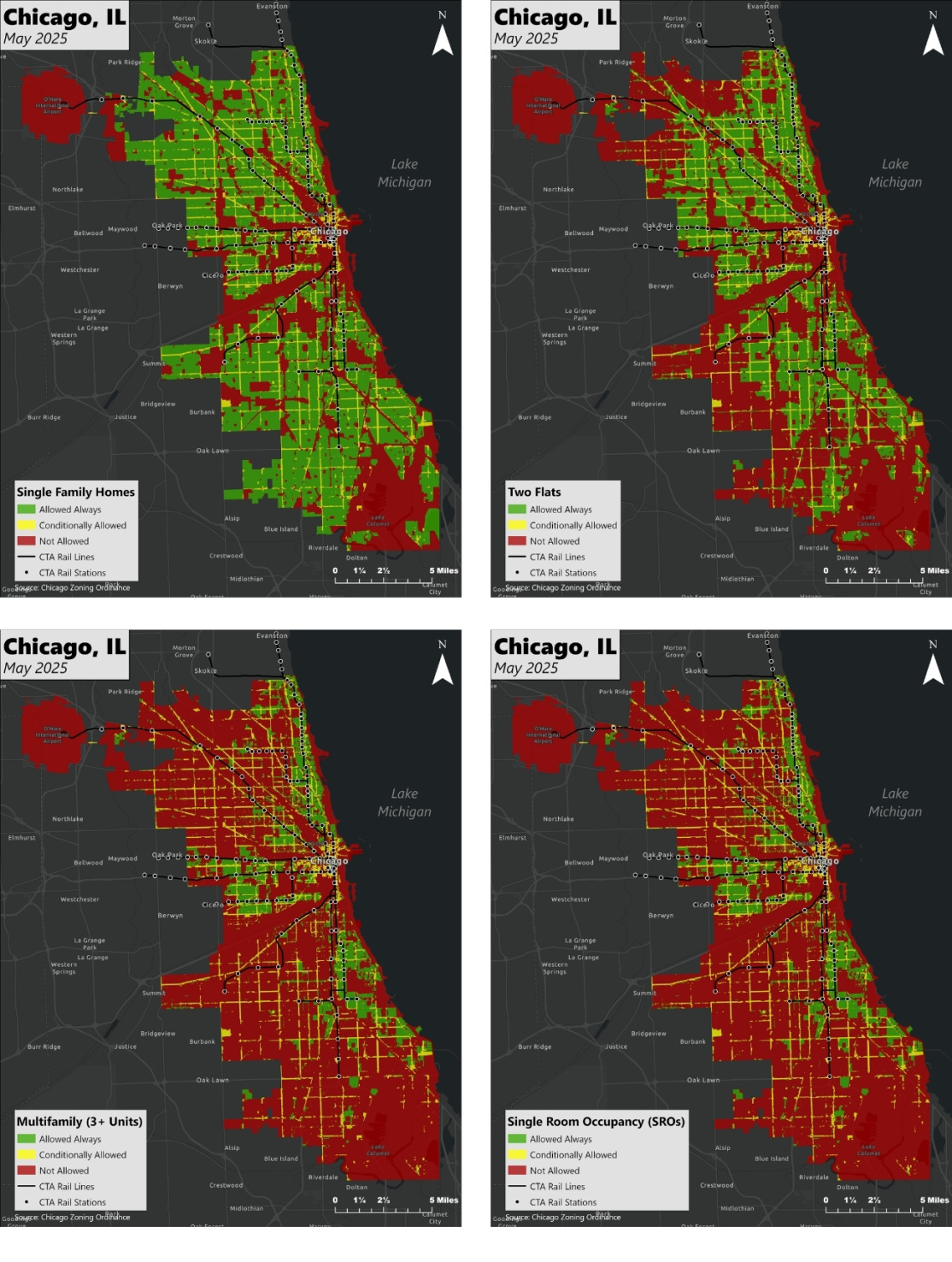
Single family homes can be constructed most anywhere in the city. Two-flats, one of Chicago’s main sources of Naturally Occurring Affordable Housing (NOAH) can be constructed in fewer places than single family homes, but still have decent coverage. Multifamily housing can only be constructed in pockets. Single Room Occupancy units (SROs), which maximize housing affordability by spreading the cost over as many units as possible, are allowed in even fewer locations. This organization of land uses dictated by zoning presents challenges:
-
If demand for an area exceeds the housing capacity allowed by the zoning code, there is little recourse to “thicken up” the area to accommodate more people.
-
This only shows where multifamily housing is allowed. Any proposed development still has to comply with parking requirements, density limitations and the threat of the alderman to actually get built.⁴
-
Since single family homes are allowed by-right in so much of the city, and multifamily housing is allowed in so little of the city and often triggers additional discretionary review, deconversions — or the replacement of multifamily units with single family units — are a common occurrence. This further reduces housing stock and worsens housing affordability.
In 2024, Chicago permitted 6% less new housing units per 100k residents than the year before, while peer cities permitted 5% more. According the annual point in time count, homeless increased over 200% in Chicago from 2023 to 2024. As an act of authority, it’s hard to argue that zoning is working in the best interest of Chicagoans.⁵
5️⃣ Housing Affordability vs Affordable Housing
Unfortunately—and even with the most well-intentioned elected officials—promises to bring down the cost of housing often end in a sleight of hand.
“Housing affordability” becomes “affordable housing.”
“Make housing more affordable” becomes “build more affordable housing.”
And while that sounds good, it’s a problem. Because “affordable housing” can mean many things, and what the government means when it says “affordable housing” is not what most voters mean when they demand that housing be more affordable. Voters want housing that’s abundant, high-quality, and affordable (as in inexpensive). But to an elected official or housing bureaucrat, “affordable housing” means housing that’s built under specific government programs, income-restricted, and — in one way or another — subsidized.
In other words, there’s a substantial disconnect between affordable housing and Affordable Housing.
If you want to understand that disconnect better, check out this article from Thesis Driven.
6️⃣ Helpful Links for Understanding Zoning
I hope this was helpful (and reasonably interesting). If you’re hooked, here are a few more resources to help you understand zoning
-
National Zoning Atlas — Organization working to digitize zoning ordinances across the United States.
-
Second City Zoning — Website that lets you visualize zoning in Chicago.
-
What is Euclidean Zoning? from Planetizen.
-
Arbitrary Lines by M Nolan Gray — My favorite book on the topic.
-
Management Cybernetics 101 for Urbanists and YIMBYS — An insightful analysis from a systems thinking Substack.
-
Key to the City by Sara. C Bronin — Another book about zoning (I’m reading it right now).
You also can look up your local town’s zoning ordinance online and try to read it. Remember, it’s not complex, it’s just boring.
7️⃣ “The Secret of Good Government? Trying” from "The Economist"
I’ve been in the planning space for nearly a decade. The challenge has not been staying informed or interacting with the public, it’s been interpersonal politics. A lot of the challenges that cities face are not very difficult, they just require political will. We know that we have a housing shortage that’s undermining housing affordability (and fuelling increasing rates of homelessness), and that zoning (at minimum) is not helping to resolve that issue. Political power brokers⁶ claim to acknowledge this issue, but when presented proven solutions (like allowing ADUs by right, eliminating parking minimums or eliminating single family zoning⁷) they cave under the screeching force of NIMBYism.⁸
Instead of addressing the root of these problemsm, political power brokers find the “solution” that polls the best or masks the most pronounced symptoms, leaving the underlying problem to fester. Let’s call this political sepsis. Until we can address political sepsis, I’m not sure we’ll be able to see housing affordability... or good governance at all.
From "The Economist":
Saying something is hard is easy, and usually taken as the end of the conversation rather than its beginning. Yet few things in government are truly complex; many more are merely either unpopular or expensive. Too often technocratic solutions are sought for the inherently political problem of convincing voters something is a good idea or worth paying for. “No amount of analysis can replace the need for political courage.”
--
1. Eliminating single family zoning does not prohibit single family homes from being constructed. It allows allows single family homes AND other housing typologies to be built.
2. Could this have been an ad hoc decision, instead of a global choice?
3. There’s a phrase, “Housing Delayed is Housing Denied.” This describes the financial cost of uncertainty in a development process. Check out this article if you want to know how
4. In Chicago, a range of criteria can send a project into the planned development process, which is basically the boss stage of discretionary review
5. That kinda includes the Pope now
6. At least those that aren’t outright grifters
7. Again, this does not prohibit single family homes from being constructed. It allows allows single family homes AND other housing typologies to be built.
8. NIMBY homeowners have a strong incentive to keep things exactly how they are. The longer housing is scarce, the more valuable their house becomes. NIMBY renters, I’ll be honest, I don’t entirely understand.


Planetizen Federal Action Tracker
A weekly monitor of how Trump’s orders and actions are impacting planners and planning in America.

Amtrak, CN end decades-long dispute with eight-year agreement
The new operating agreement establishes an updated framework for the companies to work together, including processes to resolve disputes.

Northwest rail fans eager for Sept. 30 debut of Amtrak’s Airo fleet
Get ready for that new train smell and more seats. But they won’t go faster or run more frequently on the Cascades route in Washington and Oregon.

LAX SkyLink opening delayed again, contractor won’t commit to new deadline
The project was supposed to open its doors to the public in 2023.

Caltrain may slash over one-third of its stations
If Bay Area voters reject two transit tax measures, Caltrain, BART and AC Transit will see steep service cuts.

A 'dangerous' precedent: North Carolina successfully pressures communities into voting for toll roads
Two mayors resigned from the Charlotte Regional Transportation Planning Organization after it voted in favor of the toll roads.

FREE Course: Walkable City 1: Why Walkability?
After describing his path towards focusing on walkability as the essence of good planning, Jeff Speck marches through his five principal reasons for making more walkable places.
Reinventing Malls: Planning Alchemy—Turning Gray Fields Into Gold
The course focuses on the opportunities and imperatives that shape reinvention of mall sites.

City of Thousand Oaks
City of Wisconsin Rapids
Harvard University Graduate School of Design
The Architects Foundation
University of Cincinnati Online
The Pocatello Development Authority
The Urban Renewal Agency of the City of Pocatello


