Nearly three-quarters of Amtrak's trains operate on tracks owned by private companies. What does this mean for U.S. passenger rail?


Unlike people in many other countries, travelers in the United States rarely rely on heavy rail as a common transportation option. When Americans travel from city to city, they usually turn to air travel or driving. But what makes the U.S. passenger rail system so unreliable? As federal legislators debate transportation appropriations, which could significantly impact the future of U.S. passenger rail, it's important for Americans to understand how their rail system got where it is today.
The U.S. freight rail system, one of the largest in the world, covers almost 140,000 route miles and is operated by seven Class I railroads, 22 regional and 584 local/short line railroads. Tracks and railroad infrastructure are owned by the private operators who are responsible for maintenance and improvements. American railroads served as an engine of the nation's industrial development, dramatically increasing the ease and speed of transporting everything from ore to grain to cattle. While new technologies and government subsidies helped the rise of new transport modes like airplanes, rail remains a key player in U.S. goods movement.
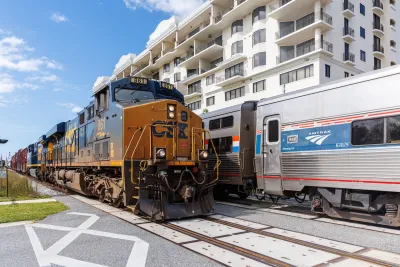
Until 1970, passenger rail was run by the same private companies that operate freight rail. As passenger rail began losing significant amounts of money, the federal government created Amtrak to operate passenger rail services. The agency relies on federal funding for its capital costs and fare revenue for operations. Amtrak's operations consist of the Northeast Corridor, long-distance routes, and state-supported routes. It owns just 623 route miles. While Amtrak has a legal right to preference on shared tracks based on a 1973 statute, limited track capacity and the larger profit margin of freight mean that freight trains often get priority. Because freight companies pay for the vast majority of rail maintenance projects, they also have the right to remove infrastructure at will, regardless of Amtrak's needs.
Today, over 70% of Amtrak travel is on freight rails, and Amtrak blames freight operators for causing delays for passenger trains. In 2024, the Department of Justice sued Norfolk Southern over Amtrak's access to tracks on the Crescent passenger rail route. According to Amtrak, in 2023, just 57% of Crescent trips arrived on time, below the 80% required by federal standards. The two entities reached a settlement in September 2025, giving Amtrak the right of preference. In the year that the lawsuit was ongoing, Amtrak noted that delays related to Norfolk Southern on the Crescent route went down by 34%. Freight train interference over all NS-hosted routes dropped by 42%, while ridership on those routes rose by 2%.
Amtrak is planning a massive expansion of new and existing intercity lines, which will put added pressure on existing infrastructure. Its success will rest in part on the ability of Amtrak to assert its rights over tracks and deliver reliable service. Passenger rail also faces a threat from a new insurance requirement that could cripple operations. On the bright side, Amtrak also broke ridership records in 2025, and its newly restored Mardi Gras line exceeded ridership projections in its first months of operation.
As gas prices rise, more Americans are seeking alternatives to car and air travel. If government funding, regulations and infrastructure align, passenger rail offers a way out.

Opinion: Prioritize Amtrak, but Don’t Demonize Freight
A proposed bill would tighten enforcement of a 1973 law that gives passenger trains priority over freight shipments.
Why are America's trains so slow?
A brief historical inquiry.
Amtrak Trains Get Priority Over Freight in Legal Settlement
Freight operator Norfolk Southern has agreed to prioritize Amtrak trains and work with the agency to identify the cause of delays on the Crescent line.

Planetizen Federal Action Tracker
A weekly monitor of how Trump’s orders and actions are impacting planners and planning in America.

The state-sanctioned urbicide of Austin
People don’t kill cities. Freeways do.

US to reduce Colorado River water deliveries to Mexico
A new Colorado Treaty amendment reduces Mexico’s Colorado River water allocation by 250,000 acre feet.

5 New England states march closer to 800 megawatt wind energy project
Securing federal approval for the project may be complicated under the Trump administration, which has historically been hostile towards domestic wind power.

Baltimore to break ground on $50 million Transit Priority Project
The project will bring faster bus trips, safer streets and better bike connections to Baltimore.

Airbnb launches $250 million 'last-dollar financing' housing accelerator, makes first investment in Austin
The company will put $6.4 million towards affordable housing development in Texas’ capital.

FREE Course: Walkable City 1: Why Walkability?
After describing his path towards focusing on walkability as the essence of good planning, Jeff Speck marches through his five principal reasons for making more walkable places.
Reinventing Malls: Planning Alchemy—Turning Gray Fields Into Gold
The course focuses on the opportunities and imperatives that shape reinvention of mall sites.

Eagle County Government
Harvard University Graduate School of Design
Nashville Planning Department
The Architects Foundation
University of Cincinnati Online
The Pocatello Development Authority
The Urban Renewal Agency of the City of Pocatello
Journal of the American Planning Association

