A new analysis reveals a more significant growth in housing supply after zoning changes than an Urban Institute study shows.


A recent Urban Institute study fails to accurately assess the impact of recent zoning reforms, argues Tobias Peter in a piece for American Enterprise Institute.
Although the Urban Institute's study claims that zoning reform has only increased housing supply by cumulatively 0.8% over a three- to eight-year period, an analysis by AEI shows that "Meaningful zoning reforms can increase housing supply by 1 to 2.5 percent per year."
According to Peter, of the 180 zoning changes underlying the UI dataset, 178 do not qualify as major reforms. "They are misclassified, too minor to plausibly affect housing supply, or do not contain enough information to evaluate the policy change."
Peter adds,
If the underlying classifications are incorrect, the estimated effect cannot be interpreted as the impact of zoning reform. When the dataset mixes fundamentally different policy changes and the methodology cannot properly distinguish between them, the estimated average effect will inevitably be biased and misleading.
For Peter, the issue is about measurement. While prioritizing scale, UI's study sacrifices accuracy, giving zoning reform opponents a weapon against change by minimizing the impacts of reforms.
Read the full story: The Urban Institute’s Zoning Study Doesn’t Hold Up Under Scrutiny


San Diego wants to limit upzoning law to just 16% of transit-adjacent parcels
The city's planning director says some areas are unfit for immediate upzoning due to a lack of resources or hazards such as wildfire risk.
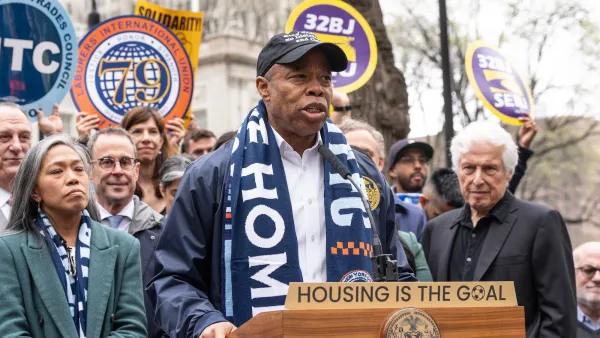
What Actually Got Built Under Eric Adams’ ‘Pro-Housing’ Administration
The outgoing mayor claims credit for hundreds of thousands of new homes. The truth is more complicated.

Over 90% of Massachusetts Towns Have Changed Zoning to Comply With MBTA Communities Law
Massachusetts municipalities have until December 31 to adjust their zoning codes or face the potential loss of state funding.

Planetizen Federal Action Tracker
A weekly monitor of how Trump’s orders and actions are impacting planners and planning in America.

The state-sanctioned urbicide of Austin
People don’t kill cities. Freeways do.

Colorado’s Largest Data Center Could Rise Next to Homes — Without a Public Hearing
The proposed campus would consume 11 times the power of Denver International Airport; as it has across the country, opposition mounts.

Judges permit Denver to divert 77,000 acre feet from the Colorado River for reservoir expansion
Overuse and climate change have caused the Colorado River’s water levels to plummet.

Amtrak, CN end decades-long dispute with eight-year agreement
The new operating agreement establishes an updated framework for the companies to work together, including processes to resolve disputes.

Raised interest rates may kill financially vulnerable construction projects
The chief economist at ConstructConnect warns that if construction project owners are negatively impacted by the raised rates, it could result in delayed payments to contractors.

FREE Course: Walkable City 1: Why Walkability?
After describing his path towards focusing on walkability as the essence of good planning, Jeff Speck marches through his five principal reasons for making more walkable places.
Reinventing Malls: Planning Alchemy—Turning Gray Fields Into Gold
The course focuses on the opportunities and imperatives that shape reinvention of mall sites.

KFH Group Inc.
Greater Baltimore Committee
Eagle County Government
The Architects Foundation
University of Cincinnati Online
The Pocatello Development Authority
The Urban Renewal Agency of the City of Pocatello