Science fiction has long painted a picture of the city of the future. What if it’s our roadmap out of dystopia?


Urban planners are always thinking about cities of the future. It’s one thing to obsess over what exists in the present — the day-to-day lives of anyone invested in making our cities better are mostly beholden to addressing these urgent issues today. But it’s also an irresistible impulse to imagine what could become reality tomorrow.
This is also the natural purview of science fiction, and authors have long used this genre to do precisely that: design the cities of the future. With the benefit of pure imagination, of course, it can be easy to ignore the nitty-gritty details while focusing more on utopian ideals of how these cities could be designed and run. At the same time, some writers revel in the details, all in the name of world-building. It is this alignment which confers some of the greatest sci-fi works with incredible, even inspiring ideas for what a city could be, or what could go wrong if we don’t properly address what we already know to be at stake. These cities of the future, whether completely fabricated or an imagined version of a familiar metropolis, are vessels for warnings or for moonshots, and the best of each are able to leverage the strengths of sci-fi to make compelling cases for these futures, one way or another.
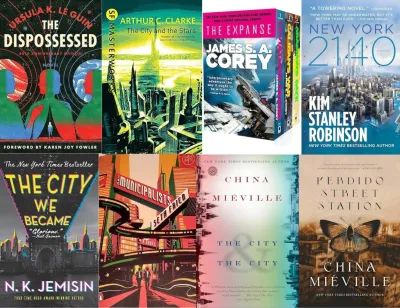
The following examples are some of the most accomplished books to have looked ahead at the cities of the future.
The Dispossessed by Ursula K. Le Guin
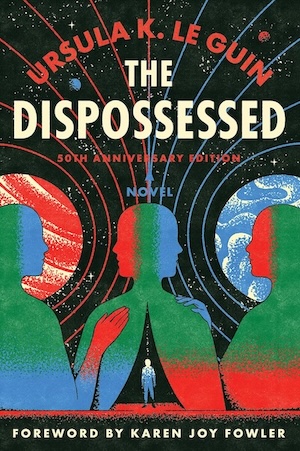
Le Guin’s anarchist utopia is one of sci-fi’s greatest creations, in part because the structures of the planet Urras and its moon Anarres are precisely designed to be ambiguous in their respective efficacy. There are states on Urras organized by capital and patriarchy, by authoritarianism, while on Anarres, there is an idealistic anarchism which the protagonist, perhaps unlikely for a plot like this one, wishes to leave. The most populated city on the moon, Abennay, is described as being “a bare city,” laid out “as plain as spilt salt.” This city, then, can reflect the revolutionary spirit of the moon’s utopian society.
Anarres is organized via a social and economic system which forgoes ownership, a principle which already helps to fundamentally re-shape what a city ought to be when property is not thought of in capitalist terms. Abennay is full of low-rise, single-storey homes, not the sheer looming skyscrapers of most sci-fi (which Urras is home to). This has the obvious symbolic value of putting each and every inhabitant literally on the same level, the removal of penthouse power. These buildings, moreover, are constructed according to utility and practicality, simple architectural designs of what can be locally sourced from the arid landscape. The buildings, like the society they are attempting to build and maintain, are in need of regular collective care, beyond the scope of money but determined instead by a practice of mutual aid. A city run by alternative means, where there is always a home available to you, however basic and unadorned, a truly egalitarian approach to design and planning for an urban life among people.
Even so, Le Guin emphasizes the ambiguity of this utopia, as it leaves very little room for art or aesthetics that go beyond functionality (“Painting and sculpture served largely as elements of architecture and town planning,” Le Guin writes), and as the protagonist puts it, there may be something to miss about the world of excess on Urras: “We have no states, no nations, no presidents, no premiers, no chiefs, no generals, no bosses, no bankers, no landlords, no wages, no charity, no police, no soldiers, no wars. Nor do we have much else.” Le Guin makes sure to make this a conflicted utopia, not a prescriptive blueprint of the perfect city of tomorrow. For city planners, it’s a reminder not only that your wildest dreams must always be counter-balanced by a measure of feasibility, but that what may first appear ideal for all may not be so universally felt and desired.
The City and the Stars by Arthur C. Clarke

Taking place more than a billion years in the future, Clarke’s classic presents Earth’s last remaining city for humans, Diaspar, as a tightly enclosed space where no one leaves and no one arrives. This is a city wholly operated by what’s called the Central Computer, as Clarke envisioned a future humanity that has fully automated how life is governed through machines, as indeed most “people” are nothing more than data in the computer’s memory. The main character, Alvin, a so-called “Unique” (one without any past life in the computer), wants to re-access forgotten terminal transport infrastructure that is said to have connected Diaspar to other cities long ago.
Diaspar is an evocative example of the familiar trope of the fully-technologized future existence for humanity, whereby we are all controlled by machines and even, in this case, born through them. The domed city itself is practically barren, as people mostly entertain themselves in virtual reality, so they mostly keep to themselves and seek no adventure. It is a city in stasis: “Diaspar alone had challenged Eternity, defending itself and all it sheltered against the slow attrition of the ages, the ravages of decay, and the corruption of rust.” Clarke’s prose is almost praising this city, even as the reader is almost undoubtedly bristling at its dystopic qualities. The people, the city, the computer, “designed as part of one master plan.” While Alvin does make his way to another city, full of nature and life, it is the concept of a city run by a Central Computer that tends to linger. Perhaps we ought to reflect, in this moment of automation, AI, and algorithmic governance, to what extent we want to plan our cities according to these techno-logics, and where we can hold onto humanist design principles that transcend mechanical solutionism.
The Expanse by James S.A. Corey

This series is full of various “cities,” or stations, which are located on asteroids or moons throughout the Solar System, which humanity has colonized. Those who live there are called Belters. Each station tends to be cramped and precarious, with a highly-industrialized form, hydroponic agriculture, and flimsy prefabbed constructions. Some, like Tycho, are home to massive factories and docks, an oasis of sorts for engineers and far more orderly than other stations. Lovell City, on the other hand, is the largest settlement on Earth’s moon, and is largely modelled on our planet’s cities, except with a more advanced mass transit tube system. The Belters, though, by and large exist as mining colonies that double as basic city-like infrastructure for those that live there. These are layered and latticed spaces, people on top of people, a labor force thrown together in a maze of spaceports and drilling facilities, uncomfortable and under the thumb of the future’s corporate spacefaring economy. Put simply, it is a vision of hypercapitalist colonization that asks the planning-oriented reader what the point of such “exploration” would be if settlements cannot be something greater than a gloomy throwback (at best) to factory towns.
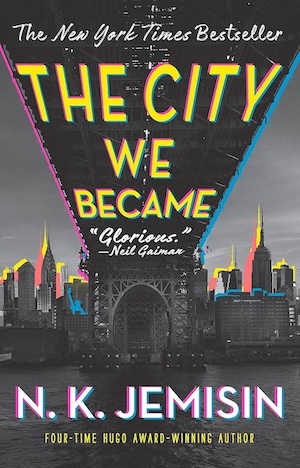
New York 2140 by Kim Stanley Robinson & The City We Became by N.K. Jemisin

These books are a bit different from these other examples, in that they are not about imagining a completely new future city, but instead are interested in extrapolating forward for Earth’s biggest city under the ravages of climate change and other threats. Unlike Neal Stephenson’s future Los Angeles in Snow Crash, a satire with sovereign neighborhoods called “burbclaves” owned by corporations with their own laws and architecture (alongside the metaverse, a virtual city of possibility all its own), Robinson’s New York is a partly-drowned city that has re-wilded itself, nature’s return. Yet, while some buildings are repurposed into cooperatives and resources get shared among communities, the city is still run by Wall Street in many ways, making money off of disaster and, of course, residing at the top of the remaining high-rises. It’s a way of imagining a future where our cities are battered by climate change, but where they are also defined by their ability to adapt. New York becomes snaked by canals, populated by boats and new skybridges, and improvisation when it comes to everything from agriculture (like rooftop gardens) to governance. There is an entire subgenre of speculative climate fiction which typically, and understandably, imagines the destruction to come to these urban centers if we fail to act appropriately, while in this case, Robinson takes a more nuanced approach, making an argument for the city’s resilience which mirrors the resilience of our species. City planners, then, can understand the significance of incorporating adaptability into their designs as a core principle.
Like Robinson’s book, Jemisin’s imagines a future New York, which here has become sentient and is represented by human avatars. In the book, we meet the avatars for each of the city’s five boroughs, and this group is tasked with saving the city itself from a force that threatens to destroy it. Here, Jemisin has literalized the idea that every city has a soul, and has anthropomorphized each borough into a figure who must work together as a team to make sure New York survives. The city really is the main character. Many of New York’s existing problems are addressed, including racist police and gentrification, and are formed into symbols of the common enemy the avatars are facing. It is like an urban fairy tale, and unlike the contested world of Jemisin’s popular Broken Earth trilogy with its unfamiliar planet and caste-organized city-states, this future New York is undoubtedly one where everyone agrees it’s worth saving.
The Municipalists by Seth Fried
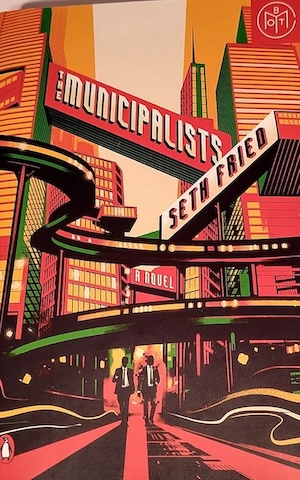
Fried’s book is a cheeky exploration of what the ultimate American city of the future would be like, combining elements of New York, Chicago, Los Angeles, and more to become the grandest version of American excess. Artificial intelligence and high-tech automated systems are integrated into the mundane details of organizing daily life, and everything is ornate and blown up as big as possible. The hero, Henry, is dedicated to improving the country’s infrastructure as an employee with the United States Municipal Survey, so it’s a rare example of having an urban planner as the protagonist of the book! The actual city, Metropolis, may be an idealized idea of the future city, but as a result, it’s a messy mishmash of ideas that clash, resulting in bureaucratic and political snafus (which any planner can almost certainly relate to), and Henry is concerned about maintaining the systems, grids, and policies that do work while trying to uncover the book’s mystery about a plot to destroy the city. Designing the “ultimate city,” then, is not so simple as combining the best aspects of each major area — planners must edit, and curate, and, as Henry attempts to do, stay focused on the details.
The City & the City and Perdido Street Station by China Miéville
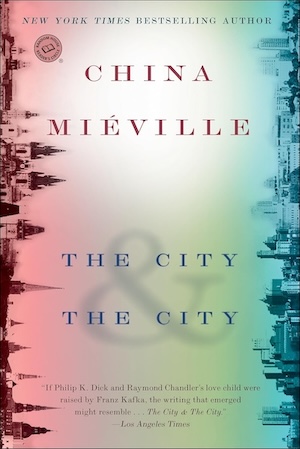
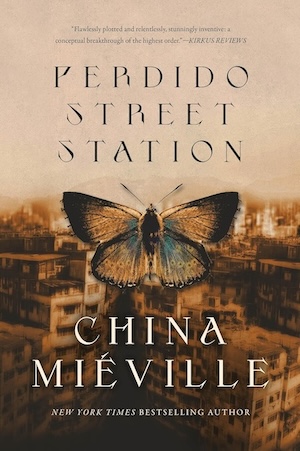
Miéville’s books are often very descriptive when it comes to their cities and settings, but these two stand out. In The City & the City, it is the contrast between two Eastern European cities that are side-by-side, Besźel and Ul Qoma, and how the citizens of each are forbidden to visit or even mention the other. Fascinatingly, the cities often overlap, like two dimensions existing at the same time in the same place, though generally going unseen. The cities, then, are very similar, with minor variations in architecture and design, and larger ones in policy and culture. Much is going on here, but one strand is certainly the idea that urban life can be structured so that it becomes easy to ignore what is happening all around you, potentially nudging planners to consider ways of bringing people together in their communities, even through the shape of the physical space itself, to make it harder to ignore your neighbors. Perdido Street Station, on the other hand, takes place in New Crobuzon, a city “unconvinced by gravity,” situated where three rivers meet, an oligarchic nightmare of power, an industrialized steampunk space built according to a logic of squalor and repression. As the book’s protagonist, Isaac, says: “I turn away from him and step into the vastness of New Crobuzon, this towering edifice of architecture and history, this complexitude of money and slum, this profane steam-powered god.” This is a city, richly described, holding a future we ought not yearn for.
If nothing else, these books tell us that imagining the cities of the future should help us learn — learn what has succeeded and what has failed in our imaginations and, especially, what needs in the cities of today are not yet being addressed, so we can avoid the dystopian futures that have been drawn for us.

10 great urban planning summer reads
Wherever you're going (or staying) this summer, here are some suggestions for books to bring along.
Review: "An Even Better Way to Zone"
Don Elliot’s sophisticated and much-anticipated follow up to "A Better Way to Zone" tackles equity, affordability and provides a better blueprint from theory to application.
March Must-Reads: Top 10 Articles From Last Month
Seattle may roll back a development fee as housing permits plummet, an ambitious Google-led project in the heart of San Jose goes sideways, and a list of sci-fi books to feed your futurist dreams.

The state-sanctioned urbicide of Austin
People don’t kill cities. Freeways do.

US to reduce Colorado River water deliveries to Mexico
A new Colorado Treaty amendment reduces Mexico’s Colorado River water allocation by 250,000 acre feet.

New Jersey’s second-largest city bans standalone data centers
Jersey City will continue to allow co-location facilities, such as those meant for research institutions that store their own data.

Amtrak not solely to blame for New Jersey commuter rail's unreliability, report finds
A new study from the Garden State Initiative found that NJ Transit’s budget grew 20% across a 4 year period, but reliability declined significantly over the same period.

EPA erases limits on planet-warming pollution from power plants
Under Monday’s plan, power plants would still have some limits on how much mercury, arsenic and other contaminants they can emit.

Phoenix announces new on-demand transit service, more frequent RAPID buses
Both new services will launch in October, and are part of Phoenix's Project Effective Access Solutions for Easing Congestion.

FREE Course: Walkable City 1: Why Walkability?
After describing his path towards focusing on walkability as the essence of good planning, Jeff Speck marches through his five principal reasons for making more walkable places.
Reinventing Malls: Planning Alchemy—Turning Gray Fields Into Gold
The course focuses on the opportunities and imperatives that shape reinvention of mall sites.

Eagle County Government
Harvard University Graduate School of Design
Nashville Planning Department
The Architects Foundation
University of Cincinnati Online
The Pocatello Development Authority
The Urban Renewal Agency of the City of Pocatello
Journal of the American Planning Association

