Los Angeles County sent city officials a report outlining strategies for clearing homeless encampments, but advocates point out that the report itself notes there are not enough shelte resources to accommodate all unhoused residents.


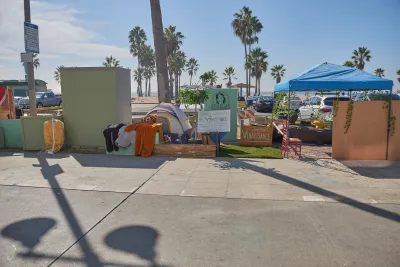
Los Angeles County officials issued a report to local governments outlining how they can clear people from encampments near Olympic sports venues, reports Libby Rainey for LAist. While the report refers to placing people in temporary housing, it also “notes that there are concerns there won’t be enough beds and there’s no new funding for such an effort.”
Like other cities in advance of international sporting events, Los Angeles is hoping to reduce visible signs of homelessness. LA28, the organization planning the Olympics, says it is establishing ‘security perimeters’ “to identify and coordinate with host jurisdictions to prioritize encampments that may be affected.” According to Shayla Myers of the Legal Aid Foundation of Los Angeles, “It is about taking resources to clear encampments in the most visible locations when you have cameras and tourists all putting their focus on Los Angeles.”
But “The county’s guidance points out that additional resources for plans to clear encampments at this point don’t exist. And Kassenbrock, the [county] spokesperson, said in a follow up email that the region faces ‘a significant deficit for homelessness and housing programs next fiscal year due to losses in federal, state, and other one-time funding, and cost increases.’” City of Long Beach officials told the county that it would likely be difficult to find motel rooms to use as interim housing during an event like the Olympics.
FULL STORY: LA County considers plans to remove unhoused people and clear encampments around Olympic venues


LA has no plan — or funding — to help unhoused people displaced by Olympics security efforts
City and county officials say they don't have the funds to offer housing to the up to 1,600 people that will be displaced by perimeters around event venues.

LA Housing Authority Buys 30-Unit Apartment Building for Supportive Housing
The Koreatown building will offer housing as well as healthcare services and case management.
HUD Approves L.A. Housing Voucher Changes
The city requested changes to federal housing voucher approvals to streamline the approval process for people experiencing homelessness.

Planetizen Federal Action Tracker
A weekly monitor of how Trump’s orders and actions are impacting planners and planning in America.

The state-sanctioned urbicide of Austin
People don’t kill cities. Freeways do.

US to reduce Colorado River water deliveries to Mexico
A new Colorado Treaty amendment reduces Mexico’s Colorado River water allocation by 250,000 acre feet.

Mamdani overhauls NYC's Vision Zero plan with 100 new policy goals
The overhaul aims to reduce traffic deaths and make streets safer for pedestrians, cyclists and drivers through lower speed limits, new safety infrastructure and more.

Amtrak not solely to blame for New Jersey commuter rail's unreliability, report finds
A new study from the Garden State Initiative found that NJ Transit’s budget grew 20% across a 4 year period, but reliability declined significantly over the same period.

EPA erases limits on planet-warming pollution from power plants
Under Monday’s plan, power plants would still have some limits on how much mercury, arsenic and other contaminants they can emit.

FREE Course: Walkable City 1: Why Walkability?
After describing his path towards focusing on walkability as the essence of good planning, Jeff Speck marches through his five principal reasons for making more walkable places.
Reinventing Malls: Planning Alchemy—Turning Gray Fields Into Gold
The course focuses on the opportunities and imperatives that shape reinvention of mall sites.

Eagle County Government
Harvard University Graduate School of Design
Nashville Planning Department
The Architects Foundation
University of Cincinnati Online
The Pocatello Development Authority
The Urban Renewal Agency of the City of Pocatello
Journal of the American Planning Association