To achieve the level of transit access that most global cities enjoy, the United States would need trillions more in funding… and a LOT of buses.


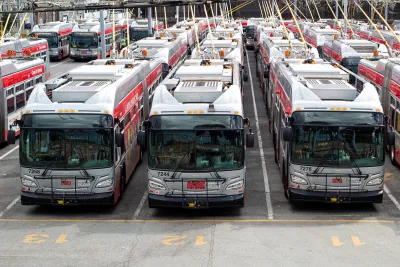
For all American cities with populations over 50,000 to achieve “world-class” transit systems, the United States would need to nearly triple its transit vehicle fleet and invest $4.6 trillion over a twenty-year period, a new Transportation for America (T4A) report claims. “That sounds costly, but the U.S. is projected to spend an additional $6.3 trillion on highways in that time, and since 1956, we have spent $9.6 trillion more on highways than transit,” the T4A writes.
The report defines “world-class” as “Transit that operates with extensive coverage and predictable, frequent service that grants people a high level of mobility, where they can reach nearly everything they need.” To set the benchmark, T4A evaluated global cities using International Association of Public Transport data, finding that the cities had, on average, 130 transit vehicles in service for every 100k residents – a level that would cost $229 billion annually for the United States to achieve. But, the report notes, that number obscures a larger savings: “$5.4 trillion just from the costs of car ownership that could be avoided.”
Read the full report at the link below.
Read the full story: What we need for World-Class American Transit

Milwaukee transit agency plans 25% service cuts
The MCTS system will have to make a difficult choice between service frequency and coverage.
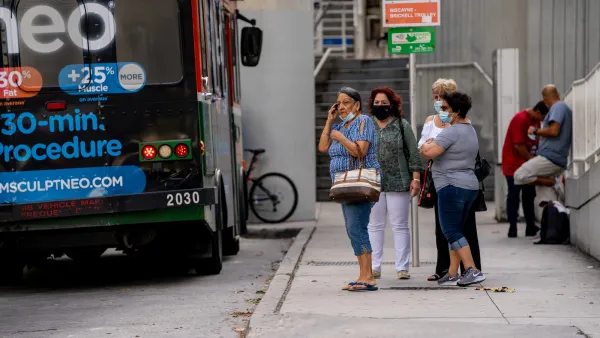
Miami promised a 'Better Bus Network.' Riders say it hasn't delivered.
Ridership on Miami-Dade Transit dropped by 2%-10% every month between October and December 2025.
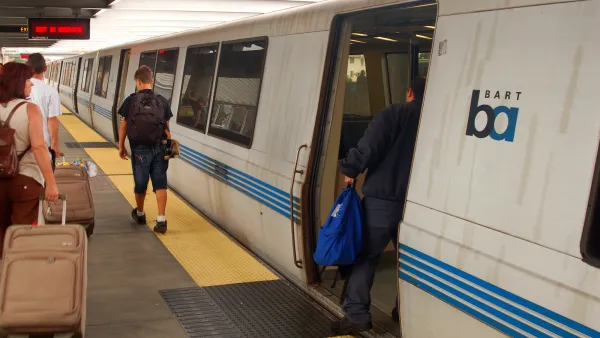
BART Service Cuts, Station Closures Could ‘Set Back the System 50 Years’
The agency could close dozens of stations and eliminate the Blue line between Daly City and Dublin-Pleasanton entirely.

Planetizen Federal Action Tracker
A weekly monitor of how Trump’s orders and actions are impacting planners and planning in America.

California plans to bury El Niño’s downpour
If the state plays its cards right, it may be able to store a billion acre-feet of El Niño’s water in aquifers.

Desperate measures: Advocates weigh draining Lake Powell to fill Colorado River
Draining the reservoir could reduce evaporation losses by a couple hundred thousand acre-feet.

US buildings threatened, destroyed by fires set to triple by 2060
Researchers found a high fire risk for socioeconomically vulnerable neighborhoods in the American West.

LA residents may be allowed to paint their own crosswalks
Councilwoman Katy Yaroslavsky put out a motion instructing the Los Angeles Department of Public Transportation to study the feasibility of allowing volunteers to paint crosswalks.

Dallas moves to overhaul its zoning code
The city's zoning reform will allow more multi-family and mixed-use developments.

FREE Course: Walkable City 1: Why Walkability?
After describing his path towards focusing on walkability as the essence of good planning, Jeff Speck marches through his five principal reasons for making more walkable places.
Reinventing Malls: Planning Alchemy—Turning Gray Fields Into Gold
The course focuses on the opportunities and imperatives that shape reinvention of mall sites.

City of Rosemead
Rutgers University, Edward J. Bloustein School of Planning and Public Policy
One Hundred Miles
Hunter College, City University of New York (CUNY)
The Architects Foundation
University of Cincinnati Online
City of Cambridge
Montrose County
The Pocatello Development Authority