Companies are pressing ahead to develop emerging technologies, like fusion reactors and small modular units.


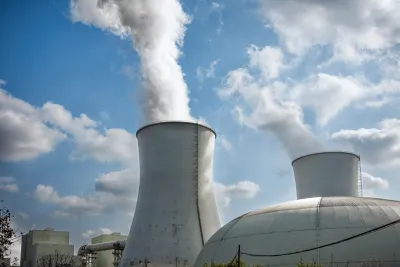
This article by John Stang was originally published in the Washington State Standard. It has been shortened. It is republished under Creative Commons license CC BY-NC-ND 4.0.
Washington spent much of the 1970s trying to become a center for nuclear power, with plans for five huge fission reactors at Richland and Satsop.
Fast forward to today.
Again, Washington is trying to become a hub for nuclear power. But instead of monster-size reactors, the state is now home to multiple ventures involving smaller reactors — all using technologies unheard of in the 1970s and 1980s.
One of the first commercially viable fusion reactors in the U.S. is under construction roughly 6 miles southeast of Wenatchee. It’s expected to be working by 2028, with power going to Microsoft.
Efforts are also underway to develop a different type of fusion reactor in Everett and Richland. These would be small portable units.
Two Republican Washington state legislators — with high-ranking Democratic cosponsors — have introduced similar 2026 nuclear fission power reactor bills in the Senate and House.
The bills, which do not mention fusion power, call for developing a nuclear power development master plan for Washington state by Dec. 15, 2026.
Read the full story: Nuclear power ventures heat up around Washington state
South Carolinians Still on the Hook for Failed Nuclear Plants
“It has to be one of the greatest wastes of money in any state’s history,” Alan Greenblatt writes.
Trump-backed startup wants 9,000 acres of public land for data center
If approved, developers will build 456 small nuclear reactors on federally-owned land in Utah.
What data center host communities can learn from former nuclear hubs
The sometimes painful process of decommissioning former nuclear facilities offers useful lessons for communities planning to host data centers.

Planetizen Federal Action Tracker
A weekly monitor of how Trump’s orders and actions are impacting planners and planning in America.

California plans to bury El Niño’s downpour
If the state plays its cards right, it may be able to store a billion acre-feet of El Niño’s water in aquifers.

Desperate measures: Advocates weigh draining Lake Powell to fill Colorado River
Draining the reservoir could reduce evaporation losses by a couple hundred thousand acre-feet.

NITA’s first budget outlines $5 billion operating plan
The plan also proposes a $9.73 billion capital program for 2027 through 2031.

In Texas, data centers are swallowing promised parkland
Residents who moved to Taylor, Texas for a rural community now have to contend with three data centers in their backyard.

How a Chicago-sized wind farm beat the odds and powered on
The project spanned five presidential administrations and a standoff with a U.S. military base.

FREE Course: Walkable City 1: Why Walkability?
After describing his path towards focusing on walkability as the essence of good planning, Jeff Speck marches through his five principal reasons for making more walkable places.
Reinventing Malls: Planning Alchemy—Turning Gray Fields Into Gold
The course focuses on the opportunities and imperatives that shape reinvention of mall sites.

City of Rosemead
Rutgers University, Edward J. Bloustein School of Planning and Public Policy
One Hundred Miles
Hunter College, City University of New York (CUNY)
The Architects Foundation
University of Cincinnati Online
City of Cambridge
Montrose County
The Pocatello Development Authority