A nonprofit-backed project is bringing efficient duplexes to Cleveland.


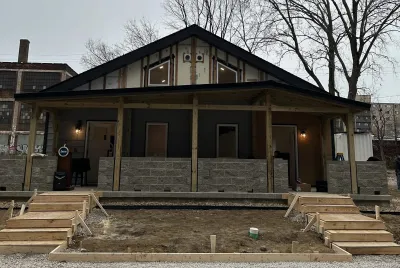
Cleveland is looking to improve housing affordability through highly efficient, solar-powered homes, reports Olivera Perkins in Signal Cleveland.
Because utilities comprise up to 30 percent of renters’ housing costs, Cleveland’s Lutheran Metropolitan Ministry (LMM) is building affordable housing that uses solar power and efficiency tools to bring down utilities costs. “The LMM solar efficiencies were built on parcels transferred from either the Cuyahoga Land Bank or the Cleveland Land Bank,” and LMM hopes it can build similar projects on other properties owned by the land bank. “Each LMM solar efficiency costs $170,000 to construct or a total of $680,000 for the two duplexes. The funding came from public and private sources.”
According to Cuyahoga County Executive Chris Chris Ronayne, “This is a model to not only construct solar housing, but affordable housing. These homes can be replicated many times over here in the city of Cleveland and in many of our suburban communities that lack affordable housing.”
Read the full story: Cleveland turns to the sun in push for more affordable housing

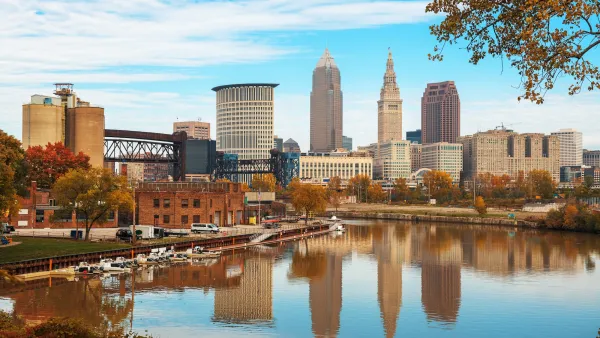
Cleveland program has housed 200 people since 2024
The A Home For Every Neighbor initiative successfully moves people into housing in under two weeks.

Cows at Tennessee's 'Silicon Ranch' graze under solar panels
The project aims to prove that agriculture and solar energy production can work in tandem.
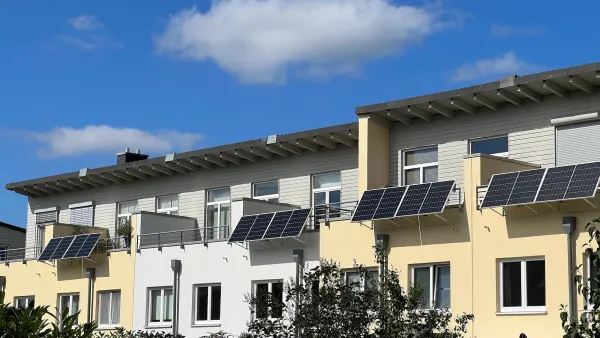
28 States and DC Could Legalize ‘Balcony Solar’
Plug-in solar panels, which are becoming popular across Europe, live in a regulatory gray area in the United States.

Planetizen Federal Action Tracker
A weekly monitor of how Trump’s orders and actions are impacting planners and planning in America.

California plans to bury El Niño’s downpour
If the state plays its cards right, it may be able to store a billion acre-feet of El Niño’s water in aquifers.

Chicago breaks ground on $3 billion megadevelopment
The new neighborhood, titled Foundry Park, will one day host 3,700 residences.

California High-Speed Rail Authority CEO resigns after $600,000 scandal
Under Ian Choudri, the authority used taxpayer dollars to fund first class flights and trips to nightclubs.

Want to study the Missouri River? Soon, you may need unanimous approval from 10 states
Legislation would require 10 governors’ permission to study or build projects moving water outside the basin.

Desperate measures: Advocates weigh draining Lake Powell to fill Colorado River
Draining the reservoir could reduce evaporation losses by a couple hundred thousand acre-feet.

FREE Course: Walkable City 1: Why Walkability?
After describing his path towards focusing on walkability as the essence of good planning, Jeff Speck marches through his five principal reasons for making more walkable places.
Reinventing Malls: Planning Alchemy—Turning Gray Fields Into Gold
The course focuses on the opportunities and imperatives that shape reinvention of mall sites.

City of Rosemead
Rutgers University, Edward J. Bloustein School of Planning and Public Policy
One Hundred Miles
Hunter College, City University of New York (CUNY)
The Architects Foundation
University of Cincinnati Online
City of Cambridge
Montrose County
The Pocatello Development Authority