Let’s see what the data says.



This article is part of an ongoing column on AI and planning by urban planner and AI expert, Tom Sanchez. Learn more about Tom and read more installments of his column.
The question might sound like clickbait, but the potential for AI to perform planners' work makes it impossible to ignore. Tools like ChatGPT and Gemini can already draft zoning memos, condense lengthy environmental documents into bite-sized summaries, and sketch development scenarios in less time than it takes you to finish a cup of coffee. If computers can crank through our routine work in minutes or hours instead of days or months, what does that mean for the future of our profession? More bluntly: how many urban planners will actually be needed and what will be their new set of tasks?
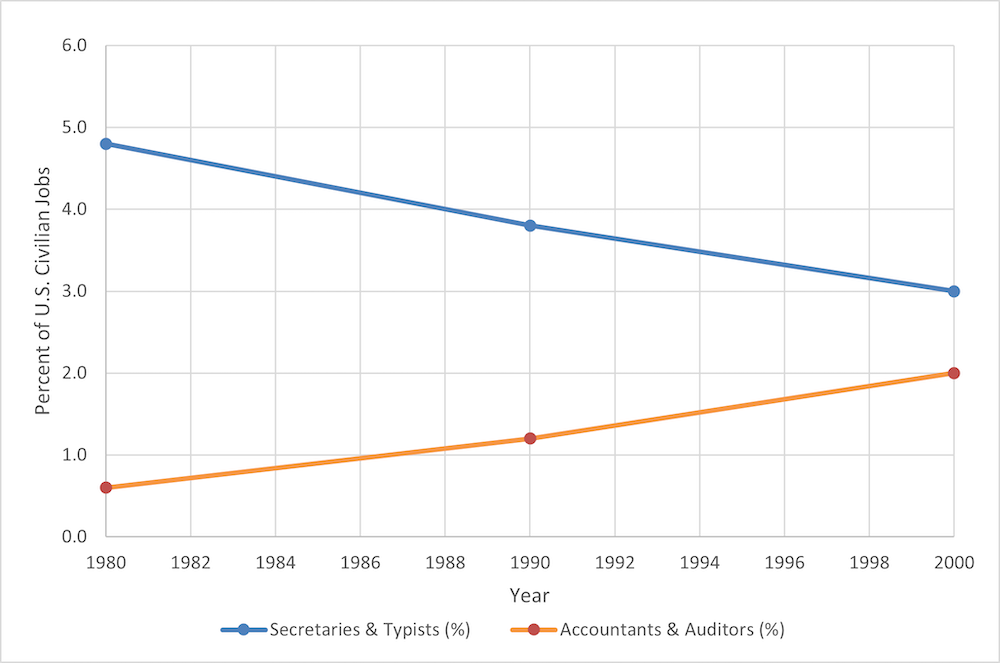
John Landis’s forthcoming paper, “Lead, Follow, or Get Out of the Way”, makes the point with a sharp comparison. In the 1980s, secretarial jobs declined as word processors automated typing and filing, dropping from 4.8% of the U.S. workforce in 1980 to just 3% by 2000 (see also BLS, 2006). Accountants, meanwhile, embraced computerization and spreadsheets, and their share of jobs actually tripled. The lesson? Technology doesn’t just “arrive,” it reshuffles who thrives and who disappears. As planners face the same crossroads, will they go the way of secretaries, clinging to old routines, or will they adapt like accountants, using technology to enhance their skills?
Figure 1. Historical Comparison Chart – Secretaries vs. Accountants, 1980–2000
The broader job market also points to what’s at stake. When AI enhances expertise, employment actually grows. The Bureau of Labor Statistics (BLS) projects that software developer positions will increase by nearly 18% from 2023 to 2033, database administrator positions will increase by 8% and database architects by 11%. Even in engineering, where AI is already redesigning workflows, demand is ticking upward with the number of electrical engineers expecting to grow by 9%, hardware engineers by 7%, and aerospace engineers by 6% (BLS, 2025). In contrast, roles built mostly on routine tasks are expected to decline dramatically. Recent research predicts that office and administrative support jobs could lose up to a million positions by 2029 as AI and automation continue to advance (Pennathur et al., 2024).
The AI job story isn’t all doom and gloom. Goldman Sachs has estimated that up to 300 million jobs worldwide could be exposed to automation, with roughly two-thirds of U.S. occupations facing at least some degree of impact (Goldman Sachs, 2023). In the U.S., more than 10,000 job cuts in 2025 were directly attributed to generative AI, according to Challenger, Gray & Christmas (CBS News, 2025). But the broader reality is more nuanced. A September 2025 survey by the Federal Reserve Bank of New York found that AI-driven layoffs remain relatively rare so far, with most firms using the technology to retrain workers rather than fire them. Even so, the Fed cautioned that as AI adoption deepens, layoffs and slower hiring are expected to rise (Reuters, 2025).
Figure 2. Projected Job Growth Bar Chart (2023–2033)

So, where does all this leave urban planners? As of May 2023, there were about 42,700 urban and regional planners employed in the U.S., with a median wage of around $81,800. Nearly three-quarters (about 72–73%) worked in local government (excluding schools and hospitals). The broader employment forecast projects growth of roughly 3% for planners from 2024 to 2034, about as fast as the average occupation. The longer-term BLS projections (2023-2033) for all professions are closer to 4%. Still, specific planner forecasts do not appear to fully capture the potential disruptions from AI, which many stakeholders expect may reshape certain aspects of the job.
This is where the profession’s “dual reality” comes into play. The bread-and-butter work of junior staff, development reviews, database upkeep, research memos, and baseline community profiles, is exactly what generative AI is learning to do, faster and cheaper. Tools can already parse zoning codes, summarize census data, and churn out boilerplate reports with minimal human help. Yet the true heart of planning, including balancing competing priorities, mediating disputes, and setting goals in messy, uncertain contexts, remains a human task. The danger is what happens in between. If AI greatly reduces the entry-level pipeline, wiping out the training ground for new planners, who will step into senior roles a decade from now?
Looking at aligned professions gives us some hints. In architecture, AI is already helping generate floor plans, run energy simulations, and create 3D renderings. Yet the field is still projected to grow about 4% by 2034 (BLS, 2025). The shift isn’t about whether architects are needed, it’s about what they’re needed for. Firms are hiring fewer junior draftspeople and more project managers who can interpret and refine AI output. Civil engineering shows a similar story, with AI assisting in traffic simulations and climate modeling. Employment in the field is expected to continue growing, though modestly, as engineers move into more integrative, oversight-heavy roles. Public administration, however, offers a darker warning: as mentioned above, office and administrative support jobs are projected to lose approximately one million positions by 2029 as AI and automation spread. The survivors? Analysts and managers who can apply AI to shape policy and guide decisions.
Peng and colleagues (2024) outline a typology that describes how AI could progressively shape the practice of urban planning through four phases of adoption. In the first phase, AI-assisted planning, AI functions as a support tool for routine tasks such as collecting data, producing visualizations, or mining text. At the same time, planners remain firmly in control of all substantive decisions. In the second phase, AI-augmented planning, AI expands planners’ capabilities by simulating scenarios, forecasting impacts, and evaluating multiple plan options, placing planners “on the loop” as they use AI’s outputs to refine and improve decisions. The third phase, AI-automated planning, envisions a stronger role for AI in semi-automating plan-making by generating and assessing scenarios based on goals set by planners, who in turn step back into a supervisory role. The final phase, AI-autonomized planning, remains largely speculative but anticipates AI agents with self-learning and decision-making capabilities that could autonomously set goals and produce plans, with planners shifting into oversight and evaluative functions. Importantly, Peng and colleagues argue that this pathway is not fixed or inevitable. Rather than replacing planners outright, the more likely outcome is a significant reorganization of workflows and professional roles within planning offices.
Figure 3. AI Adoption Progression

To be clear, the choice is not whether planners will use AI. They already are. The real choice is whether they’ll shape AI’s trajectory or be shaped by it. This means that planning schools will need to step up, teaching graduates to act as strategists who can apply AI outputs to complex political decision-making, and not just be clerks stuck cranking out zoning memos by hand. Professional associations (e.g., APA) should increase AI training opportunities, certification programs, and resource libraries so that smaller jurisdictions aren’t left out of the revolution. And planners themselves? We need to stop seeing AI as a threat hovering at the door and start treating it as an extension of their problem-solving toolkit.
AI won’t make planners obsolete, far from it. The bigger danger is that whole departments that refuse to engage will become irrelevant, ceding their influence to faster, cheaper, AI-driven alternatives. As both Landis and Peng et al. argue, the real question isn’t if AI will change planning. That’s already happening. The question is whether planners will lead, follow, or step aside while others, like consultants, tech firms, or even entirely new professions, take the steering wheel.
At its core, urban planning has always been about imagining better futures. Yet unless we act, that future will be imagined for us by algorithms and private platforms. The profession can either embrace a future where humans and machines work together or risk becoming spectators in someone else’s vision. As AI takes over routine tasks, planners must still vet outputs for bias and error, a role that offers valuable training for entry-level staff. Freed from drudge work, planners can devote more time to engaging with stakeholders and communities. Perhaps this could also lead to extending services to smaller towns that otherwise lack access to professional planning.
Additional references
Landis, J. (2025). Lead, follow, or get out of the way: Generative AI and the future of American city planning.
Peng, Z. R., Lu, K. F., Liu, Y., & Zhai, W. (2024). The pathway of urban planning AI: From planning support to plan-making. Journal of Planning Education and Research, 44(4), 2263-2279.
Pennathur, P. R., Boksa, V., Pennathur, A., Kusiak, A., & Livingston, B. A. (2024). The future of office and administrative support occupations in the era of artificial intelligence: A state-of-the-art review and future research directions. International Journal of Industrial Ergonomics, 104, 103665.
Thanks to John Landis and Tom Wallsten for their insightful comments and suggestions.


5 ways to hallucination-proof your AI output
With public trust on the line, the stakes are high for urban planners to ensure accuracy in our AI work. Here’s how to do it.
Everything you Need to Know from the APA’s 2026 Trend Report for Planners
Plus, a conversation with the APA’s Chief Foresight and Knowledge Officer, Petra Hurtado.

Getting Started with AI: A Practical Guide for Urban Planners
Planetizen’s resident AI and planning expert answers the number one question he gets asked: where do I begin?

Planetizen Federal Action Tracker
A weekly monitor of how Trump’s orders and actions are impacting planners and planning in America.

The state-sanctioned urbicide of Austin
People don’t kill cities. Freeways do.

US to reduce Colorado River water deliveries to Mexico
A new Colorado Treaty amendment reduces Mexico’s Colorado River water allocation by 250,000 acre feet.

5 New England states march closer to 800 megawatt wind energy project
Securing federal approval for the project may be complicated under the Trump administration, which has historically been hostile towards domestic wind power.

Baltimore to break ground on $50 million Transit Priority Project
The project will bring faster bus trips, safer streets and better bike connections to Baltimore.

Airbnb launches $250 million 'last-dollar financing' housing accelerator, makes first investment in Austin
The company will put $6.4 million towards affordable housing development in Texas’ capital.

FREE Course: Walkable City 1: Why Walkability?
After describing his path towards focusing on walkability as the essence of good planning, Jeff Speck marches through his five principal reasons for making more walkable places.
Reinventing Malls: Planning Alchemy—Turning Gray Fields Into Gold
The course focuses on the opportunities and imperatives that shape reinvention of mall sites.

Eagle County Government
Harvard University Graduate School of Design
Nashville Planning Department
The Architects Foundation
University of Cincinnati Online
The Pocatello Development Authority
The Urban Renewal Agency of the City of Pocatello
Journal of the American Planning Association

