Urbanist Lewis Mumford visited Santa Fe in 1962–63, and four conversational essays followed. Mumford’s observations are still relevant today.
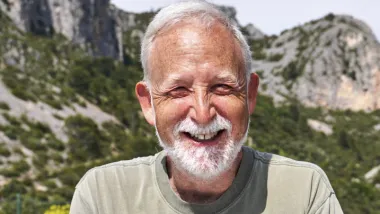


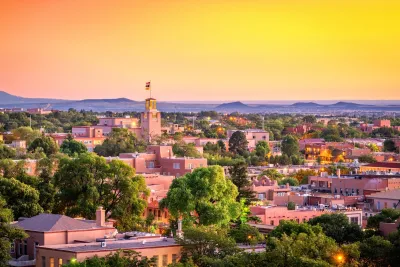
This piece originally appeared on Chuck Wolfe’s Substack — Resurgence: A Journey — in advance of Dan Parolek’s Missing Middle talk in Santa Fe.
For about a year, I’ve been writing about Santa Fe as a laboratory for tensions and ambiguities within both places and ourselves. Today, I turn to a lesser‑known Santa Fe episode from 1962–63: Lewis Mumford’s visit and the four conversational articles that followed in New Mexico Architect.
These articles were informal talks led by J.B. Jackson and Landscape magazine. Mumford played many roles — expert, observer, and conversant — discussing Santa Fe’s landscape, architecture, growth, and civic life.
If you think Mumford seems outdated or only see him as a contemporary critic of Jane Jacobs, please keep reading. He highlighted challenges we still face today and offered a straightforward way to understand the dynamics of place.
Thanks in part to Travel and Leisure, Santa Fe’s historic core is synonymous with adobe walls, earthen hues, and narrow streets that many admire. But as many know better than I, there are many other aspects of Santa Fe.

As a relative newcomer to the City Different — with a legal and planning background — I’ve been learning not only from the City’s pending plan and code updates, but also from local and diverse sources. Examples include the Historic Santa Fe Foundation, the advocacy‑driven Chainbreaker Collective, Friends of Architecture Santa Fe, and the housing resource Homewise, whose speaker series regularly hosts contemporary thinkers on walkability, zoning, and housing.
There is, of course, an elephant in the room — Santa Fe’s distinctive architectural style — especially in the historic center. Other plots and subplots span from the railyards to Midtown — and the omnipresent tension between preservation goals and today’s housing and other social needs.
When Mumford arrived in Santa Fe, he was one of America’s most influential thinkers on cities and culture. In the four informal discussions, he offered sharp first impressions: ecological wisdom, architectural critique, urban planning observations, and civic education stories.
His remarks remain uncannily relevant today, echoing the topics of the Homewise Speaker Series, the Preserving Place Symposium, recent Friends of Architecture events, and, not least, the regional architecture which Chris Wilson has articulated in the intervening years.
Mumford’s perspectives frame many of the questions we still ask about housing types, climate, water availability, “authenticity,” sprawl, and community.
The remainder of this piece comments on each of the four Mumford conversations and provides links for further review.
Conversation One: The ‘social oasis’ and high desert austerity
“Sometimes it happens that things you see about a city during the first twelve hours are more sharply incised on your mind and sometimes truer than the things you discover after being there for twelve months… At least you have my sharp impressions this evening.”
On his first walk through Santa Fe, Mumford saw how the City’s brown tones and starkness outside of the center vary from other cities and places. He celebrated the absence of lush lawns in an arid climate: “Grass lawns are an absurdity… In dry areas, you are commanded by the climate and the landscape to use the natural vegetation and keep it relatively austere.”
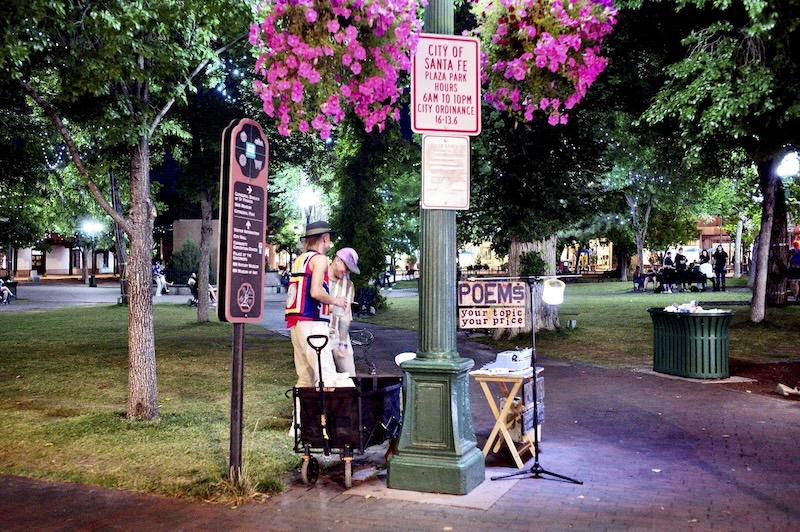
This ecological realism led him to cast Santa Fe as a social oasis: a place of community in the high desert. He praised small housing clusters surrounded by select trees and adobe houses as models for future housing: “a miniature oasis with an excellent micro‑climate and a fine human environment.”
Like later New Urbanists who came to and worked in New Mexico, he noted how courtyards reflect pueblo patterns, paralleling Jane Jacobs’ “eyes on the street” — an environment where children remain within adult lines of sight and physical proximity between neighbors encourages mutual support.
Mumford warned against isolated homes on large open parcels. Sprawl undermines neighborliness and access, he said: “People tend, when they think of their ideal home, to picture one as far as possible from the center of town. How unfortunate!”
He believed Santa Fe’s beauty comes from intimate urban spaces rather than surrounding, unbounded subdivisions. In modern terms, Mumford’s “social oasis” has much in common with trendy concepts today, such as accessory dwelling units (ADUs), cohousing communities, pocket neighborhoods, “missing middle housing” and “15‑minute cities”—places designed for connection rather than isolation.
Conversation Two: The pitfalls of a historic style ordinance
“What is the New Mexican style? You can’t stop life at any one moment. You can’t stop the development of architecture at any one moment.”
The second conversation with Mumford focused on the early phase of the ongoing Santa Fe Style debate — the recently enacted Historic Style Ordinance from the late 1950s, which required new buildings in Santa Fe’s core to replicate an “old” look.
Albert Solnit — then the Principal Planner of the New Mexico State Planning Office, and formerly the planning director in Fairfield, Connecticut, who had once lived in Greenwich Village — argued that imposing a style developed under obsolete materials ignored the realities of modern construction. Mumford agreed that adobe had virtues — its mass, warmth, and ability to limit glass had spared the City from “absurdities” wrought by all-glass modernism. But he opposed legislation that forced architects to build “fake” adobe:
“The attempt to perpetuate this traditional form by purely external means without regard to the actual character of the building is a dubious one.”
Mumford agreed that new buildings should respect climate and culture, but warned against superficial imitation. Mumford insisted that architecture must evolve and that regional styles should allow latitude: “I would agree with you, it is very dangerous to lay down by ordinance a fixed style. That’s the way to kill the development of architecture”.
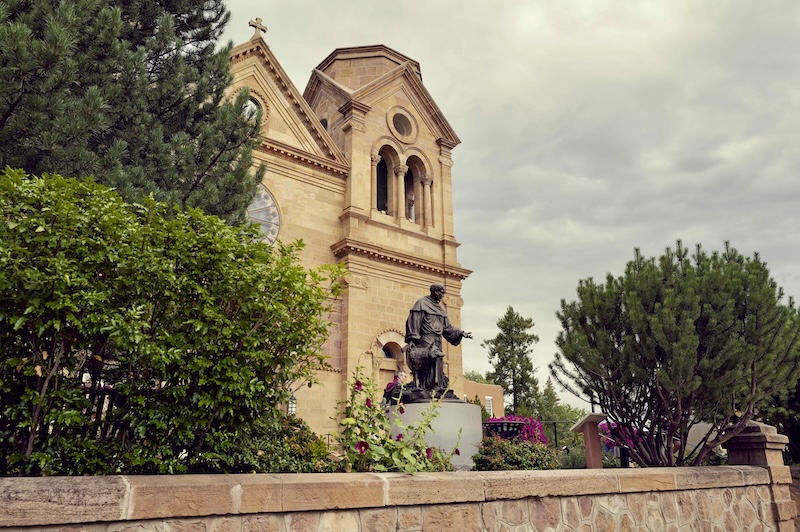
Instead, he proposed a flexible advisory commission and underscored civic education to inspire ongoing new designs. He commented — based only on his brief visit — that the City’s architectural heritage should include more than adobe: Archbishop Lamy’s stone Cathedral is part of the tradition, he said. Disallowing new forms would erase this diversity.
John Gaw Meem, often called the father of the Santa Fe Style, defended the Historic Ordinance. He explained how modern stucco and cement supplementations were natural evolutions from adobe and that calling them “fake” was misguided.
Meem said Santa Fe’s basic shapes and elemental forms — parapets softened by cement, low walls, and rounded corners — link buildings into a centuries‑old tradition that flowed from indigenous, Spanish, and territorial influences. Meem believed that inside the historic areas, architects should follow these forms to preserve the City’s “unique” human quality and charm.
The exchange revealed three distinct problems, which Mumford explained: preserving historic structures within the core; allowing sensitive adaptations for modern uses; and recognizing that much of the City lies outside the historic center.
In summary, he respected Meem’s point but pushed back: In his view, requiring imitation by law risked superficiality and stifled innovation. Rather than legislating taste, he urged education and context‑sensitive design.
Article Three: Controlling growth to preserve character
“There is a top limit to the population in such a region as this… if you want to keep your character and integrity.”
In the third conversation, Mumford foreshadowed the phased growth controls later litigated in Ramapo and Petaluma. He confronted the City’s future size. He suggested that Santa Fe might cap its population at about 75,000 — after which new growth should form another center a few miles away.
According to Mumford, water supply and thriving communities need such natural limits: “When cities grow without control, they cease to perform their functions… they end up just going in for bigness for bigness’ sake.” He noted how sprawl not only diminishes the organic associations of community life but also burdens city budgets with the costs of roads and utility extensions.
Participants debated further where and how growth should occur. Planner Wallace Franke spoke to urban form and suggested that Santa Fe’s identity lies more in its narrow streets and plaza than in any single architectural style. (See my “Leveraging Place in Santa Fe” talk for more on this point of view).
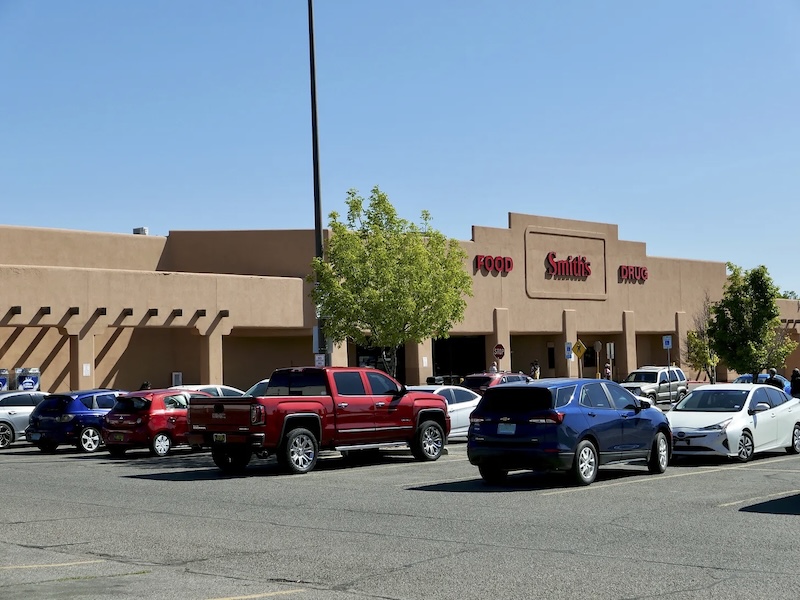
Franke’s insights are revealing if one considers how Santa Fe has evolved. He suggested that replicating “Santa Fe style” houses along highways (think Cerrillos Road) would compromise the City’s urban form.
Mumford agreed: linear sprawl along highways was “hideous,” and evoked compact, connected development and using hillsides (like in San Francisco or pueblos) to cluster houses and preserve open space. He challenged the Federal Housing Administration for promoting low‑density subdivision sprawl over time and urged local authorities to advocate for solutions consistent with New Mexico’s ecology.
Mumford also stressed that row houses and courtyards could create higher density without significant height impacts. His clear message was that “stringing out” houses in unbounded fashion has a negative impact on land and resources, and undermines a sense of community.
Once again, such ideas resonate today with the monikers of missing‑middle housing, compact development, and other buzzwords of land‑use reform.
Article Four: The power of vision and education
“The most educative thing for any community is to have a vision of what might be.”
The final article suitably turned from analysis to advocacy. Mumford reiterated that laws alone cannot create a good city, an adage relevant to regulatory reform efforts in every era.
From Mumford’s perspective, community transformation happened through shared vision and public education. Today, this perspective translates to co-creation and stakeholder participation. Both Santa Fe’s pending code and plan updates must address this perspective through robust implementation of the Santa Fe Forward approach, the multi-organization Santa Fe Data Platform, and Housing for Santa Fe Coalition Platform (“Protect, Invest and Permit”).
Mumford’s chief examples were more history-based, but the underlying principles provide lessons learned. He cited Daniel Burnham’s 1909 Plan of Chicago, and attributed much of its success to “a civic book” — Wacker’s Manual — used in schools, which he said gave Chicagoans ownership of the City Beautiful plan.

He urged Santa Fe to develop its vision, teach it widely, and empower citizens to imagine alternatives to car‑dependence and sprawl. Frustrations with leaders or lack thereof are a now-familiar refrain that some of the advocacy organizations have taken up, as noted above.
Mumford had another example — the Amana colonies in Iowa as of the early 1960s. He said an elder explained their then-decline as follows: “We have had no leader with inspiration for the last 50 years.” Hence, another gem from Mumford that seems universal: Communities need leaders with courage and vision, not just administrators. He challenged Santa Fe to fight federal programs that undermined local needs — particularly those then biased toward low‑density suburbs.
Ultimately, he said, a city’s health depends on civic education, imagination, and continuous renewal. Sound familiar?
Final reflections: Why it matters now
More than six decades after Mumford’s visit, Santa Fe — and other cities — still grapple with the questions he raised. Now, a new generation of stakeholders and outside thought leaders restate these questions in modern terms. And the truth is, much of what he forewarned came true.
Santa Fe’s human-scaled core still draws admirers and awards. Its edges have sprawled and its citizens wrestle with affordability, equity, and aesthetics — perhaps in ways far worse than Mumford imagined. Some blame the Santa Fe Style.
In the end, Mumford’s words are key, as they can still guide us today. They suggest that answers lie in social oases, contextual design, sustainable density, and shared civic vision. I may be old-fashioned, but in my immersion, I’m still listening to what he had to say.
Further reading
- New Mexico Architect, Vol. 4, No. 6 (1962): “Conversations in Santa Fe with Lewis Mumford.” The first installment of Mumford’s visit.
- New Mexico Architect, Vol. 5, No. 1 (1963): “Conversations in Santa Fe with Lewis Mumford.” The Solnit–Meem debate.
- New Mexico Architect, Vol. 5, No. 2 (1963): “Conversations in Santa Fe with Lewis Mumford.” The third installment.
- New Mexico Architect, Vol. 5, No. 3 (1963): “Conversations in Santa Fe with Lewis Mumford.” The fourth installment.
- Chris Wilson, The Myth of Santa Fe: Creating a Modern Regional Tradition (1997). A detailed exploration of Santa Fe’s architectural evolution and its cultural contradictions.

10 great urban planning summer reads
Wherever you're going (or staying) this summer, here are some suggestions for books to bring along.
April must-reads: Top 10 articles from last month
The world's longest car-free bridge opens in Finland, Amtrak's new Mardi Gras line shatters ridership predictions, and Bay Area commuters could lose a third of Caltrain stations.
March Must-Reads: Top 10 Articles From Last Month
Seattle may roll back a development fee as housing permits plummet, an ambitious Google-led project in the heart of San Jose goes sideways, and a list of sci-fi books to feed your futurist dreams.

Planetizen Federal Action Tracker
A weekly monitor of how Trump’s orders and actions are impacting planners and planning in America.

The state-sanctioned urbicide of Austin
People don’t kill cities. Freeways do.

US to reduce Colorado River water deliveries to Mexico
A new Colorado Treaty amendment reduces Mexico’s Colorado River water allocation by 250,000 acre feet.

Nation's most wind-powered state turns to coal as data centers increase energy demand
For the first time in decades, Iowa has increased its generation of coal power.

NYC cools commuters with city's first rain garden above a bus stop
New York City officials say the plants in the rain garden can absorb 16 gallons of rainwater during heavy storms.

Brightline West’s future may rely on $6 billion federal loan
The company has until Nov. 2 to make a $400 million equity investment into its proposed high-speed rail line.

FREE Course: Walkable City 1: Why Walkability?
After describing his path towards focusing on walkability as the essence of good planning, Jeff Speck marches through his five principal reasons for making more walkable places.
Reinventing Malls: Planning Alchemy—Turning Gray Fields Into Gold
The course focuses on the opportunities and imperatives that shape reinvention of mall sites.

Greater Baltimore Committee
Eagle County Government
Harvard University Graduate School of Design
The Architects Foundation
University of Cincinnati Online
The Pocatello Development Authority
The Urban Renewal Agency of the City of Pocatello
Journal of the American Planning Association

