The Federal Railroad Administration cited concerns about disruptions to federally owned properties along the proposed HSR line, which would take passengers from Baltimore and D.C. in 15 minutes.


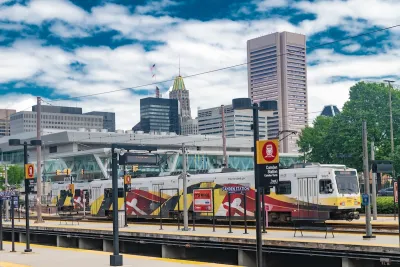
The federal government announced plans to kill a proposed Baltimore-to-D.C. high-speed rail line, citing concerns about potential disruptions and “significant, unresolvable impacts to federal agencies and federal property” along the proposed route. “The Federal Railroad Administration announced that it will end its ‘involvement in the environmental review process,’ putting up a roadblock that prevents the project from proceeding.”
As Jacob Baumgart explains in Patch, “The privately operated train was expected to zip by each site, traveling at 311 mph and whisking passengers between Washington and Charm City in 15 minutes with an intermediate stop underneath Baltimore/Washington International Thurgood Marshall Airport.” The project was slated to expand with connections to New York City, Delaware, Philadelphia, and Newark.
Northeast Maglev, the company that planned to build and operate the line, said the decision to cancel the project is a “missed opportunity of a generation to deploy the fastest and safest ground transportation system in the world.” In a statement, the company added, “The SCMAGLEV would have resulted in over $6 billion in private investment, created more than 160,000 jobs, and replaced 16 million car trips. With cars being the largest source of pollution in Maryland, significant air quality benefits would have been realized,” pointing out that Washington, D.C. was recently named the nation’s most congested metro area.
FULL STORY: 300 MPH Train Rejected Amid Cost Overruns In MD, DC


The World’s 10 Fastest Trains
From Japan to Morocco to China, these passenger trains travel at speeds of up to 311 miles per hour.
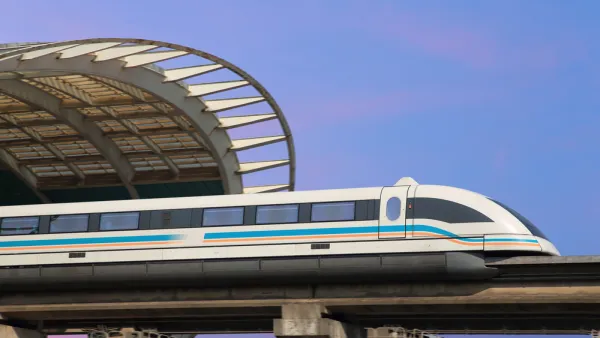
Federal Review of High-Speed Maglev Train Between D.C. and Baltimore Nearing the Finish Line
The Federal Railroad Administration recently released a preliminary study of a proposed high-speed maglev train route between Baltimore and Washington, D.C.

Colorado unveils fox mascot, branding for 'CoCo' high-speed rail
The new Denver-to-Fort Collins train is expected to begin service in 2029.

Planetizen Federal Action Tracker
A weekly monitor of how Trump’s orders and actions are impacting planners and planning in America.

The state-sanctioned urbicide of Austin
People don’t kill cities. Freeways do.

US to reduce Colorado River water deliveries to Mexico
A new Colorado Treaty amendment reduces Mexico’s Colorado River water allocation by 250,000 acre feet.

Mamdani overhauls NYC's Vision Zero plan with 100 new policy goals
The overhaul aims to reduce traffic deaths and make streets safer for pedestrians, cyclists and drivers through lower speed limits, new safety infrastructure and more.

Amtrak not solely to blame for New Jersey commuter rail's unreliability, report finds
A new study from the Garden State Initiative found that NJ Transit’s budget grew 20% across a 4 year period, but reliability declined significantly over the same period.

EPA erases limits on planet-warming pollution from power plants
Under Monday’s plan, power plants would still have some limits on how much mercury, arsenic and other contaminants they can emit.

FREE Course: Walkable City 1: Why Walkability?
After describing his path towards focusing on walkability as the essence of good planning, Jeff Speck marches through his five principal reasons for making more walkable places.
Reinventing Malls: Planning Alchemy—Turning Gray Fields Into Gold
The course focuses on the opportunities and imperatives that shape reinvention of mall sites.

Eagle County Government
Harvard University Graduate School of Design
Nashville Planning Department
The Architects Foundation
University of Cincinnati Online
The Pocatello Development Authority
The Urban Renewal Agency of the City of Pocatello
Journal of the American Planning Association