Popular in Germany, wall- or balcony-mounted solar panels come at a lower cost and face fewer regulatory hurdles than rooftop solar, but their legal status in California is murky.


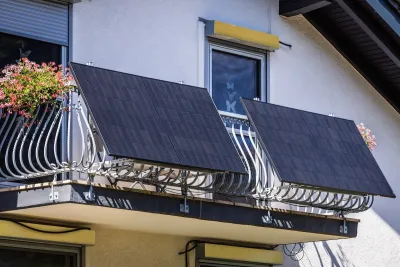
Bay Area residents are catching on to a renewable energy trend already popular in Germany and other parts of the world: wall- or fence-mounted solar panels.
As Laura Klivans explains in an article for KQED, wall-mounted panels are more affordable, require minimal permitting and paperwork, and are easier to install than rooftop solar. Also known as ‘balcony solar,’ “plug-and-play solar can hang from an apartment balcony, out a window, or be tented in the backyard — the smaller, more affordable displays offer an attractive alternative for renters and people with no roof at all.”
In Germany, millions of panels power households around the country. In the United States, Utah recently passed a law that allows people to use small solar arrays as long as they comply with the national electric code and product safety standards. The technology lies in a legal gray area in states like California, where state regulators say users must register their systems before using them. One company, Bright Saver, stays within these rules by not allowing their systems to feed power back into the grid.
FULL STORY: Forget Rooftops — Bay Area Residents Are Plugging Solar Into the Wall

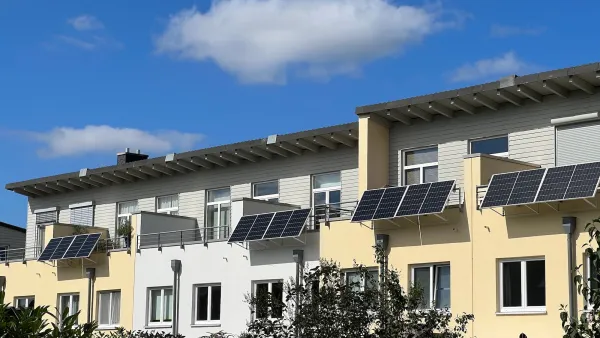
28 States and DC Could Legalize ‘Balcony Solar’
Plug-in solar panels, which are becoming popular across Europe, live in a regulatory gray area in the United States.
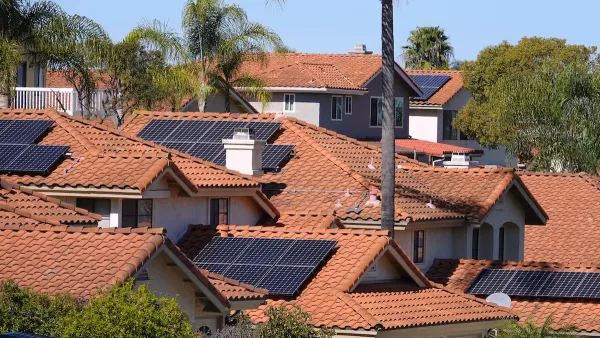
California Leads in Solar Rooftops
A combination of state and local incentives and building code mandates has helped California far outpace other states in residential rooftop solar permits.

Rooftop Solar on Mexico City Market to Power 300 Transit Buses
A solar project atop a massive food market will provide electricity to Mexico City's public transit buses.

Planetizen Federal Action Tracker
A weekly monitor of how Trump’s orders and actions are impacting planners and planning in America.

The state-sanctioned urbicide of Austin
People don’t kill cities. Freeways do.

US to reduce Colorado River water deliveries to Mexico
A new Colorado Treaty amendment reduces Mexico’s Colorado River water allocation by 250,000 acre feet.

5 New England states march closer to 800 megawatt wind energy project
Securing federal approval for the project may be complicated under the Trump administration, which has historically been hostile towards domestic wind power.

Baltimore to break ground on $50 million Transit Priority Project
The project will bring faster bus trips, safer streets and better bike connections to Baltimore.

Airbnb launches $250 million 'last-dollar financing' housing accelerator, makes first investment in Austin
The company will put $6.4 million towards affordable housing development in Texas’ capital.

FREE Course: Walkable City 1: Why Walkability?
After describing his path towards focusing on walkability as the essence of good planning, Jeff Speck marches through his five principal reasons for making more walkable places.
Reinventing Malls: Planning Alchemy—Turning Gray Fields Into Gold
The course focuses on the opportunities and imperatives that shape reinvention of mall sites.

Eagle County Government
Harvard University Graduate School of Design
Nashville Planning Department
The Architects Foundation
University of Cincinnati Online
The Pocatello Development Authority
The Urban Renewal Agency of the City of Pocatello
Journal of the American Planning Association