Where they're working, where they're banned, and where they're just as annoying the tourists that use them.


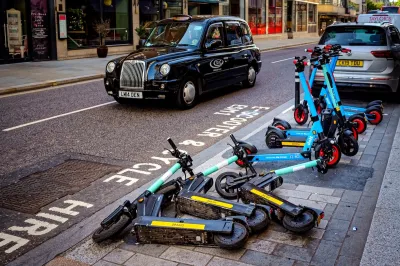
The shared e-scooter industry is booming in Europe, reports David Zipper for Bloomberg CityLab. “The tiny devices have found a niche, particularly in places where many trips are short, tourists are abundant, and car use is cumbersome and expensive.” Scooters, particularly rentals users don’t have to park or store themselves, offer a convenient, efficient way to travel across urban neighborhoods.
But not all cities are equally enthused: Paris, Madrid, and Malta have banned shared e-scooters, while many Europeans perceive them as useful only to tourists. In the Netherlands, scooters are banned “because it’s hard to see the upside. Dutch cities already have so many cyclists, and if people riding bikes shifted to e-scooters they would lose the health benefits of biking,” said Karen Vancluysen, the secretary general of POLIS, a network of European city transportation officials that has monitored and researched micromobility deployments across the continent.
According to Vancluysen, “The most common sentiment was, ‘they’re cluttering urban space.’ But that wasn’t really fair, because people didn’t realize that the biggest polluter of public space isn’t a tiny scooter, but a car.” Meanwhile, some officials have suggested charging e-scooter companies for parking areas — though no one has made a similar suggestion for carmakers.
Vancluysen points out that because many European cities already have high rates of walking and cycling, e-scooters have a greater potential to benefit U.S. cities, where most trips are still made by car.
FULL STORY: How E-Scooters Conquered (Most of) Europe

Lyft Shifting to Docked E-Scooters
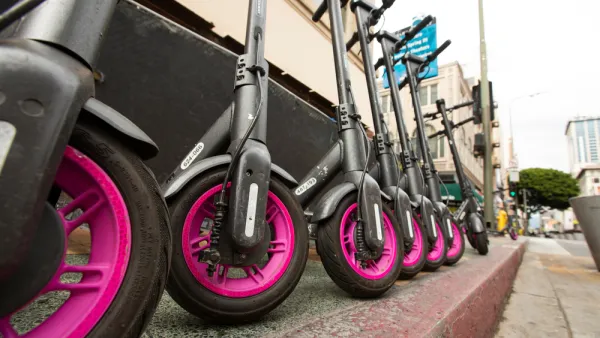
After failing to deliver on promises of frictionless, free shared mobility, the operator will begin docking its scooters at stations to reduce sidewalk obstructions and eliminate the need to collect scooters for recharging.
Bikeshare Ridership Up From Pre-Pandemic Levels
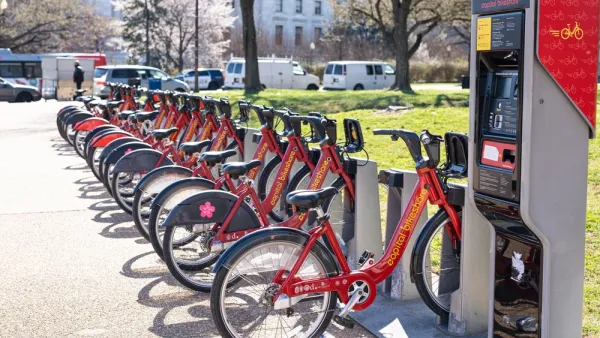
Shared micromobility, particularly docked bikeshare systems, are seeing record growth, but ‘scooter inflation’ may cool riders’ enthusiasm.
New Data Reveals Shared Mobility's Significant Impact on Emissions
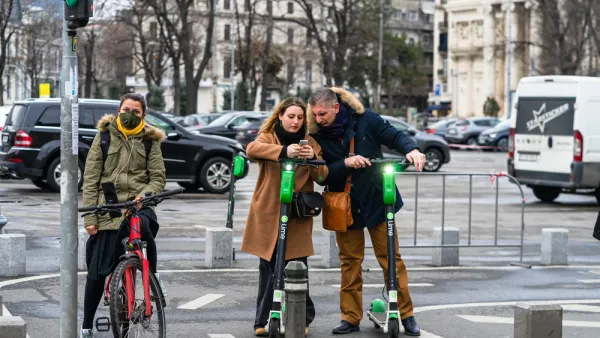
Two new studies show that the adoption of shared micromobility can reduce transportation-related emissions and congestion by substantial margins.

Planetizen Federal Action Tracker
A weekly monitor of how Trump’s orders and actions are impacting planners and planning in America.

The state-sanctioned urbicide of Austin
People don’t kill cities. Freeways do.

US to reduce Colorado River water deliveries to Mexico
A new Colorado Treaty amendment reduces Mexico’s Colorado River water allocation by 250,000 acre feet.

5 New England states march closer to 800 megawatt wind energy project
Securing federal approval for the project may be complicated under the Trump administration, which has historically been hostile towards domestic wind power.

Baltimore to break ground on $50 million Transit Priority Project
The project will bring faster bus trips, safer streets and better bike connections to Baltimore.

Airbnb launches $250 million 'last-dollar financing' housing accelerator, makes first investment in Austin
The company will put $6.4 million towards affordable housing development in Texas’ capital.

FREE Course: Walkable City 1: Why Walkability?
After describing his path towards focusing on walkability as the essence of good planning, Jeff Speck marches through his five principal reasons for making more walkable places.
Reinventing Malls: Planning Alchemy—Turning Gray Fields Into Gold
The course focuses on the opportunities and imperatives that shape reinvention of mall sites.

Eagle County Government
Harvard University Graduate School of Design
Nashville Planning Department
The Architects Foundation
University of Cincinnati Online
The Pocatello Development Authority
The Urban Renewal Agency of the City of Pocatello
Journal of the American Planning Association