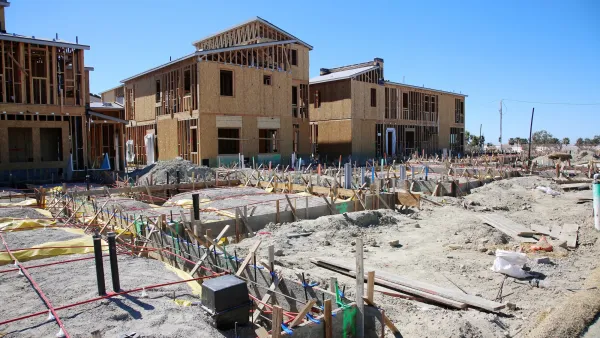
Last year, the city permitted just 30 percent of the number of housing units needed to meet a growing need.



Los Angeles is falling short of its state-mandated housing goals, reports David Wagner for LAist. “Under state law, L.A. is required to plan for more than 456,000 new homes between 2021 and 2029.”
Last year, the city only permitted 17,200 units, or 30 percent of what it should be producing every year. Of those, around 3,000 were deemed affordable for low-income residents.
“Part of the downward trend has to do with high interest rates, rising material and labor costs and other economic factors that are largely out of the city’s control. But housing advocates attribute much of the development slowdown to local policy decisions.” Some housing advocates blame the city’s “mansion tax,” a tax on property sales over $5 million that is meant to apply to large homes but also levies the fee on multifamily developments.
Some recent changes to city policy could speed up development, including a proposed “self-certification” program for builders that could cut down permitting times for smaller projects and the potential legalization of single-stairway buildings, which would free up more square footage for housing units and allow for more diverse building designs. A California state bill, Senate Bill 79, would support transit-oriented development and allow multifamily housing in more areas.
Read the full story: Not enough new homes

Less than 6% of California cities are building enough housing for very low-income households
Only five jurisdictions are on track to meet their housing goals for all income brackets.

Vacant downtown LA office building will be transformed into 512 affordable homes
The World Trade Center will create hundreds of new apartments with rents starting as low as $937.

LA delays state housing mandate with 'low-rise ordinance'
The new ordinance allows the city to delay implementing SB 79, a state law requiring more density near transit.

Planetizen Federal Action Tracker
A weekly monitor of how Trump’s orders and actions are impacting planners and planning in America.

Amtrak, CN end decades-long dispute with eight-year agreement
The new operating agreement establishes an updated framework for the companies to work together, including processes to resolve disputes.

Judges permit Denver to divert 77,000 acre feet from the Colorado River for reservoir expansion
Overuse and climate change have caused the Colorado River’s water levels to plummet.

NYC DOT wants faster, more permanent street upgrades
The city is examining ways to build more concrete infrastructure without getting entangled in 'decades-long' projects.

'Something we’ve never seen before:' rising utility rates could strain city finances nationwide
Data centers, climate change and other factors have caused utility rates in the United States to increase by 38% since 2020.

Trump to overrule local leaders, lease millions of acres of America’s Pacific Island territories’ seafloors to mining companies
International law says that the Indigenous people of America’s territories have a right to prior and informed consent regarding projects that impact their countries.

FREE Course: Walkable City 1: Why Walkability?
After describing his path towards focusing on walkability as the essence of good planning, Jeff Speck marches through his five principal reasons for making more walkable places.
Reinventing Malls: Planning Alchemy—Turning Gray Fields Into Gold
The course focuses on the opportunities and imperatives that shape reinvention of mall sites.

Harvard University Graduate School of Design
KFH Group Inc.
Greater Baltimore Committee
The Architects Foundation
University of Cincinnati Online
The Pocatello Development Authority
The Urban Renewal Agency of the City of Pocatello