How architecture and urban landscapes reflect the trauma and dysfunction of the post-war experience.


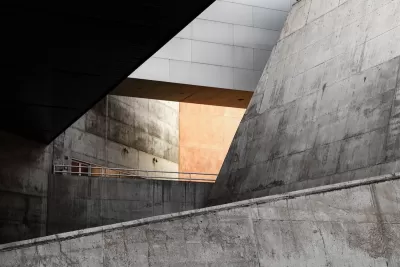
In vivid, very sad, detail, the Oscar-nominated and Golden-globe winning The Brutalist tells the story of how trauma and the immigrant experience can haunt people throughout their lives. It brings to the fore what we often sweep under the rug: how horrifying the immigrant experience was and can still be. Remarkably, it also reveals the story of how modern architecture came about and how this immigrant experience directly connects to why so many of us live in blank, ugly, soul-crushing urban landscapes.
While The Brutalist introduced a fictional architect, László Tóth, historic figures in the Modernist movement tend to be lauded in history books as great designers and visionaries. Swiss architect Le Corbusier’s designs for auto-oriented cities, replete with high-rise towers surrounded by greenspace and highways, are not only taught in every Architecture classroom, but his vision was largely adopted.
Le Corbusier’s Tower-in-the-Park proposal was a hallmark of the German Bauhaus movement that was widely influential globally in bringing a machine mentality to the construction of ornament-free, futuristic buildings set in unnatural parks and wind-swept plazas. This anti-urban philosophy spread across cities in the post-World War II era and created infamous buildings like the public housing complex Pruitt-Igoe in St. Louis (since demolished), Boston’s much-reviled City Hall Plaza, and the vast stretches of suburban sprawl typified by Levittowns in New York, New Jersey, and Pennsylvania.
What is not taught in this tale of so-called “genius” designers is the same lesson from The Brutalist: that for many of the leading architects of this period, it was trauma from war and violence that scarred their minds. Noted luminaries in this movement Mies van der Rohe and Walter Gropius were both infantrymen for the German army during World War I – personally confronting unimaginable horrors during years of trench warfare. Like Adrien Brody’s character Tóth in the film, van der Rohe and Gropius were never the same after their tangle with atrocities. Like most people impacted by trauma, they sought to allay themselves by revisiting their trauma – they literally rebuilt the landscapes of war, devastation, and death through their built work. Psychologists now call this 'reenactment', a typical PTSD response, as the body struggles to work through its trauma and heal.
We see how Tóth seeks comfort in recreating a room in the Buchenwald concentration camp in an American design, pathologically soothing his own post-traumatic stress disorder (PTSD). The real “found father” of Modern architecture, Walter Gropius, did the same thing: he designed his home in Lincoln, Massachusetts to resemble a World War I-era bunker. His bedroom looks like a dugout – the sleeping quarters soldiers use to rest inside a trench. The home’s upper deck is built with a defensive posture so no one on the outside could easily find him on the inside.
The Modernist movements that replaced traditional building styles, the vernacular town planning and layouts that gave primacy to the pedestrian that were eliminated, were not the work of brilliant artists finally in tune with a science-based sensibility, as we are told. Instead, they are the product of trauma and dysfunction. The fictional Tóth is a placeholder for these titans of Modernism, but for the first time, popular culture has embraced a contextualization of their origin stories in a way that our research has shown for years. It is not an accident that we largely live in sterile, unadorned, auto-centric, scary places. It is not by chance that the kind of beauty that defined classical and traditional architecture for millennia was abandoned.
We can now fully rewrite the history of architecture and learn from these mistakes. We can now turn to the future and build the cities of tomorrow based on timeless notions of scale, harmony, balance, and symmetry, using traditional materials and forms, centering the human experience and embracing beauty and decoration. “A healthy vision of the future, is not possible without an accurate knowledge of the past,” the Buddhist teacher Daisaku Ikeda said.
He is right. It's time we reckon with the brutality of the past, particularly its impact on 20th-century architecture and urban planning. It is difficult and necessary, and future citizens will thank us.
Justin B. Hollander is a professor in the Department of Urban and Environmental Policy and Planning at Tufts University.
Ann Sussman is the President of the Human Architecture and Planning Institute and the co-author of Cognitive Architecture: Designing for How We Respond to the Built Environment.


San Francisco to Dismantle its Polarizing Brutalist Fountain
The Vaillancourt Fountain stands as a symbol of the tension between the city’s past and future.
How Typical Economic Development Kills Community Character
An economic development pro makes an argument for an approach to economic development that prioritizes the urban design decisions that favor community character.

Unequal Distribution of Shade Is Environmental Injustice
A longread, written by Sam Boch and published by Places Journal, has been creating a stir online and is highly recommended for those with an interest in intersections between social justice and urban design.

Planetizen Federal Action Tracker
A weekly monitor of how Trump’s orders and actions are impacting planners and planning in America.

Amtrak, CN end decades-long dispute with eight-year agreement
The new operating agreement establishes an updated framework for the companies to work together, including processes to resolve disputes.

Northwest rail fans eager for Sept. 30 debut of Amtrak’s Airo fleet
Get ready for that new train smell and more seats. But they won’t go faster or run more frequently on the Cascades route in Washington and Oregon.

Brightline Florida files for bankruptcy
The transit company is over $5 billion in debt.

St. Louis Metro to test if single-car trains can reduce operating costs, maintain rider satisfaction
The pilot program will run from October to spring 2027, and begin with one single-car train operating on Metrolink’s Red and Blue lines.

Pennsylvania is building data centers in abandoned mines
Housing data centers in mines provides an alternative to destroying local forests and may spare residents from data centers’ noise and air pollution.

FREE Course: Walkable City 1: Why Walkability?
After describing his path towards focusing on walkability as the essence of good planning, Jeff Speck marches through his five principal reasons for making more walkable places.
Reinventing Malls: Planning Alchemy—Turning Gray Fields Into Gold
The course focuses on the opportunities and imperatives that shape reinvention of mall sites.

City of Thousand Oaks
City of Wisconsin Rapids
Harvard University Graduate School of Design
The Architects Foundation
University of Cincinnati Online
The Pocatello Development Authority
The Urban Renewal Agency of the City of Pocatello

